IN Brief:
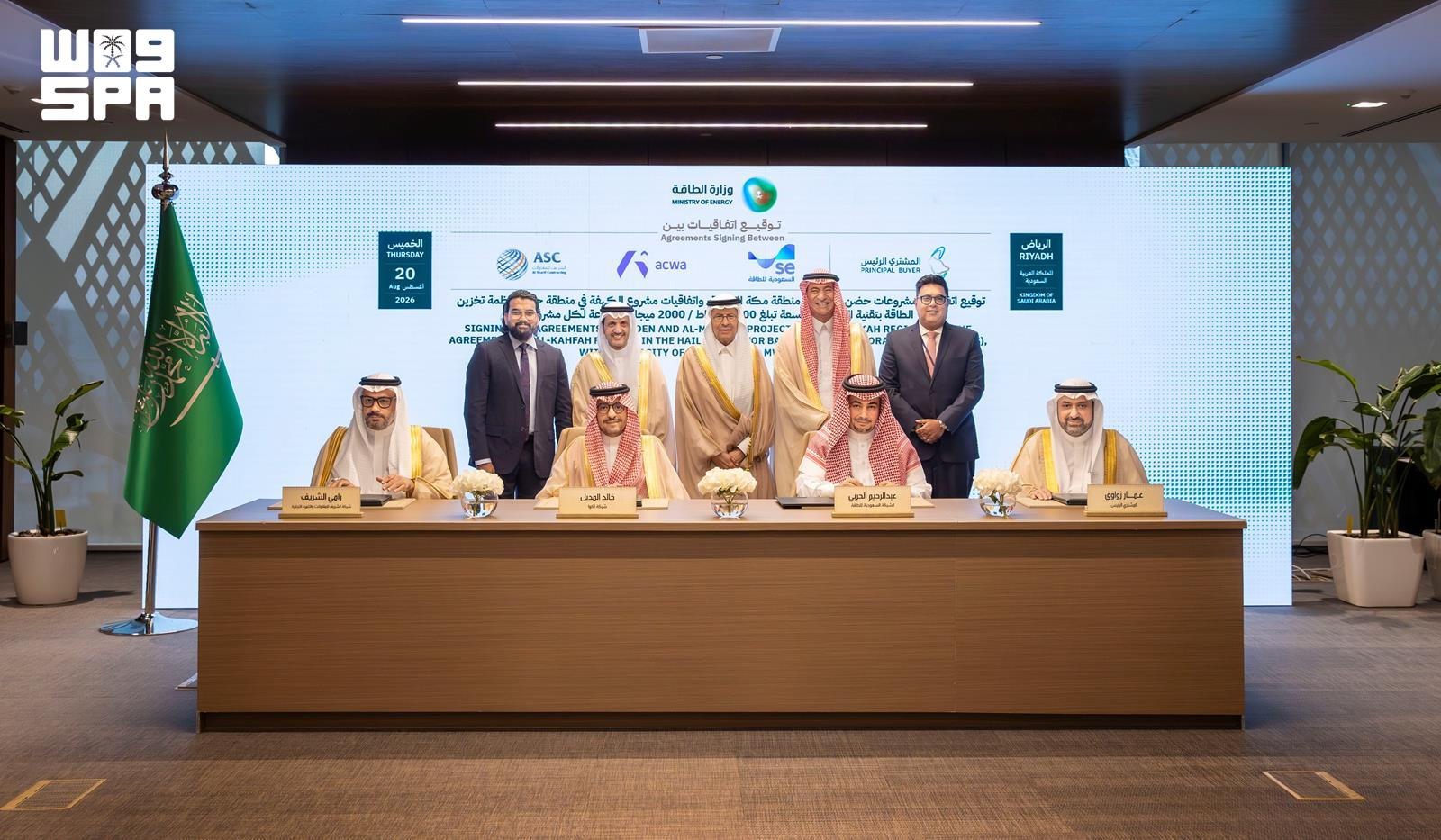
- Saudi Power Procurement Company has signed agreements for four battery projects totalling 2GW/8GWh.
- Each project is rated at 500MW/2,000MWh, providing four hours of storage at full rated output.
- Three projects have been awarded to an ACWA-led consortium, with the fourth going to an ENGIE-led consortium.
Saudi Power Procurement Company has signed agreements for four utility-scale battery energy storage projects totalling 2GW of power and 8GWh of energy capacity, establishing a major first procurement group under Saudi Arabia’s build-own-operate storage programme.
Each plant is rated at 500MW with 2,000MWh of stored energy, giving four hours of discharge at full rated output. The Saudi government places combined investment across the four projects at more than SAR4.35bn, equivalent to approximately US$1.16bn.
The projects are Al Muwayh and Haden in the Makkah region, Al Kahfah in Hail, and Al Khushaybi in Qassim. Three have been awarded to a consortium involving Saudi Energy Company, ACWA, and Al Sharif Contracting and Commercial Development Company, while Al Khushaybi has been awarded to a consortium of ENGIE and Haji Abdullah Alireza & Co.
ACWA says its three projects account for 1.5GW and 6GWh of the overall procurement. Each of those plants will operate under a 15-year storage services agreement with the Principal Buyer, creating a long-term contractual structure around availability and storage capability rather than leaving revenues dependent entirely on short-term power-market spreads.
The build-own-operate structure places development, financing, construction, ownership, and operation with the project consortia. SPPC contracts for the storage service as the country’s Principal Buyer, giving Saudi Arabia a repeatable procurement model for flexibility infrastructure alongside its separate renewable and conventional generation tenders.
The four-hour duration is significant because it moves the projects beyond batteries intended mainly for very short balancing interventions. A 500MW/2,000MWh plant can sustain substantial output through an extended demand period, providing greater scope to shift renewable electricity from periods of high production into later hours.
That does not mean the assets simply charge at midday and discharge every evening. Their operating strategy will depend on system requirements, renewable output, demand, state of charge, connection conditions, contractual availability, degradation management, and whichever ancillary or balancing functions are permitted under the final operating arrangements.
At 2GW of combined inverter capability, the electrical infrastructure becomes a system-level consideration. Transformers, medium- and high-voltage switchgear, protection, power-conversion systems, plant controllers, metering, communications, cooling, auxiliary supplies, and grid connections all have to be delivered alongside the battery modules themselves.
The network also has to accommodate both directions of power flow. Charging four projects simultaneously could create a controllable demand of up to 2GW, while simultaneous full discharge would create the same nominal quantity of generation. Dispatch coordination therefore matters if storage is to relieve system stress rather than simply move a constraint from one period to another.
Four-hour projects also carry substantially larger cell inventories than shorter-duration systems with the same inverter rating. That increases requirements for land, enclosures, DC cabling, thermal management, fire detection and suppression, auxiliary power, and replacement planning, while making degradation across the storage fleet a material lifecycle cost.
Saudi Arabia’s climate adds another engineering consideration. High ambient temperatures can affect battery efficiency, cooling demand, degradation, and component life, so thermal-management systems and auxiliary consumption become central design parameters rather than peripheral balance-of-plant items.
The 15-year service term disclosed for ACWA’s three projects means those effects have to be considered across a long operating horizon. Cell capacity will decline with age and cycling, requiring developers to manage warranties, operating depth, augmentation, replacement strategy, and availability so that the contracted four-hour capability remains commercially useful.
Saudi Arabia is developing storage alongside a rapid build-out of solar and wind generation. The government says the projects form part of efforts to increase renewable generation and storage within an energy mix intended to reach around 50% renewable sources by 2030, subject to growth in electricity demand.
Batteries can make that expansion easier to operate by moving energy through time and providing rapid control, but they do not eliminate the need for transmission reinforcement, dispatchable generation, reserve, or effective system planning. Storage is an additional controllable asset rather than a substitute for every other form of power-system flexibility.
The procurement nevertheless represents a sizeable industrial programme in its own right. Eight gigawatt-hours requires large volumes of cells, power-conversion equipment, transformers, switchgear, high-voltage engineering, civil works, controls, and commissioning resources, with several sites progressing through similar delivery stages.
That concentration can create supply-chain advantages through standardised equipment and repeatable designs, but it can also expose bottlenecks if transformer manufacture, inverter supply, battery modules, specialist contractors, or connection works cannot keep pace with the project programme.
The latest agreements move the first group beyond headline capacity targets into contractual delivery. Named sites, project consortia, investment commitments, and storage-service obligations are now in place; the next engineering milestones will be financial close, equipment procurement, construction, grid energisation, and commissioning.
At 2GW/8GWh, those milestones will matter beyond the individual projects. Saudi Arabia is attempting to make utility-scale storage a planned element of its electricity system rather than an experimental addition, and the first four plants now have to demonstrate that the procurement model can produce dependable flexibility at gigawatt scale.