
IN Brief:
- RWE is building a 236MW/470MWh battery at the former Hambach opencast mine.
- Kallista Energy has started construction of a 193MW/386MWh system in Hauts-de-France.
- Both projects combine two hour storage with balancing, trading, and wider grid support functions.
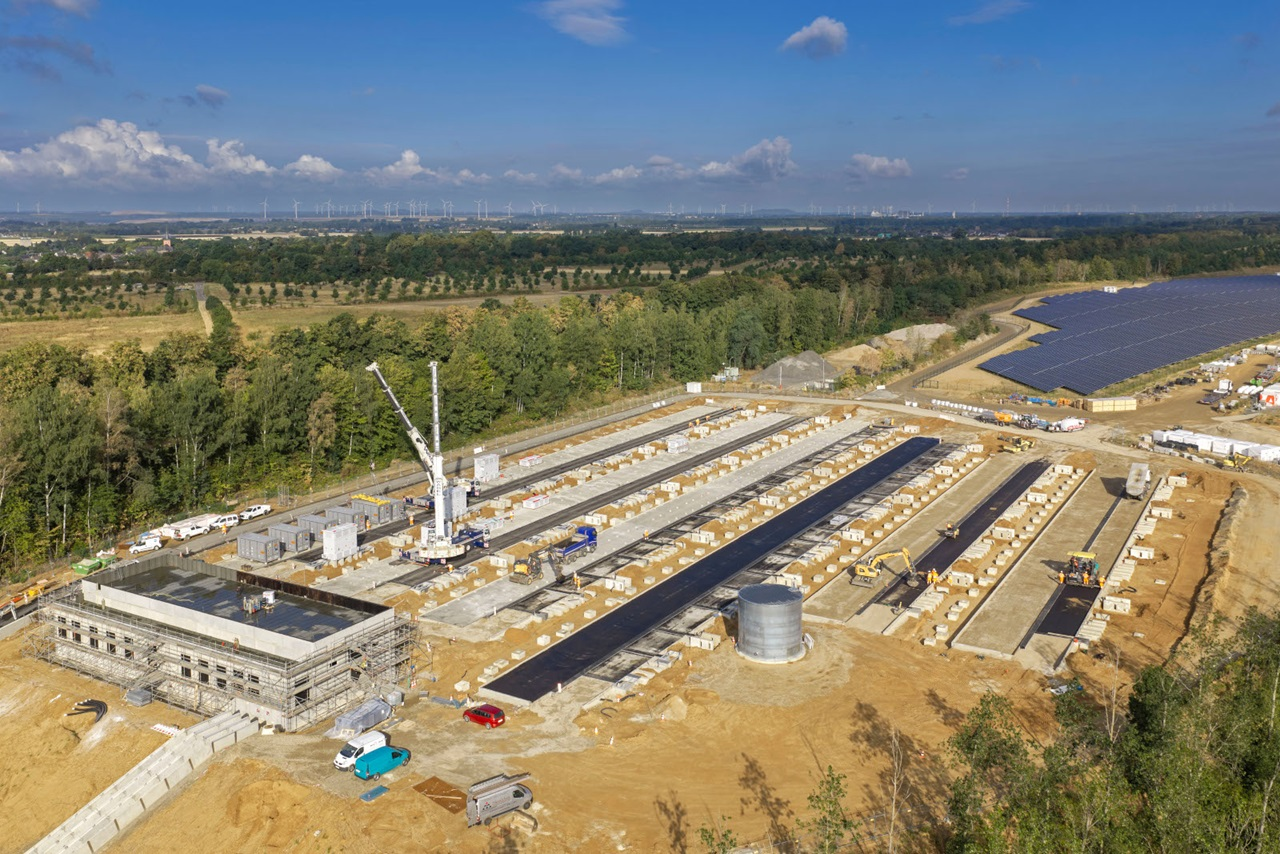
RWE has started building a 236MW/470MWh battery energy storage system at the Hambach opencast mine in North Rhine-Westphalia, extending the site’s transition from lignite production towards renewable generation and grid flexibility.
Occupying approximately three hectares near Niederzier in the Düren district, the two hour installation is taking shape after preparatory works began at the end of 2025. The first of 128 lithium ion battery containers have now arrived, and commissioning is scheduled for 2027.
Once operational, the plant will supply balancing energy and respond to fluctuations in the electricity system within fractions of a second. Its control and inverter systems are also being designed to support additional network services, including the future provision of inertia.
Hambach already hosts three solar plants with a combined capacity of approximately 50MWac and an integrated 4.1MW/8.1MWh battery. RWE is also developing a further 14.8MWac solar park and an 80MWh storage installation several kilometres away in the area earmarked for the future Manheimer Bucht development.
Those projects form part of a wider battery programme under which RWE has approximately 1.7GW of storage capacity in operation worldwide and another 2.5GW under construction. Around 1.7GW of the capacity currently being built is located in Germany.
Construction has also started on a second two hour project in France, where Kallista Energy is developing a 193MW/386MWh battery at Neuilly-en-Thelle in the Hauts-de-France region. Commercial operation is planned for spring 2028.
Envision Energy will supply lithium iron phosphate battery equipment for the French installation, following a previous 120MW/240MWh agreement between the companies. Financing is being provided by Landesbank Saar and BNP Paribas.
Omexom and Skyray will undertake construction work, while EDF Agregio Solutions is expected to optimise the asset across wholesale and balancing markets. The project is also linked to Envision’s battery manufacturing operation at Douai, which began production in June 2025 with an initial annual capacity of 10GWh.
Two hour systems take on broader duties
With an energy to power ratio of approximately two hours, both projects sit between short duration frequency response installations and the four hour systems increasingly developed for sustained peak shifting and capacity provision. They can move substantial volumes of electricity between periods of surplus and shortage while retaining enough converter capacity for rapid balancing services.
The final operating strategy at each site will depend on wholesale spreads, balancing market prices, network requirements, cycling limits, and the technical conditions attached to the grid connection. A battery may be capable of changing output almost immediately, but its commercial value depends on how that response is reserved and dispatched across competing services.
Lithium iron phosphate chemistry continues to gain ground in stationary storage because it avoids nickel and cobalt in the cathode while offering a combination of cycle life, thermal behaviour, and cost suited to frequent grid operation. Energy density remains important, although the space and weight constraints of a fixed site differ markedly from those of a vehicle.
Large battery sites require considerably more infrastructure than the visible containers suggest. Power conversion systems, transformers, medium and high voltage switchgear, protection equipment, auxiliary supplies, fire systems, communications, drainage, access routes, and control buildings must operate as a coordinated generating and consuming plant.
As inverter connected generation replaces more synchronous plant, grid support performance will increasingly be determined by converter controls rather than energy capacity alone. Frequency response, reactive power control, voltage regulation, synthetic inertia, and potential grid forming functions all depend on equipment specifications, software settings, connection studies, and successful compliance testing.
RWE’s reference to future inertia provision reflects that change. Conventional synchronous generators inherently contribute rotating mass and fault current, whereas wind, solar, and battery assets connected through power electronics must reproduce selected characteristics through controlled converter behaviour.
The expansion of Zenobē’s 1.75GW German storage pipeline illustrates how grid forming capability and transmission level support are becoming central to the design of large European battery portfolios rather than optional additions considered after construction.
Hambach also demonstrates the value of former generation and mining locations. Existing land, network infrastructure, access arrangements, industrial planning history, and local energy expertise can reduce some of the barriers faced by entirely new sites, although retained assets still require detailed condition assessment and integration studies.
The French project follows a different model, combining a standalone grid asset with regional battery manufacturing and third party market optimisation. Its performance will depend on coordinating physical dispatch with warranty conditions, degradation limits, state of charge requirements, and contractual market commitments.
Optimisation systems must reserve sufficient capacity for contracted services while retaining flexibility to respond to unexpected prices or network conditions. Excessive cycling may increase immediate revenue but accelerate degradation, while conservative operation can leave valuable converter and energy capacity unused.
The Hambach and Neuilly-en-Thelle projects will add a combined 429MW and 856MWh to Europe’s construction pipeline. Their commissioning programmes will test two distinct routes to scale: industrial site redevelopment in Germany and a financed, market optimised installation linked to regional battery manufacturing in France.

