IN Brief:
- RESolve supports equipment from 13 battery and inverter suppliers.
- Engineering applications include harmonic modelling and firmware modifications that enabled a 90-millisecond grid response.
- The platform has accumulated more than 140 project-years of deployment experience.
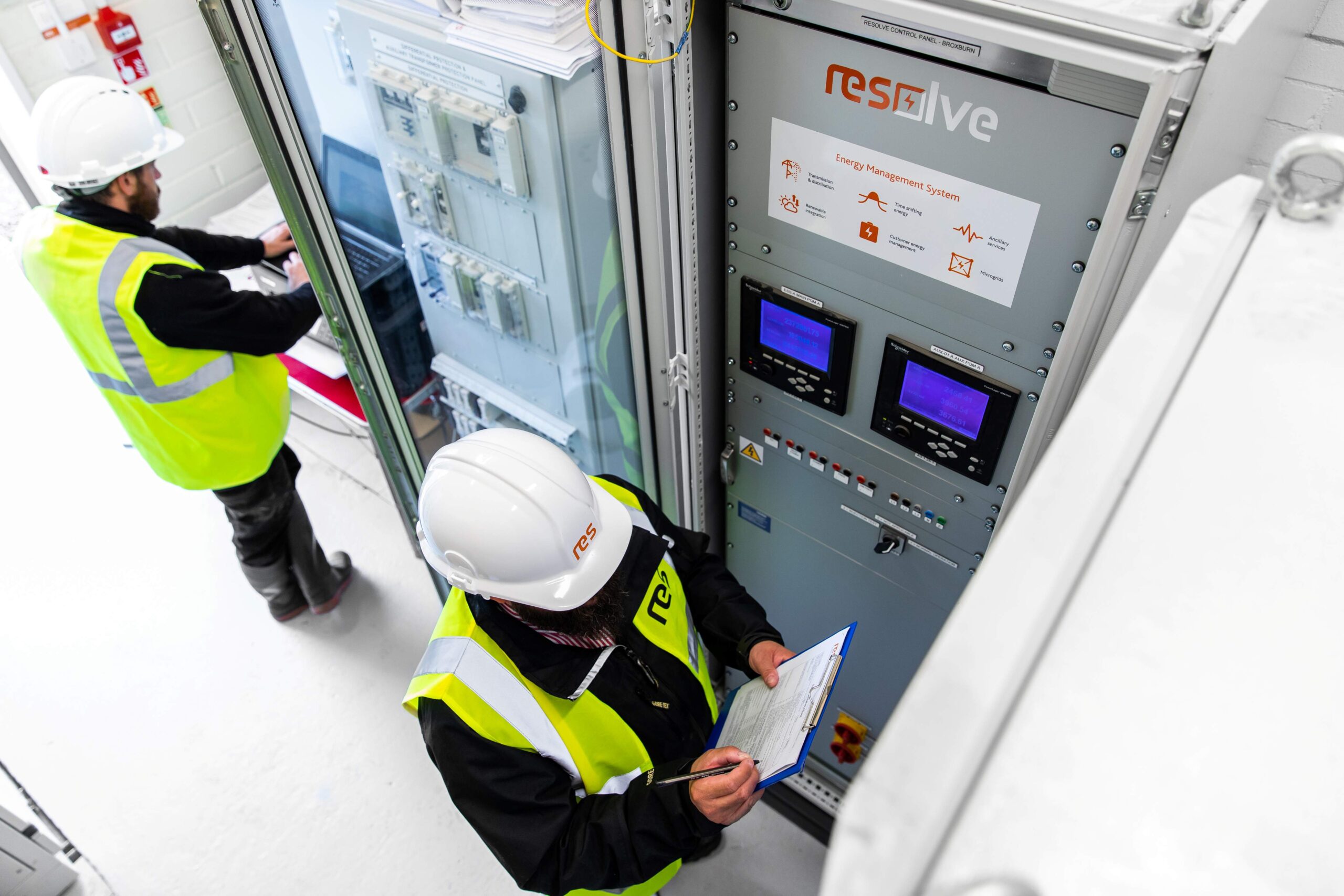
RES has won BESS Solution of the Year at the 2026 Energy Storage Awards for RESolve, its energy management system and power plant controller. The award recognises the company’s approach to integrating battery equipment from different manufacturers, addressing electricity network requirements, and modifying plant controls as the commercial and technical requirements of operating storage assets change.
Presented on 19 November at the Hilton London Metropole, the award follows the deployment of RESolve across 26 battery storage projects. The platform supports equipment from 13 battery and inverter suppliers, with more than a decade of commercial development and over 140 cumulative project-years of deployment experience.
Compatibility with equipment from different manufacturers gives storage developers greater flexibility during procurement. It can also become important later in an installation’s operating life, when replacement batteries, inverters, or other electrical equipment may differ from the original specification. Retaining a common plant control architecture can reduce the extent of software redevelopment required when those changes occur.
RES’s award submission included a British storage project where grid modelling established that harmonic filters originally specified for the installation were unnecessary. The engineering assessment allowed the equipment to be removed from the design before construction began, avoiding its procurement, installation, and subsequent maintenance.
Harmonic distortion at a battery installation depends on the interaction between its power electronic converters and the electrical characteristics of the surrounding network. A converter’s individual harmonic performance does not necessarily establish the behaviour of the complete facility, particularly where several converters operate in parallel. Modelling can identify whether additional mitigation equipment is necessary to satisfy the relevant connection requirements.
Specifying filters without assessing those interactions can introduce unnecessary capital expenditure and additional electrical components requiring protection and maintenance. Conversely, insufficient mitigation can create compliance problems that are more difficult to resolve after equipment installation. Establishing the requirement during design therefore has implications for both procurement and commissioning.
At another project, RES engineers resolved a manufacturer’s firmware problem during commissioning, enabling the battery facility to achieve a grid response time of 90 milliseconds. The case demonstrates how the behaviour of an individual equipment component can affect the response of the complete plant, even when the underlying battery and inverter technologies are capable of rapid operation.
Plant response depends on the acquisition and processing of measurements, communication of instructions, and execution of those instructions by the relevant converters. A power plant controller must coordinate these activities across the available equipment while respecting its electrical operating limits. The 90-millisecond result reported by RES relates to the individual project rather than a universal performance rating for the platform.
RESolve also supports assets after commissioning. The company’s Elektra battery project in Landskrona, southern Sweden, entered operation in 2024 using the platform for continuous storage control and dispatch. The installation provides ancillary services supporting the Swedish electricity system, illustrating how the responsibilities of plant controls extend beyond initial grid connection verification.
“A battery is only as good as the system that runs it,” said Bruce Hall, CEO Digital Solutions at RES. “This award belongs to the engineers who solve problems on live sites, often years after commissioning, and to the customers who have stayed with us as their markets have changed.”
Changing electricity market requirements can necessitate modifications to those controls. In May, RES implemented two optimisation upgrades at an operating Californian installation to accommodate requirements associated with the California Independent System Operator. Existing customers have also adopted additional RESolve capabilities during 2026, extending the functionality of equipment already in service.
The engineering challenge becomes more substantial as the number of controlled components increases. At one San Diego installation, RESolve coordinates more than 19,000 battery modules. Its applications also include projects with weak or capacity-constrained connections, where the interaction between plant controls and the electricity network must be considered when determining permissible operating behaviour.
RES has validated the platform against requirements associated with National Grid in Great Britain, ERCOT in Texas, and Svenska kraftnät in Sweden. The company has also recently secured further battery control contracts in North America, extending its activities across energy management, power plant control, and operational technology cybersecurity.
As storage installations remain in service through successive changes in market rules and network requirements, the ability to modify their controls can influence their commercial usefulness independently of their remaining battery capacity. RESolve’s award recognises that continuing engineering responsibility, encompassing the design of new installations and the adaptation of assets already operating on electricity networks.