
IN Brief:
- Nvidia is reported to be considering investment of up to $3bn in power-infrastructure developer Lancium.
- Reported terms involve an initial $2bn investment, with a further $1bn linked to milestones including grid connections.
- Lancium independently confirms a 1.2GW ERCOT-approved interconnection at its Abilene AI data-centre campus.
Nvidia is reportedly preparing to invest up to $3bn in Texas power-infrastructure developer Lancium, potentially linking one of the world’s largest AI semiconductor businesses directly with the electrical infrastructure needed to support gigawatt-scale data centres.
The proposed transaction has not been confirmed by Nvidia or Lancium. The reported terms involve an initial investment of $2bn for a stake of roughly 20% in Lancium, followed by a possible additional $1bn if the infrastructure developer meets specified milestones.
Those reported milestones include grid connections, making access to electrical capacity unusually explicit within the proposed investment structure. Lancium and its portfolio of land and power connections are reported to carry an enterprise value of approximately $10bn.
The financial terms therefore remain provisional. The physical infrastructure behind them is easier to establish. Lancium develops gigawatt-scale data-centre campuses around high-capacity grid connections, power engineering, on-site resources, and software used to manage the interaction between computing loads and the electricity system.
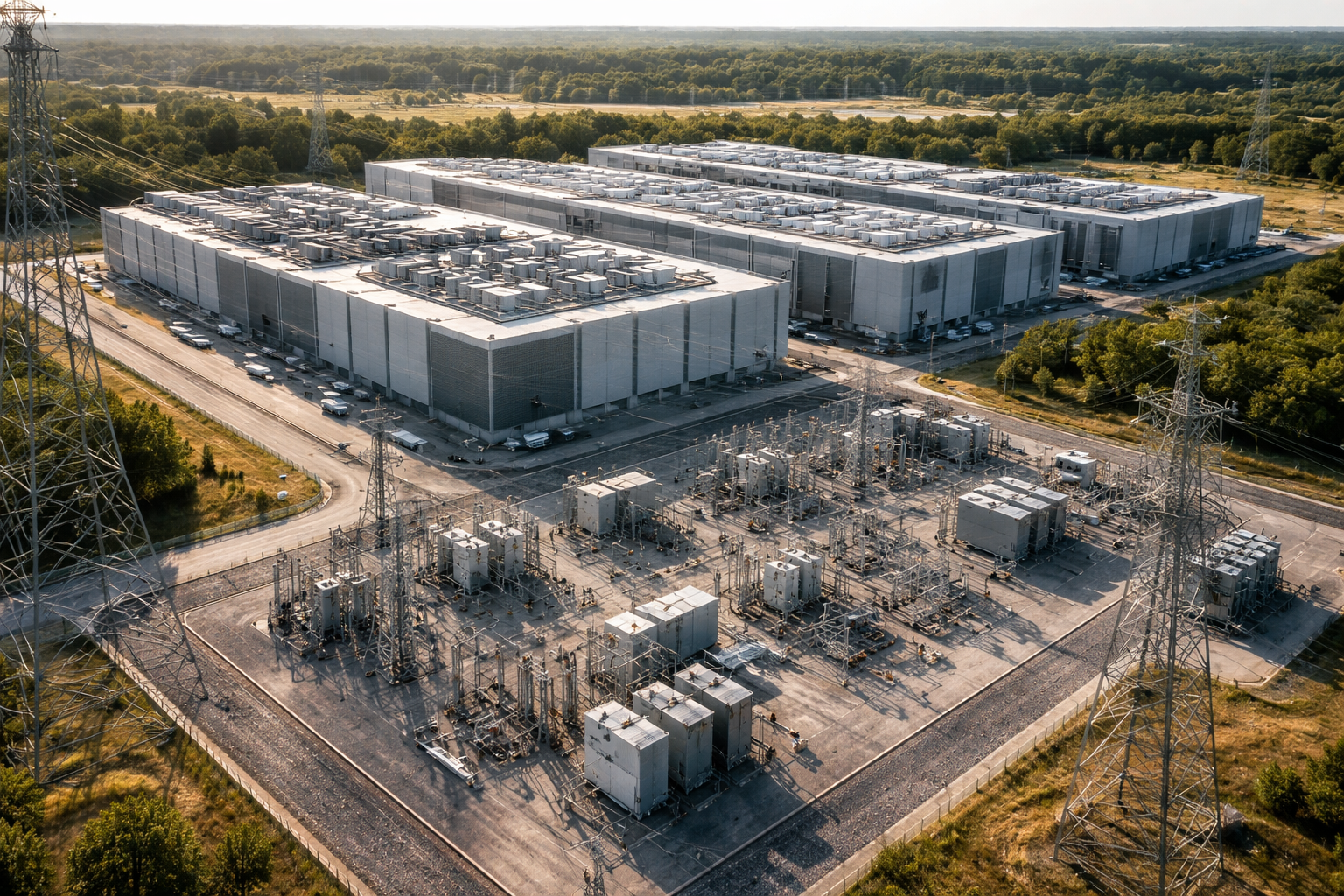
Its flagship Abilene Clean Campus in Texas has a 1.2GW interconnection approved through ERCOT and hosts the first operational site associated with the Stargate AI infrastructure programme. Lancium describes the campus as combining grid access with on-site generation and power orchestration intended to support large, concentrated computing loads.
Earlier project material also describes large-scale behind-the-meter battery storage and solar resources as part of the power plan. The aim is to combine several sources of electricity and flexibility at one site rather than relying exclusively on a single utility connection for the entire computing load.
A 1.2GW data-centre campus presents an electrical engineering problem closer to heavy industry than conventional commercial property. It requires high-voltage transmission access, major substations, transformers, switchgear, protection systems, backup generation, cooling infrastructure, power-quality management, and controls capable of coordinating an exceptionally large load.
Transformers and high-voltage equipment can become critical procurement items because their manufacturing lead times are often measured in years. Connection studies also have to determine whether the surrounding transmission network can support the additional demand without unacceptable voltage, stability, or thermal effects.
That makes the grid connection itself a valuable development asset. Land can be acquired and buildings designed relatively quickly, but a site intended to draw hundreds of megawatts may not be viable unless sufficient transmission capacity exists and the required network reinforcement can be delivered on the same timescale as the computing hardware.
The reported Nvidia investment structure reflects that constraint. If the additional capital is genuinely linked partly to successful grid hookups, access to power becomes a financing milestone rather than a facilities issue dealt with after the data-centre design has been completed.
AI infrastructure is increasingly exposing that change. Earlier phases of the build-out were dominated by concerns over semiconductor supply, particularly access to accelerators and high-bandwidth memory. Large data-centre projects now face comparable constraints around electricity, transformers, switchgear, generation, construction resources, and transmission connections.
The power requirement also changes the relationship between the data-centre operator and the wider grid. Large computing campuses can run at high utilisation for extended periods, creating substantial continuous demand, while workload scheduling and cooling systems can alter the load profile over shorter periods.
Lancium’s power-orchestration model is intended to manage that interface. A controllable campus can potentially adjust parts of its demand, coordinate on-site resources, or respond to grid conditions rather than behaving as an entirely inflexible block of load. The practical value depends on how much computing demand can actually be shifted without affecting customer workloads.
Battery storage can provide another layer of flexibility by smoothing short-duration changes and supporting local resilience. Behind-the-meter generation can reduce dependence on the grid during constrained periods, although the emissions, fuel supply, cost, and operating regime of those resources remain material parts of the project design.
Lancium is applying the same model beyond Abilene, developing additional Texas campuses around gigawatt-scale power access. That shifts part of the infrastructure-development burden away from the eventual data-centre operator: land and electricity connections can be advanced before every detail of the final computing deployment is fixed.
The reported investment would take that relationship a stage further by putting semiconductor capital directly into the company assembling the power-ready sites. Nvidia already has an obvious commercial interest in the expansion of AI computing capacity, but investing in electrical infrastructure would extend its exposure beyond chips and computing systems.
That possibility should not be overstated while the transaction remains unconfirmed. Nvidia and Lancium had not publicly endorsed the reported terms when the deal emerged, so the proposed $2bn initial investment, additional $1bn, 20% stake, and $10bn enterprise value must remain attributed rather than treated as completed corporate facts.
The underlying power-system issue does not depend on the transaction closing. Lancium already has a 1.2GW approved interconnection at Abilene, and AI developers are increasingly treating access to electricity as one of the defining constraints on new capacity. Whether Nvidia ultimately invests or not, gigawatt-scale data centres are turning grid connections, generation, storage, and high-voltage equipment into core components of the AI supply chain.

