IN Brief:
- NSW data centres are seeking network connections totalling up to 28GW, with around 13GW already in advanced discussions.
- Ten proposed reforms cover connection planning, network cost recovery, renewable supply, firming, and demand flexibility.
- More than 90% of prospective data-centre load is concentrated around Sydney, Newcastle, and Wollongong.
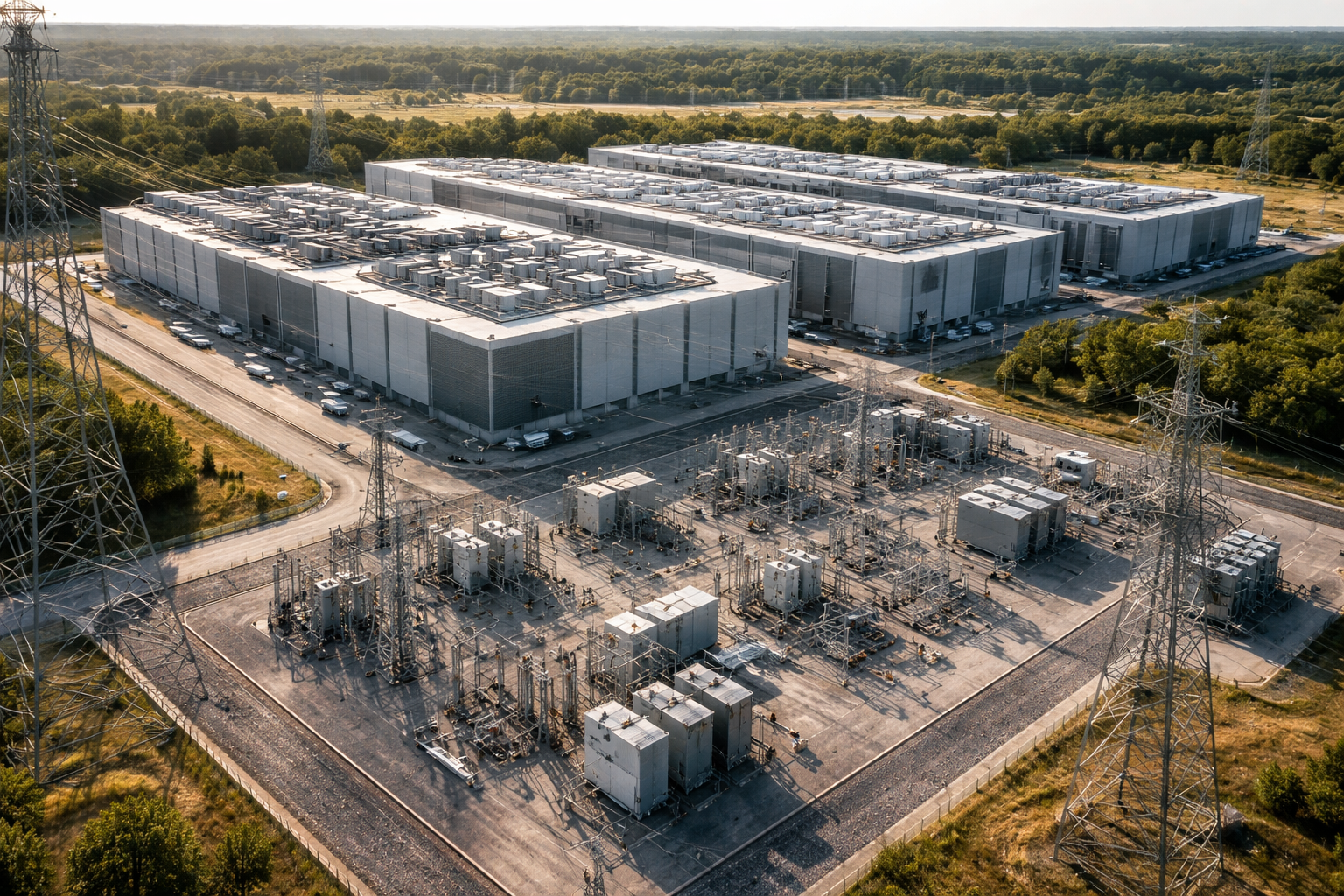
NSW Department of Climate Change, Energy, the Environment and Water has proposed a package of electricity-network reforms to manage a data-centre connection pipeline reaching as much as 28GW, a level of prospective demand substantially larger than the state’s existing average electricity requirement.
Government analysis shows data centres seeking around 13GW of capacity are already in advanced discussions with network operators. Average daily demand in New South Wales typically ranges between 7.5GW and 10GW, meaning even the more advanced portion of the development pipeline exceeds the state’s normal system load.
The headline 28GW figure does not mean every project will ultimately connect. That uncertainty is part of the network-planning problem because operators have to decide where substations, transmission reinforcements, generation, storage, and other system assets may be needed while distinguishing credible developments from capacity requests that never reach construction.
The consultation consequently puts connection discipline alongside grid expansion. Its ten proposals include an entry bond for applicants, stronger requirements for network service providers to gather and share information on prospective data centres, coordinated load forecasting, and the inclusion of agreed demand profiles within connection agreements.
Those measures are intended to reduce the risk of scarce network capacity being reserved for projects that do not proceed while more advanced developments wait behind them. A single multi-hundred-megawatt request can influence reinforcement studies years before its eventual energisation date, so speculative applications can distort investment planning even without drawing any electricity.
Location sharpens the problem. More than 90% of the current NSW data-centre pipeline is seeking connections within the Sydney–Newcastle–Wollongong region, concentrating prospective demand around the state’s principal load centre rather than distributing it evenly across the network.
That area is already navigating a wider power-system transition. Ageing coal generation is expected to leave the system while renewable energy, storage, firming plant, and new transmission infrastructure are developed to replace its energy and operational contribution.
Regional renewable energy zones are intended to bring additional wind, solar, and storage onto the network, but the output still has to reach major demand centres through transmission corridors with finite capacity. Additional generation cannot resolve a local connection constraint if the grid between the new supply and the proposed data centre is already saturated.
Transgrid has warned prospective developers that additional transmission capacity is expected to become a constraint in Western Sydney beyond 2033. The consultation points to Sydney Ring South as one of the transmission projects being considered for earlier delivery as forecasts for large electrical loads continue to increase.
Cost allocation forms another major strand of the proposed reforms. NSW wants distribution network service providers to recover appropriate upstream transmission-upgrade costs from data centres connecting through their networks rather than spreading those costs automatically across other electricity users.
Data-centre operators could also be required to guarantee payment for network capacity made available to them whether or not they use the full amount. That would change the commercial consequences of requesting a large connection because reserved capacity would carry an ongoing cost rather than simply functioning as an option on future network availability.
The government is separately proposing a Major Network Upgrade Fee. The consultation gives an indicative default rate of A$200,000 per megawatt for connections in the Sydney–Newcastle–Wollongong region and A$100,000/MW elsewhere, subject to the final regulatory design.
At those rates, network impact would become a material element of development economics. A large data centre can trigger investment well beyond the immediate cable, transformer, or substation serving the site, including reinforcement on upstream transmission circuits carrying power into the wider metropolitan area.
The reforms also address how data centres behave after connection. NSW proposes requiring network operators to incorporate demand profiles into connection agreements and to use those agreements to enforce obligations around renewable power purchase arrangements, firming, and reductions in consumption during defined periods of grid stress.
Demand profiles are particularly important for facilities capable of operating at high utilisation for long periods. A site that occasionally reaches its maximum connection rating creates a different planning requirement from one expected to run close to that level continuously, even if both request the same nominal megawatt capacity.
The consultation therefore explores demand flexibility as an operating attribute rather than assuming every data-centre load is permanently fixed. Some computing workloads can potentially be shifted in time, while others require extremely high availability, so the amount of usable flexibility will depend on the technical and commercial design of each facility.
Embedding requirements in connection agreements could give network operators a defined response during periods of system stress. The practical value would depend on the volume of load that can be curtailed, its response time, the duration of the reduction, and where the facility sits electrically within the network.
Firming requirements address a related issue. A renewable power purchase agreement can match a site’s energy consumption commercially over a defined period, but it does not guarantee that electricity will be physically available at the connection point during every operating interval.
Storage, flexible generation, transmission capacity, demand response, and the instantaneous output of renewable plant all influence whether supply and demand balance in real time. The proposed NSW framework therefore links data-centre expansion with both new generation and the infrastructure required to make that generation deliverable.
The government is also considering a broader access scheme for large loads. Under that approach, scarce connection capacity could be allocated competitively using technical, financial, and social criteria including energy efficiency, water efficiency, demand flexibility, and willingness to contribute to network costs.
Such a model would represent a significant departure from treating very large connections primarily as bilateral processes between an applicant and a network operator. Where several multi-hundred-megawatt projects are competing for the same constrained infrastructure, the cumulative effect becomes a system-planning issue rather than a series of isolated customer applications.
NSW already hosts around 60 discrete data centres, which the consultation estimates account for roughly 5% of annual grid electricity consumption. Over the decade to 2025, data-centre demand grew by an average of around 14% a year, while subsequent forecasts have continued to move upwards.
The Australian Energy Market Operator’s 2026 planning work indicates NSW data-centre electricity consumption could reach 26TWh by 2035 under a higher-demand sensitivity. The government notes that this projection is almost 70% higher than a comparable forecast produced less than a year earlier.
Individual proposals are also moving beyond the scale historically associated with conventional commercial connections. The consultation identifies one proposed facility rated at 1,200MW, larger than the 950MW rating cited for the Tomago aluminium smelter, traditionally one of the state’s largest individual electricity loads.
At that scale, a data centre starts to look like a major power-system asset from the perspective of network planning. Its location can influence where substations, transmission lines, transformers, reactive-power equipment, firming resources, and additional generation are ultimately required.
Public consultation is due to run until 14 September, with the government intending to use the responses to develop regulations subject to passage of the Electricity Infrastructure Investment Amendment Bill 2026. If adopted, the framework would make network capacity, flexibility, and cost responsibility much more explicit conditions of large data-centre connections.
The eventual 28GW pipeline will almost certainly change as projects advance or fall away, but transmission and distribution operators cannot plan on the assumption that the demand will simply disappear. NSW is attempting to establish rules that identify credible loads early enough for the physical grid to be built around the developments that actually proceed.