
IN Brief:
- GEN-I Sonce has started construction of its 55MW/220MWh standalone battery project at Gheorgheni in Romania.
- WALDEVAR Energy's EPC scope includes a 110kV, 63MVA substation and associated transmission-system connection works.
- The nominal four-hour configuration is intended to support sustained energy shifting alongside shorter grid-balancing services.
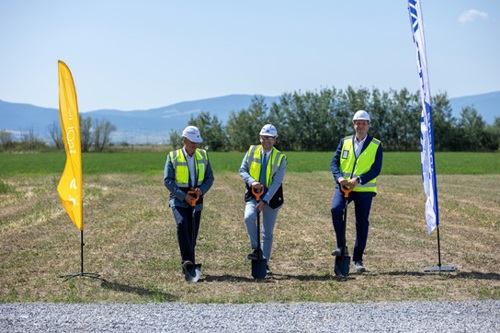
GEN-I Sonce has started construction of a 55MW/220MWh standalone battery energy storage system at Gheorgheni in Romania, moving the project from permitting and connection development into physical delivery.
The company has signed a full engineering, procurement, and construction contract with WALDEVAR Energy, which is also delivering the associated high-voltage connection works. GEN-I says the project has secured land, permits, and grid connection rights, giving the construction programme a defined route towards energisation rather than leaving major development dependencies unresolved.
The battery’s 220MWh energy capacity against 55MW of power gives a nominal four-hour energy-to-power ratio. That places Gheorgheni in the part of the storage market designed for sustained energy shifting as well as shorter balancing activity, rather than a system optimised principally around brief frequency-response events.
The grid interface is a substantial part of the scheme. WALDEVAR announced in June that its scope includes a 110kV, 63MVA substation and associated works required for connection to the transmission system, adding primary high-voltage equipment, protection, control, and commissioning requirements to the battery installation itself.
At this scale, the storage containers are only one layer of the electrical plant. Power-conversion systems have to coordinate the DC battery blocks with the AC collection network, while transformers, switchgear, protection systems, metering, communications, supervisory controls, and auxiliary supplies must operate as one controllable asset from the network operator’s perspective.
The four-hour configuration changes the balance of that equipment compared with a shorter-duration battery. More stored energy sits behind each megawatt of inverter capacity, increasing the cell inventory, thermal-management load, DC cabling, fire-protection requirements, physical footprint, and long-term replacement exposure associated with the same maximum export power.
GEN-I identifies energy arbitrage and ancillary services among the commercial uses for utility-scale storage. In practice, operating strategy will depend on market prices, connection conditions, state of charge, degradation management, and the technical services for which the completed plant qualifies, so the battery has to be designed around more than one idealised dispatch cycle.
Romania is providing an increasingly active policy backdrop for projects of this type. Renewable generation is growing, while storage is being treated as a means of shifting energy between periods, supporting balancing, and reducing the operational gap between variable generation and demand.
That does not make every battery automatically valuable to the network. Large storage fleets can create substantial charging demand as well as discharge capacity, and simultaneous responses to the same market signal can move constraints rather than remove them. Connection studies, plant controllers, dispatch rules, and network visibility therefore become more important as installed capacity grows.
Gheorgheni is also intended to provide GEN-I with a repeatable delivery model for further regional storage development. That puts construction control, procurement, commissioning, and grid integration under as much scrutiny as the choice of cell technology, because the commercial advantage of standardisation disappears quickly if each project requires a different solution to basic electrical interfaces.
WALDEVAR brings an established regional EPC record to the programme and says it has completed more than 3.5GW of projects. For a battery scheme, the useful part of that experience is the ability to coordinate civil works, medium-voltage systems, the 110kV substation, controls, testing, and energisation without allowing those packages to drift into separate schedules.
Battery plants can appear comparatively simple beside conventional generating stations because much of the electrochemical equipment arrives as factory-built assemblies. The grid does not see a collection of containers, however; it sees a 55MW power-electronic plant whose fault behaviour, active and reactive power control, protection, metering, communications, and operating limits have to comply with the connection agreement.
The 63MVA substation rating also provides useful context for the connection package without defining the battery’s active-power export on its own. Apparent-power capability, voltage control, transformer loading, and reactive-power requirements all have to be coordinated with the 55MW battery rating, particularly when the plant is operating near its connection limits.
Commissioning will therefore be a significant stage rather than an administrative finish. Protection settings, control responses, communications paths, inverter behaviour, and the high-voltage interface all have to be demonstrated before the asset can move from installed equipment to dependable system capability.
GEN-I has now crossed the easier boundary between developing a storage project and actually building one. The remaining task is to turn 220MWh of batteries, 55MW of power conversion, and a 110kV connection into a plant that can be dispatched repeatedly without the electrical balance of plant becoming the limiting component.

