IN Brief:
- GE Vernova has been selected by Laing O'Rourke to deliver the new 400kV GIS substation at Chesterfield.
- Its scope includes primary and secondary engineering, protection and control, installation, testing, commissioning, and network integration.
- The substation supports National Grid's uprating of the Brinsworth–Chesterfield–High Marnham transmission corridor from 275kV to 400kV.
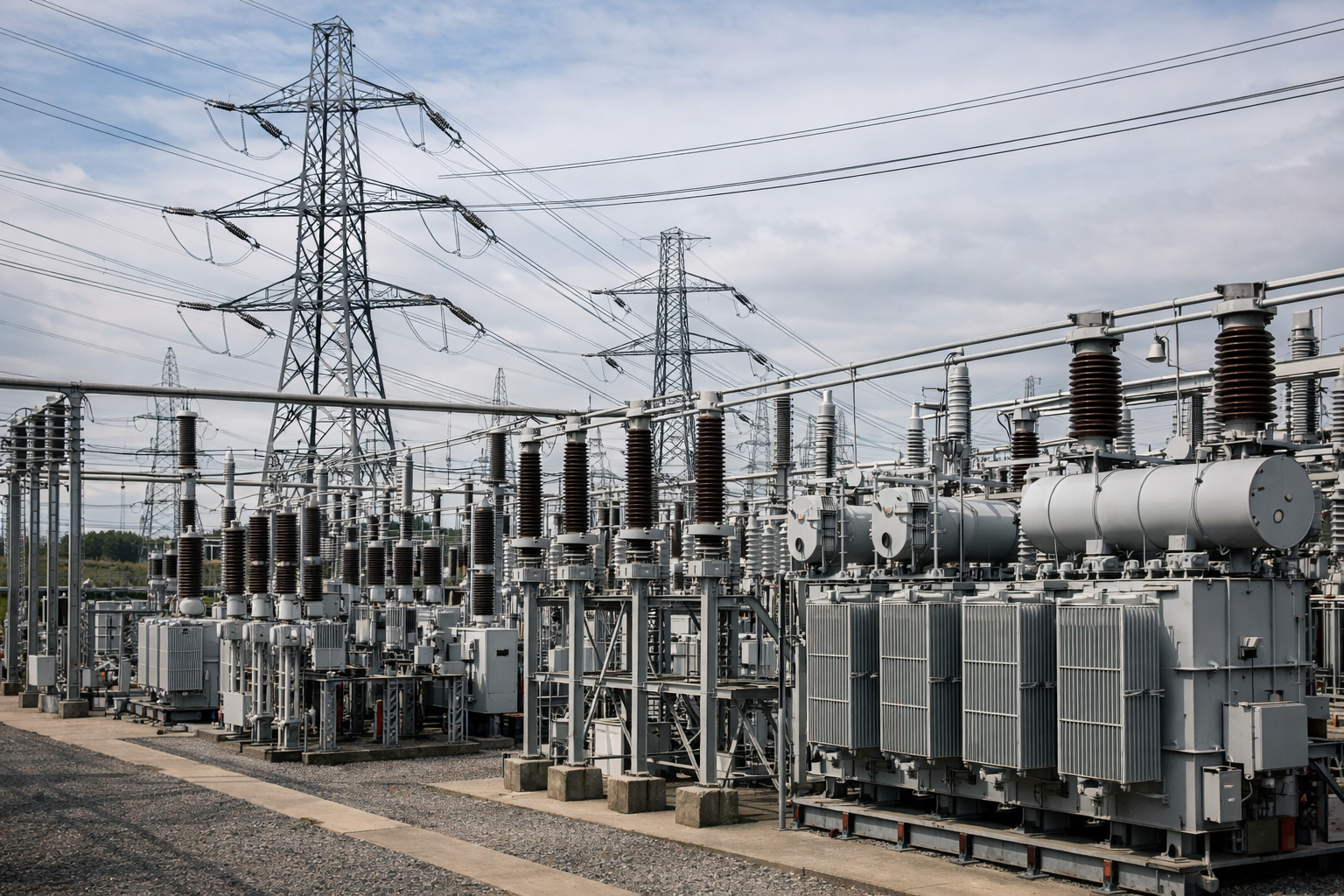
GE Vernova has been selected by Laing O’Rourke to deliver the new 400kV gas-insulated switchgear substation at Chesterfield, adding a substantial electrical-engineering package to National Grid’s reinforcement of the transmission corridor between South Yorkshire and the East Midlands.
The scope extends beyond supply of the GIS itself. GE Vernova will cover design engineering, procurement, equipment delivery, installation, testing, and commissioning, alongside primary and secondary engineering, protection and control, interface management, integration with the existing transmission network, and decommissioning of existing equipment.
The Chesterfield installation forms part of the linked Brinsworth to Chesterfield and Chesterfield to High Marnham projects. National Grid plans to uprate the existing double-circuit overhead lines along both sections from 275kV operation to 400kV, increasing the capability of an established transmission route rather than replacing it with an entirely new corridor.
Planning permission has already been secured for the three substations required by the programme at Long Lane near Brinsworth, Chesterfield, and High Marnham. The Chesterfield site currently operates at 132kV and 275kV, so new high-voltage infrastructure is required before the uprated circuits can operate at 400kV through the site.
Line uprating transfers complexity to the substations
Operating an existing overhead-line route at a higher voltage can release substantially more transfer capacity without creating a new end-to-end transmission alignment, but the conductors are only one part of the system. Substations at each interface must be able to switch, protect, measure, and control the new 400kV circuits, while neighbouring equipment has to remain coordinated with the revised network configuration.
At Chesterfield, the GIS installation therefore sits directly in the electrical path created by the uprating. Circuit-breaker duties, busbar arrangements, protection zones, control interfaces, communications, and commissioning sequences all have to work with new equipment while the surrounding transmission network continues operating.
Gas-insulated switchgear can reduce the physical space needed for high-voltage clearances compared with a conventional air-insulated yard, which is valuable when new capacity has to be fitted around established infrastructure. The compact arrangement does not remove the engineering involved in assembly, monitoring, maintenance, insulation management, and testing, particularly at a live transmission site.
GE Vernova plans to use its g3 technology at Chesterfield as an alternative to sulphur hexafluoride. SF6 has historically been used extensively in high-voltage equipment because of its dielectric and switching performance, but its environmental impact is pushing utilities and equipment manufacturers towards lower-impact alternatives in new installations.
The contract therefore combines two changes at once: National Grid is raising the operating voltage of an existing transmission corridor while the new substation equipment adopts a different insulation technology from conventional SF6 GIS. Both have to be demonstrated through detailed design and commissioning rather than assumed from equipment specifications alone.
Integration now becomes the critical programme
Transmission construction at an established site has to be sequenced around an operating network. Civil works, equipment delivery, erection, cable and overhead-line interfaces, auxiliary systems, protection testing, outage windows, and final energisation have to converge without unnecessarily reducing system security during the transition.
Protection and control are especially sensitive because the electrical characteristics of the network change as 400kV infrastructure is introduced. Fault levels, power flows, switching arrangements, and interfaces with the lower-voltage system all have to be reflected in schemes that isolate faults selectively while leaving healthy sections energised.
GE Vernova’s responsibility for interface management and network integration consequently gives the award a systems-engineering dimension beyond manufacture of the switchgear. Factory-tested equipment still has to be assembled correctly on site, linked into station control and auxiliary systems, and commissioned against National Grid’s operational requirements before it can carry transmission load.
The programme is also entering a crowded equipment market. National Grid has raised its five-year capital investment programme to at least £70 billion, with UK electricity transmission accounting for a substantial share as reinforcement and new connections accelerate.
That wider programme increases competition for transformers, switchgear, protection systems, cables, specialist engineering labour, and commissioning resources. Equipment manufacturing slots have to align with civil construction and planned outages, because a completed building waiting for GIS or a delivered switchgear package waiting for access creates little usable network capacity.
Chesterfield has now cleared several important barriers between proposal and physical delivery. Planning is in place, the 400kV requirement is defined, and a major switchgear and integration package has been awarded. The next stage is less visible but considerably harder: bringing design, manufacturing, construction, protection, and outage programmes together on an operating transmission site without losing control of either schedule or network risk.