IN Brief:
- A coalition initiated by Mantle8 and led by Hydrogen Europe proposes a €1bn programme to investigate natural hydrogen resources across the EU.
- The suggested programme would support approximately 50 exploration and appraisal wells across at least ten Member States, alongside permitting and subsurface-data reforms.
- The European Commission has opened a consultation on its renewed hydrogen strategy but has not approved the coalition’s funding request or proposed natural hydrogen atlas.
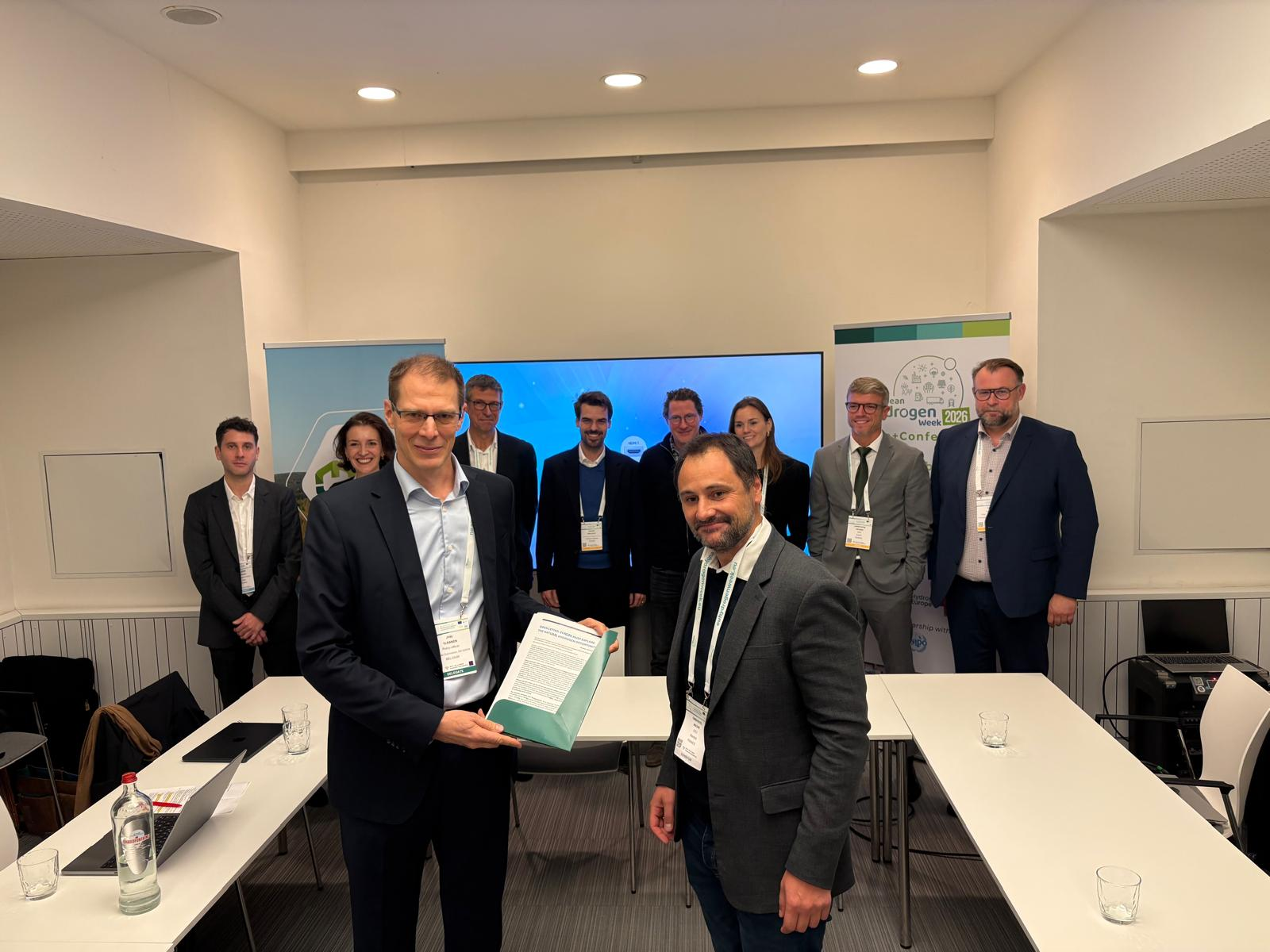
Mantle8 and a European coalition led by Hydrogen Europe are urging the EU to establish a €1bn programme for natural hydrogen exploration, alongside clearer permitting rules and access to geological information. The proposal envisages approximately 50 exploration and appraisal wells across at least ten Member States. It was presented at European Hydrogen Week in Brussels as the European Commission began consultation on its renewed hydrogen strategy. The €1bn is an industry request, not an approved funding allocation or a forecast of commercially recoverable hydrogen.
Natural hydrogen occurs underground through geological reactions rather than being manufactured in an electrolyser or processed from fossil fuels at the surface. Its potential as an energy resource depends on whether hydrogen is generated in sufficient quantities, migrates into suitable formations and can be recovered at an economically useful flow rate. Deposits may also contain other gases that need separation. Drilling and reservoir appraisal are therefore required before a geological indication can be translated into a production estimate.
The coalition’s letter asks the Commission to recognise natural hydrogen explicitly in EU energy policy and to consider it in future hydrogen certification and support systems where applicable emissions criteria are satisfied. The signatories also want more predictable national exploration permits and a common means of identifying promising geological settings. These measures are designed to reduce uncertainty at the investigation stage rather than bypass the tests required to approve individual wells or production facilities.
Mantle8 is developing a subsurface exploration approach that combines geology, geophysics and geochemical analysis to identify settings where hydrogen is actively generated and may accumulate. A subsurface reaction capable of releasing hydrogen is only one part of the problem. A viable prospect also needs pathways for migration, a formation capable of holding the gas and production conditions that support sustained recovery. Survey results help narrow drilling targets, but gas composition, reservoir pressure and deliverability have to be tested in the field.
The proposed €1bn envelope would support approximately 50 exploration and appraisal wells and related work in at least ten EU countries. Expenditure could include subsurface investigations, drilling, well testing and pilot production where evidence permits. The headline sum is not a €1bn contract for Mantle8, and the proposed well count is a programme objective rather than a set of licensed drilling locations. Well depth, geology, access, environmental controls and testing duration would all affect the cost of individual campaigns.
Well testing can establish how hydrogen behaves beyond isolated samples. Downhole logs and gas analyses indicate formation properties and composition, while controlled flow tests assess pressure response and the ability to sustain production. A short initial flow may reflect a limited pocket rather than a replenished resource. Repeated measurements and suitable reservoir models are needed to understand depletion, possible recharge and the engineering provisions required for extraction. Gas handling, pressure control and the treatment of other constituents are part of that appraisal work.
National permitting remains a separate constraint. Exploration rights, drilling authorisations, environmental assessment and commercial production permissions are distinct decisions in many jurisdictions. Defined application procedures and decision timetables would give investors a clearer sequence in which to commit funding and design field programmes. They would not remove obligations covering groundwater, land access, well integrity or the environmental effects of drilling and processing. The coalition wants these routes clarified across Member States without claiming that one permit can replace all others.
A European natural hydrogen atlas is another element of the proposal. It would draw together publicly funded geological records and subsurface observations to help identify promising exploration areas. Legacy oil and gas, geothermal and mineral surveys can provide useful evidence but were not collected to answer the same hydrogen questions. Data quality, coverage and measurement methods vary considerably, while an atlas cannot confirm a reserve or a recoverable flow rate in the absence of direct testing.
The coalition has also requested technology-neutral consideration under relevant certification and financial support arrangements, provided any qualifying emissions limits are satisfied. Natural occurrence does not establish that an extracted gas has low lifecycle emissions. Exploration, drilling, separation, compression, transport and leakage can influence the result. An eventual framework would need credible measurements and defined calculation boundaries before an individual project could qualify for support on emissions grounds.
The Commission opened its call for evidence and targeted stakeholder consultation on 26 October, with submissions accepted until 23 November 2026. The exercise will inform a new hydrogen strategy, and it has not yet created the funding programme, permitting framework or atlas sought by the coalition. Mantle8 has indicated that the letter will be sent formally to relevant Commission officials after its presentation in Brussels. Future decisions must still address the technical uncertainty around the resource as well as the proposed policy mechanisms.
If field appraisal eventually establishes viable production, natural hydrogen would need treatment, storage or transport arrangements and a defined industrial or energy customer. It might serve industrial processes or fuel uses, with electricity generation dependent on the characteristics and economics of the eventual supply chain. Prospecting alone cannot establish the fuel’s delivered cost or its contribution to power production. The coalition is seeking a route to gather that evidence before decisions are made about development at commercial scale.