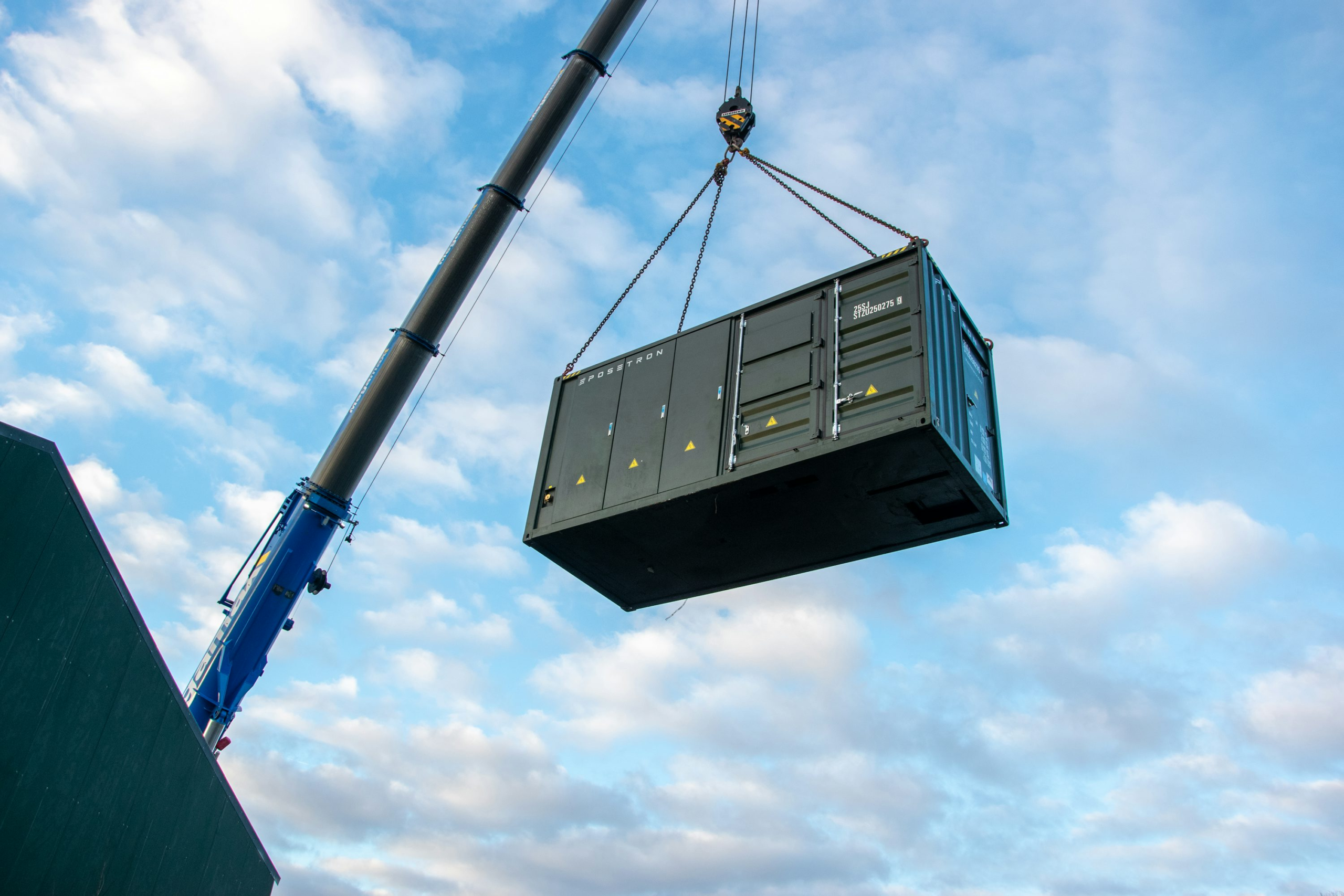
IN Brief:
- Santander UK is providing approximately £42.7 million for the Immingham battery.
- The 80MW/240MWh project has a nominal operating duration of three hours.
- Two ten-year EDF agreements provide a revenue floor while retaining shared market upside.
Econergy Renewable Energy has secured approximately £42.7 million of project finance from Santander UK for its planned 80MW/240MWh battery energy storage system at Immingham in North East Lincolnshire.
The package includes a main construction facility of around £38.4 million, together with a VAT revolving facility and a debt-service reserve facility. Econergy intends to use the principal loan for construction expenditure and to repay shareholder funding advanced during development.
The three-hour battery is supported by two ten-year revenue-floor agreements with EDF, each covering 40MW of capacity. EDF will optimise the plant across available electricity markets while guaranteeing Econergy a minimum level of annual income, with revenue earned above the floor shared between the companies.
Econergy expects the revenue floor and associated Capacity Market payments to produce between £45 million and £50 million over the contract term. Capacity Market income is expected to account for around 11% of that amount, while the combined contracted revenues are projected to represent approximately half of the project’s anticipated income over the decade.
The arrangement gives lenders greater visibility than a wholly merchant battery would provide. Storage revenues can change rapidly as wholesale spreads, balancing requirements, ancillary-service prices, and competition between assets move, making long-term debt more difficult to support when income depends entirely on market forecasts.
A floor limits part of that downside without fixing every pound of revenue. Econergy retains exposure to higher returns when trading conditions are favourable, while EDF gains control of an 80MW flexible asset and a share of the upside in exchange for accepting some of the revenue risk.
At maximum rated output, the battery’s 240MWh energy capacity would support approximately three hours of discharge. Actual usable duration will depend on state-of-charge limits, auxiliary consumption, conversion losses, degradation allowances, and the capacity reserved for contracted services.
The duration gives EDF more scope to shift energy between trading periods than a one-hour system while retaining access to shorter balancing products. Longer operation can capture wider price spreads, respond to sustained system events, and support Capacity Market obligations where sufficient stored energy is available.
Optimisation will involve choices between competing uses. A battery charged for a wholesale opportunity may have less headroom for frequency or balancing response, while an obligation to remain available for a system-stress period can limit trading immediately beforehand.
Warranty conditions add another constraint. Repeated cycling, depth of discharge, temperature, and charge rate influence cell degradation, so EDF’s trading strategy must remain within the technical operating envelope agreed with Econergy and the equipment suppliers.
The revenue-floor agreement does not remove construction or operational risk from the owner. Econergy remains responsible for delivering an available plant, and the financing case will depend on planning conditions, grid connection, engineering, equipment performance, operating expenditure, augmentation, and the timing of commercial operation.
The precise floor level and upside-sharing formula have not been disclosed. Those terms will determine how much price and volume risk remains with each company, although the projected contracted income suggests that a substantial part of the project’s debt-service requirement is supported by revenues less exposed to short-term market changes.
Santander’s participation indicates that the project has passed a more detailed lender review than a development-stage announcement. Battery financing commonly examines grid rights, EPC arrangements, warranties, fire-safety design, insurance, revenue modelling, construction contingency, and the strategy for replacing or adding cells as capacity declines.
Immingham also gives the project an industrial setting. North East Lincolnshire contains port, refining, chemical, and manufacturing activity, while the wider region is experiencing substantial renewable-generation and electricity-network investment.
The battery will not remove regional constraints by itself, but it can respond to national and local market signals and provide controllable capacity within a changing generation mix. Its value will depend on how effectively EDF coordinates wholesale trading, balancing services, and contracted availability.
The financing follows a similar structure used for Econergy’s Dalmarnock battery in Scotland, which also involved Santander and EDF. Reusing a commercial model can reduce documentation and due-diligence friction, although each project still depends on its own connection, construction programme, equipment, and market assumptions.
Immingham must now convert financial close into operating capacity through construction, equipment installation, energisation, control-system integration, market qualification, and performance testing. The debt package has reduced one major uncertainty; the electrical and civil work remains stubbornly physical.