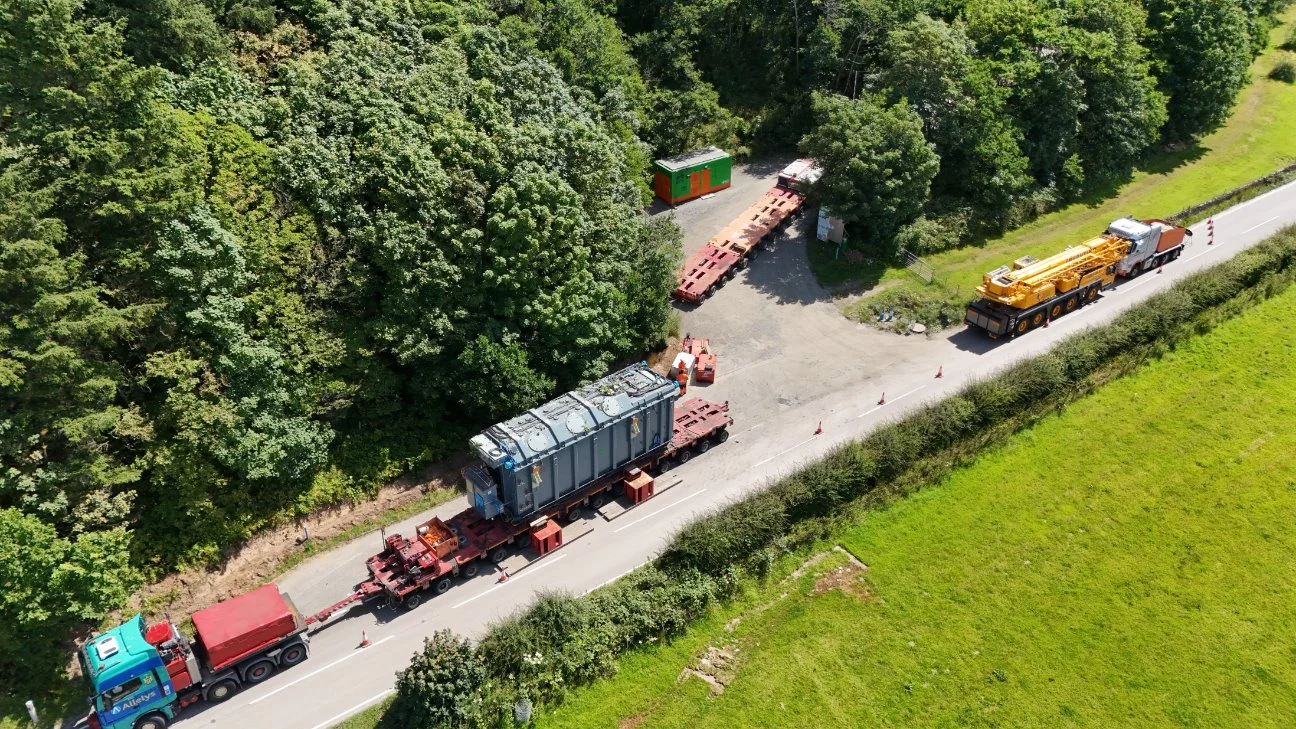
IN Brief:
- The first of two approximately 200-tonne supergrid transformers has reached SSEN Transmission’s Crossaig North 275kV substation.
- Project documentation specifies two 480MVA, 275/132kV transformers as part of the new substation’s electrical plant.
- Crossaig construction began in early 2024 and is currently expected to continue until mid-2029.
SSEN Transmission has delivered the first of two supergrid transformers to its new Crossaig North substation in Argyll, bringing a major item of 275/132kV plant onto site as construction moves further into the electrical installation phase.
The transformer weighs approximately 200 tonnes and travelled by sea from Poland to Campbeltown Harbour before completing the final road journey towards Crossaig. It was transported along the A83 under managed escort before being transferred to a remotely operated 14-axle trailer for the last 24km over the project’s dedicated access route.
The transport operation is conspicuous, but the electrical specification is more important. SSEN Transmission’s project documentation identifies two new 480MVA, 275/132kV supergrid transformers for Crossaig North, establishing a high-capacity interface between the new 275kV infrastructure and the regional 132kV system.
A second transformer has already reached Campbeltown Harbour and is due to follow to site. Delivery is only the beginning of the electrical programme: assembly, cooling systems, auxiliary supplies, high-voltage connections, protection and control interfaces, testing, and commissioning all have to be completed before either unit can carry operational load.
Crossaig North is being built beside the existing Crossaig facilities as part of the wider Argyll and Kintyre reinforcement programme. The new substation will connect with the completed 275kV Inveraray–Crossaig overhead line and increase the network’s ability to export renewable generation from the region.
Construction began in early 2024 and is currently expected to finish by mid-2029. Most of the principal civil works for the new substation had been completed by July 2026, allowing the electrical installation phase to begin while modifications continued around the existing site.
A supergrid transformer performs a straightforward function with demanding consequences: it changes voltage between transmission levels so that bulk electricity can move efficiently while the two networks remain electrically coordinated.
Increasing transmission voltage reduces the current required to transfer a given amount of power, cutting resistive losses and allowing larger transfers than would be practical over the same route at lower voltage. Crossaig’s 275/132kV transformation is therefore part of the wider move to operate the reinforced Argyll route at 275kV.
The 480MVA rating describes apparent-power capability rather than a fixed active-power export figure. Usable capacity will depend on operating voltage, current, power factor, cooling performance, ambient conditions, neighbouring circuits, and the network configuration in service.
Two 480MVA transformers also do not independently create a 960MW renewable export route. Overall transfer capability is set by the weakest relevant part of the system, including transmission lines, cables, switchgear, busbars, protection settings, neighbouring substations, and the contingencies against which the network must remain secure.
Protection is particularly important because a transformer of this scale connects two substantial sections of the network. Differential protection, overcurrent functions, circuit breakers, monitoring, and system-level coordination must isolate abnormal conditions rapidly enough to protect the transformer without unnecessarily disconnecting healthy infrastructure.
Thermal performance is another constraint. Transformers rely on substantial cooling equipment to keep winding and oil temperatures within acceptable limits under sustained loading, while civil design must accommodate foundations, oil containment, fire precautions, high-voltage clearances, and access for maintenance or eventual replacement.
Those requirements explain why logistics sit on the critical path long before energisation. Equipment weighing around 200 tonnes cannot be treated as ordinary freight, particularly on rural routes. Port capacity, bridge loading, road geometry, gradients, traffic management, axle configuration, and the condition of access tracks all become part of the transmission programme.
For Argyll and Kintyre, the underlying driver is the volume of renewable generation seeking access to the electricity system. Wind farms can only contribute fully to the wider market where sufficient network capacity exists to move their output away from the locations in which it is generated.
Substations and transformers therefore increasingly determine the timetable for renewable development. Generating plant can sometimes be installed more quickly than the transmission reinforcements needed to accommodate it, particularly where major new voltage levels, routes, substations, and outages must be coordinated.
The first Crossaig transformer has now completed the unusually visible part of its journey. Its useful life begins with quieter milestones — connection, protection commissioning, electrical testing, and energisation — before the 480MVA unit can become part of the live transmission system and start doing the job that justified moving 200 tonnes through Argyll.