IN Brief:
- Dajin Heavy Industry is supplying 60 monopiles, averaging approximately 81 metres in length and 1,350 tonnes in weight.
- Buss Ports is coordinating component handling for Nordseecluster B alongside the separate 795 MW OranjeWind project.
- Commercial operation of Nordseecluster B is scheduled for early 2029.
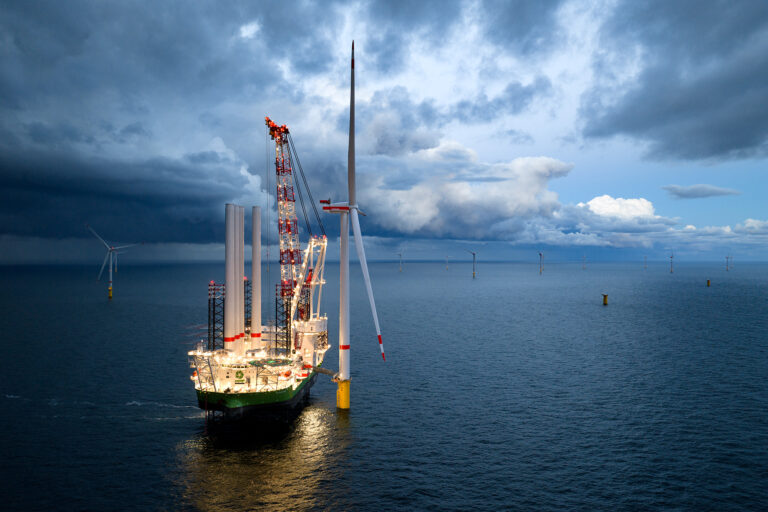
RWE has received the first ten monopile foundations for its 900 MW Nordseecluster B offshore wind development at the Dutch port of Eemshaven. The delivery begins a component handling programme covering all 60 foundations required for the second phase of the company’s approximately 1.6 GW Nordseecluster project in the German North Sea.
Dajin Heavy Industry is manufacturing and supplying the monopiles, which average approximately 81 metres in length and weigh around 1,350 tonnes each. Buss Ports will handle the foundations and associated secondary steel structures at its Eemshaven terminal throughout 2026 and 2027, ahead of offshore installation beginning next year.
Nordseecluster is being developed approximately 50 kilometres north of the German island of Juist. Its first phase, Nordseecluster A, incorporates 660 MW of generating capacity and began supplying electricity to the German network in July 2026. RWE expects to complete commissioning of that phase in spring 2027, with Nordseecluster B scheduled to enter commercial operation at the beginning of 2029.
The second phase will incorporate 60 Vestas turbines, each rated at 15 MW. The generating equipment determines a significant proportion of the mechanical and structural requirements for the supporting infrastructure, with the foundations designed to accommodate both the mass of the turbine assemblies and the dynamic forces arising during operation.
Monopiles transfer those forces into the seabed through large cylindrical steel structures. Their design must address the interaction between turbine loads, wave and current conditions, and the geotechnical characteristics of individual installation locations. Foundation dimensions can consequently vary across a development according to differences in water depth and seabed conditions.
The scale of the Nordseecluster B components also influences the manufacturing and inspection requirements imposed on suppliers. Fabricating large offshore foundations requires facilities capable of forming, welding, and handling substantial steel assemblies, with manufacturing tolerances and material characteristics established through the project’s structural engineering specifications. Inspection and documentation support the acceptance of completed components before they enter the offshore delivery programme.
Port infrastructure becomes a significant determinant of installation schedules when components reach these dimensions. Handling facilities must accommodate the mass and length of the foundations while preserving sufficient space for storage, movement, and preparation ahead of offshore installation. Vessel availability and the order in which individual foundations are required also influence the management of components arriving at the terminal.
Buss Ports is simultaneously undertaking component handling activities for OranjeWind, a separate 795 MW Dutch offshore wind development. Together, the two programmes illustrate the increasing volume of specialist offshore infrastructure moving through North Sea terminals as developers progress multiple large generating projects during overlapping construction periods.
Coordinating those programmes requires more than establishing adequate terminal capacity. Installation contractors must align component deliveries with the availability of specialist offshore vessels and suitable operating conditions. Delays to one element of the supply chain can create additional storage requirements onshore or affect subsequent activities involving other equipment packages.
The importance of aligning port activities with offshore construction is also evident in British waters, where the first Inch Cape turbine components recently departed Dundee for installation. Although that Scottish development is at a different stage of construction, its component handling programme similarly depends on the coordination of manufacturing, port infrastructure, and offshore vessel schedules.
Following foundation installation, Nordseecluster B will require the delivery of turbines and the associated electrical collection infrastructure. The overall Nordseecluster programme includes two offshore substations being supplied by Atlantique Offshore Energy. Those assets will provide interfaces between electricity collected from individual turbines and the transmission infrastructure serving the wider development.
Electrical integration and testing must be coordinated with offshore mechanical construction before completed turbines can begin generating electricity. The ability to energise individual sections of a wind farm depends on the readiness of its collection circuits, protection systems, offshore substation equipment, and external transmission connection.
RWE anticipates annual electricity production of approximately 6.5 TWh across the completed Nordseecluster programme. Earlier in 2026, the developer secured a power purchase agreement with Amazon covering 110 MW of Nordseecluster B’s generating capacity, establishing a commercial route for part of the future output.
The remaining foundations will pass through Eemshaven during 2026 and 2027, with offshore installation scheduled for next year. The second phase will subsequently progress through turbine installation and electrical commissioning before its planned entry into commercial operation in early 2029.