IN Brief:
- Solar Media Market Research identifies approximately 6 GWh of operating Italian grid-scale battery capacity and 10 GWh under construction.
- Enel owns 75% of the identified operating projects and about 80% of their storage energy capacity.
- Construction-stage projects and the separate MACSE auction awards must not be counted as operational capacity.
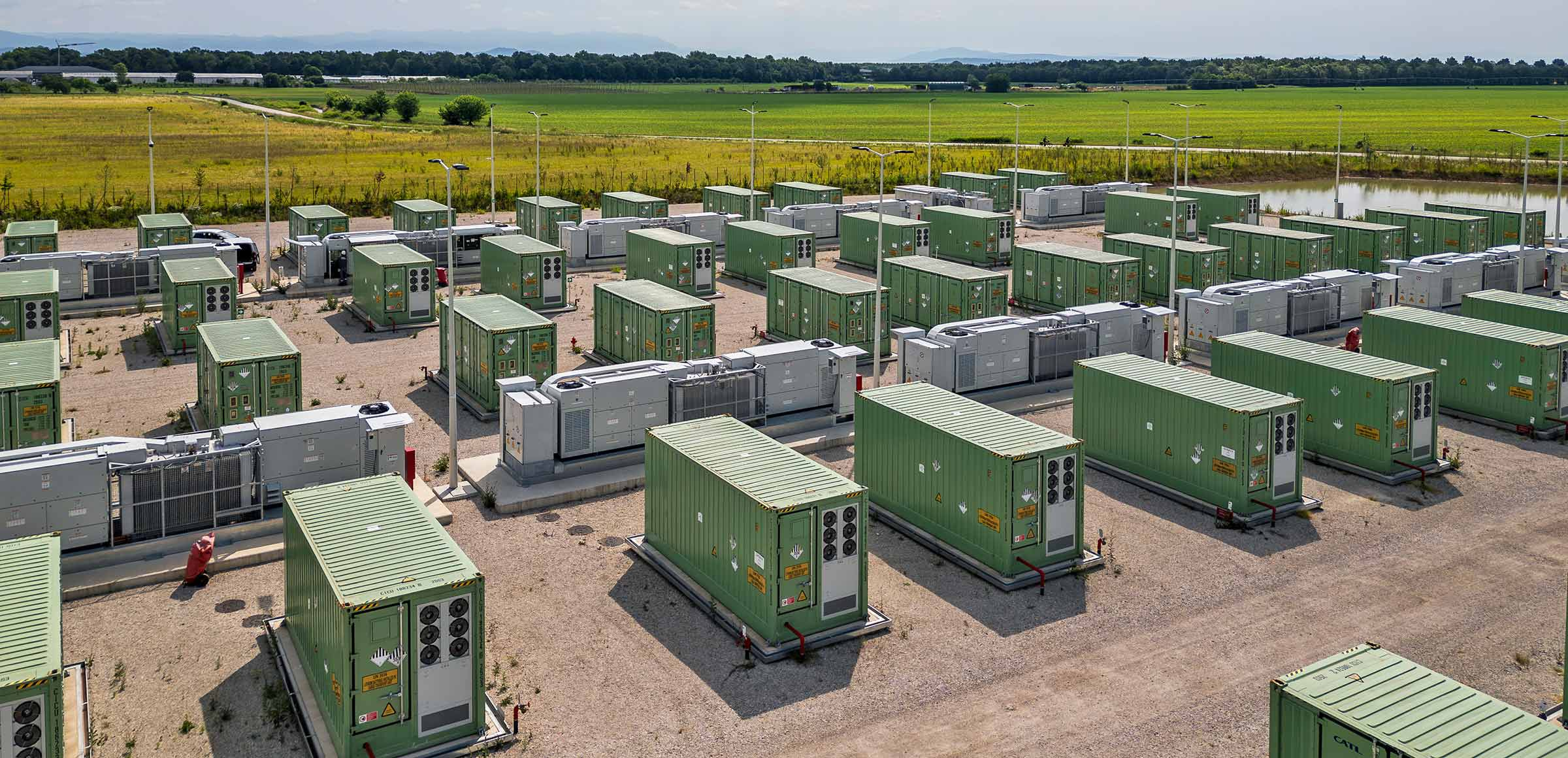
Solar Media Market Research estimates that Italy now has approximately 6 GWh of operational grid-scale battery storage, with another 10 GWh of projects under construction. The figures were disclosed on 17 November by senior analyst Josh Cornes and derive from the organisation’s new Battery Storage: Italy Pipeline & Completed Assets Database. They describe a defined segment of large-scale battery projects, not every electrochemical storage system connected to the Italian electricity network.
The research expresses national battery capacity in gigawatt-hours rather than gigawatts. GWh describes the amount of electrical energy that can be stored, while GW or MW describes charging and discharging power. A 100 MW plant with 400 MWh nominal capacity is often described as a four-hour battery, although usable delivery depends on state of charge, inverter rating, efficiency and operating constraints. The new 6 GWh figure does not reveal the combined power rating or assured discharge duration of Italy’s operating fleet.
Enel owns approximately three-quarters of the operating grid-scale projects identified by Solar Media and accounts for around 80% of their combined energy capacity, according to the database. Other owners include Engie. These shares apply to the defined project-level research sample and must not be presented as an ownership split across all Italian electrochemical storage, where systems associated with rooftop and commercial solar plants constitute a different, much larger population by installation count.
The further 10 GWh identified as under construction has not yet entered service. Depending on the project, work at that stage can encompass battery containers, power conversion equipment, transformers, cables, protection systems and interfaces to the grid. Energisation, testing, system operator approval and acceptance then remain necessary before the installation can supply market or network services. The pipeline is a measure of developments in physical delivery, not an increment to current operational capacity.
Terna’s MACSE procurement mechanism adds another category that requires separate accounting. The Italian transmission operator awarded 10 GWh in its September 2025 auction for capacity scheduled to be available in 2028. An auction award is a contractual commitment, not proof of construction or commissioning. Although this number resembles Solar Media’s 10 GWh construction estimate, there is no evidence that the two sets of projects contain precisely the same assets.
Under MACSE, storage is procured to shift energy between periods of renewable surplus and higher demand. Contract delivery depends on the installation’s usable energy, state-of-charge management, metering, dispatch communications and compliance with its technical obligations. Batteries may also participate in other services where permitted, but those arrangements cannot be inferred from an award total or the national GWh figure. Export and import limits at the connection point constrain what a nominally large battery can supply at any particular moment.
Two November construction announcements provide more granular project specifications. RWE started building a 62.5 MW / 262.5 MWh battery at Ragusa in Sicily, while BNZ began work on two Lazio sites, each rated at 27 MW / 108 MWh. Their ratios of energy to power correspond to approximately four hours at nominal discharge. Both are construction-stage examples; neither should be added to the November operational stock solely because physical works have begun.
Converter capability will influence how the new fleet supports the network. Grid-following inverters synchronise with an existing voltage waveform; a grid-forming control mode can establish a voltage reference within the equipment’s tested limits. The associated protection, fault response, reactive power controls and connection requirements differ, and a battery’s GWh capacity says nothing about which mode it can provide. Solar Media’s published country totals do not specify grid-forming capability across the projects in its database.
ITALIA SOLARE, working from Terna’s GAUDÌ registry, reported 19,983 MWh of connected electrochemical storage at the end of September, including 12,552 MWh associated with photovoltaic installations and 7,368 MWh classified as standalone. Solar Media’s 6 GWh operational grid-scale estimate may overlap parts of that wider inventory. Adding the totals together would double-count some assets, while comparing them directly would obscure their different dates and definitions.
Dispatch requirements also vary by location. A large battery near solar generation may charge when output exceeds local demand and export later, while an installation contracted for system services must reserve charge and power capacity in accordance with those obligations. Connection constraints, degradation and charging costs affect the energy that can actually be delivered. None of these operating characteristics can be established from a national energy-capacity estimate alone, even when its project count and ownership breakdown are available.
Of the two capacity totals published in November, only the approximately 6 GWh operational figure represents batteries already in service; the further 10 GWh remains under construction. Those stages must be tracked independently from Terna’s capacity auctions and the wider connected-storage registry. Subsequent commissioning and asset-level data will determine how much of the construction portfolio becomes operational and what additional power and flexibility it can supply.