IN Brief:
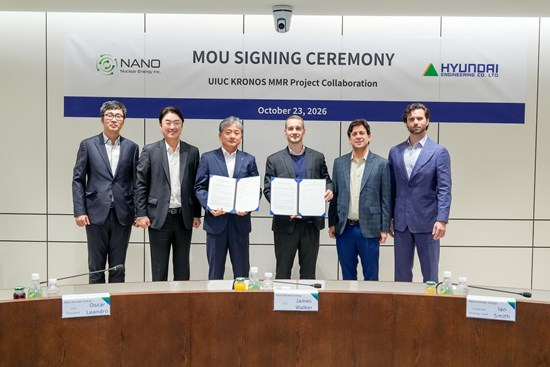
- Hyundai Engineering has signed separate cooperation memorandums with NANO Nuclear Energy and ARC Clean Technology for possible US advanced reactor work.
- Initial NANO Nuclear work would evaluate construction sequencing, procurement interfaces and supply chains for the proposed KRONOS university research reactor.
- The University of Illinois KRONOS construction permit application remains under NRC review; the ARC-100 sodium-cooled programme follows a separate development route.
Hyundai Engineering has signed separate memorandums of understanding with US reactor developers NANO Nuclear Energy and ARC Clean Technology, opening discussions over engineering, construction planning and future project delivery. The two arrangements concern different advanced nuclear technologies and possible scopes of work, rather than awarded plant contracts. Hyundai will assess where its industrial engineering, procurement, modular construction and project-management capabilities could support each developer as their designs move through regulatory review and practical delivery planning.
NANO Nuclear’s agreement is initially focused on the proposed KRONOS Micro Modular Reactor at the University of Illinois Urbana-Champaign. The university submitted a construction permit application to the US Nuclear Regulatory Commission on 31 March, and the regulator accepted it for detailed review in May. This is an application for a research reactor in Champaign County, not a licence to operate a commercial power station. Hyundai’s potential involvement must fit the university’s contracting arrangements and the boundaries established through that review.
Early activities under the NANO Nuclear framework could include a responsibility and interface matrix, site constructability studies, supplier assessments and plans for equipment logistics. This work would identify which parties are responsible for conventional buildings, site utilities, long-lead procurement and delivery interfaces around the reactor system. Once those boundaries are defined, the parties could assess whether Hyundai should bid for engineering, procurement or construction packages. The memorandum is non-exclusive, and any compensated work would require separately executed agreements.
The NRC describes KRONOS as a 45MW thermal high-temperature gas-cooled reactor. Its proposed fuel uses uranium oxycarbide kernels enclosed in tristructural isotropic particle layers, with the particles embedded in a ceramic matrix. Inert helium would transport heat from the core, while a molten-salt thermal energy storage system is proposed to receive that heat and supply downstream conversion systems. The 45MW rating is thermal output: it cannot be reported as 45MW of electrical generating capacity.
The research installation is intended to support investigation of reactor and energy-conversion technology. Its electrical output, if delivered through the proposed secondary systems, would depend on the approved configuration and the efficiency of the heat conversion process. Project construction also requires civil design, shielding and containment arrangements, electrical distribution, instrumentation, control interfaces and cooling provisions to be developed together. Modularity may shift some manufacture away from the site, but it does not eliminate the inspection, installation and testing needed at the final location.
The regulator’s published review targets include draft safety and environmental assessments in February 2027, a final environmental assessment in May and a final safety evaluation in September. These are planned review milestones, not permit decisions. Even after a construction permit, a separate operating licence and the associated safety demonstrations would be required before the research reactor could run. Hyundai’s discussions with NANO Nuclear may therefore proceed alongside licensing work, without determining its outcome or the date at which site construction can begin.
Hyundai’s other agreement is with ARC Clean Technology, which is developing the ARC-100 sodium-cooled fast reactor. The developer describes the design as approximately 100MW of electrical capacity per reactor unit. Liquid sodium transfers heat from a fast-neutron core, requiring plant design provisions for sodium handling, leak detection and heat exchange that differ from the helium-cooled KRONOS system. Those differences affect materials, maintenance arrangements, auxiliary equipment and the qualifications needed of suppliers, even where conventional civil or electrical work appears similar.
ARC has pursued a separate development path for its first-of-a-kind demonstration ambitions. Its technology cannot be treated as part of the University of Illinois KRONOS application or as a second unit of that project. Hyundai’s agreement provides an opportunity to evaluate future engineering, procurement and construction involvement, with the detailed location, contract packages and development timetable dependent on further project decisions. The signing establishes neither an authorised nuclear construction site nor an order for an operating reactor.
Both projects would require careful allocation of responsibilities between nuclear-grade equipment suppliers and conventional contractors. Site electrical systems, emergency and standby supplies, heat-transfer equipment, building services, protection and control would need design documentation and commissioning arrangements appropriate to their safety significance. Nuclear quality assurance, component traceability and regulator-facing design records can constrain procurement and installation sequencing. Heavy transport and prefabrication likewise need to be reconciled with local access routes, lifting capacity and inspection requirements.
NANO Nuclear has identified supplier mapping, long-lead equipment planning and US localisation as potential joint workstreams, building on Hyundai’s earlier experience with related microreactor technology. ARC’s agreement adds a different technical route and commercial counterparty. The next milestones are defined work packages, any subsequent binding awards, and progress through each project’s own licensing process. The two memorandums expand Hyundai’s development opportunities but do not yet add generating capacity or construction revenue.
Featured image: NANO Nuclear Energy / Hyundai Engineering, distributed with the 27 October 2026 press release.