IN Brief:
- Axis surveyed 600 utilities decision-makers in the UK and Ireland across energy and renewables, water and wastewater, and oil and gas.
- Among energy and renewables respondents, 42% identify earlier detection of equipment deterioration and maintenance needs as a priority.
- Responses concern expectations and operational practices; they are not measured reductions in failure rates or maintenance costs.
Axis Communications has published research into how utilities use security technology and the operational information it can provide alongside site protection. The study surveyed 600 decision-makers across energy and renewables, water and wastewater, and oil and gas in the UK and Ireland. Among energy and renewables respondents, 42% identify deteriorating equipment performance and maintenance needs as areas where earlier detection could deliver their greatest business benefit.
Across the wider utilities sample, 51% anticipate that business intelligence or operational efficiency will provide security technology’s greatest value in the next three to five years. The total comprises 32% selecting business intelligence and analytics and 19% selecting efficiency and productivity. These figures measure respondents’ expectations of future value rather than independently verified reductions in faults, energy losses or maintenance expenditure.
Rising operating costs are identified as a major pressure by 71% of respondents, followed by labour and skills shortages at 46% and business continuity or asset reliability at 40%. Across all three sectors, 45% highlight critical asset failure, including fire or overheating, as a potential benefit of earlier detection. Health and safety or process incidents account for 41%, while deterioration and maintenance needs account for 37%. Those percentages refer to reported priorities, not measured rates of equipment failure.
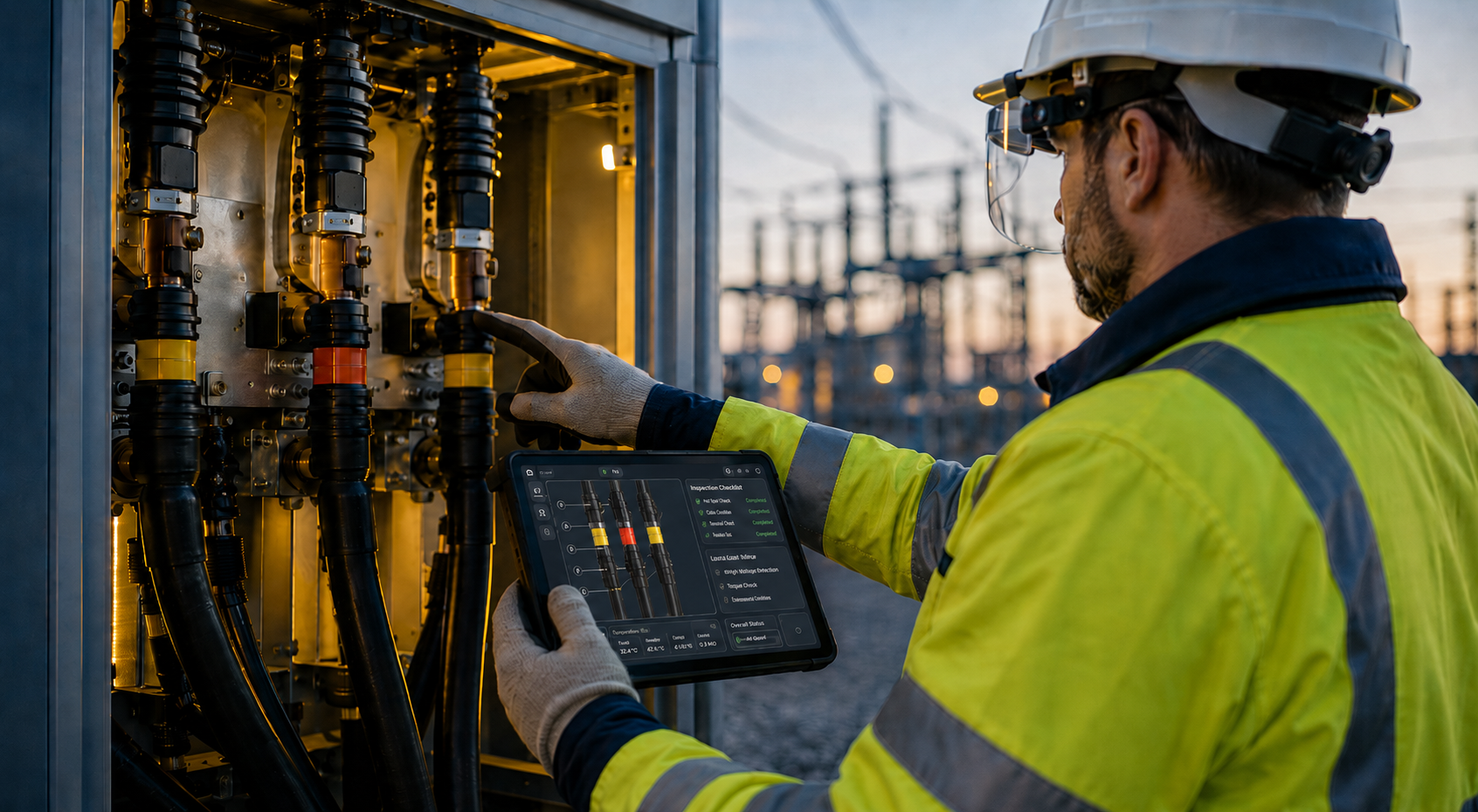
Cameras at generation sites and substations typically monitor entrances, compounds, switchgear buildings and exposed equipment. When connected to appropriate analytics, their images can help staff interpret an alarm by revealing smoke, visible damage, water ingress or unauthorised access. Video supplies context rather than a complete electrical diagnosis. A protection relay or supervisory control system may identify the tripped circuit, while a camera helps confirm the surrounding conditions before engineers decide how to respond.
Visible-light imaging and thermal measurement also have different limits. Standard video may reveal a leak, physical obstruction or damaged barrier, but it cannot determine the temperature of internal electrical contacts. A thermal camera may detect abnormal surface heating under suitable viewing conditions, with accuracy influenced by emissivity, reflection, distance, ambient conditions and loading. Oil analysis, insulation tests, equipment telemetry and physical inspection remain necessary where the failure mechanism cannot be established from an image.
Remote substations and renewable generation assets are often inspected by specialist teams travelling between dispersed sites. A timely visual check may help a control room establish whether an alert needs immediate attendance or can be investigated through other monitored signals first. The intervention still depends on the site’s safety procedures, isolation requirements and the availability of authorised electrical personnel. Cameras cannot substitute for safe access arrangements or the instrumentation used to confirm a hazardous condition.
Axis reports that 82% of survey participants already use security technology for security and incident prevention, while 43% say its data is fully integrated into operational systems and routinely informs real-time decisions. Another 32% have no consistent approach to monitoring remote or unmanned sites. The figures point to different levels of adoption: installing a camera does not by itself connect its information to maintenance scheduling, alarm handling or asset records.
Useful integration requires images to carry reliable times, equipment references and alert identifiers so an engineer can correlate what was seen with protection events and work orders. Networks must also control who can view or export footage, how long recordings remain available and how a loss of communications is handled. When a camera system is integrated into an operational interface, segmentation and access control must prevent a compromise of video equipment from affecting the electrical protection or control system.
The energy and renewables subgroup’s 42% figure for deterioration and maintenance compares with 36% in water and wastewater and 35% in oil and gas. Those responses indicate differences in reported priorities within the sample. They do not establish that energy-sector assets fail more frequently or that video monitoring is more effective on substations than on other industrial equipment. The subgroup size is not established in the published findings, which limits the precision with which these differences can be interpreted.
Axis positions visual intelligence as an additional source of operational context. Depending on equipment and configuration, analytics could correlate observed changes with alarms or allow control-room staff to review an isolated site without a routine visit. Those possibilities depend on adequate camera coverage, network availability, cyber security controls and human verification. A thermal alert, for example, needs to be checked against loading and ambient temperature before it can support a maintenance decision.
Deployment-level evidence is needed before the reported enthusiasm can be translated into quantified reliability gains or maintenance savings. Operational results would need to be evaluated against incident detection accuracy, false alarms, response times, work orders and subsequent asset condition. For electricity networks, these measures would show whether using video alongside protection data and maintenance records produces decisions that are both faster and technically sound.