IN Brief:
- The French-flagged Abeille Marengo arrived at Heraklion ahead of surveys for the planned Crete–Cyprus HVDC route.
- Nexans has assigned the investigations to Next Geosolutions Europe, with sonar, magnetic surveys, imaging and sampling envisaged.
- The 898km route has EU funding, but survey commencement and cable installation remain separate milestones with political and maritime constraints.
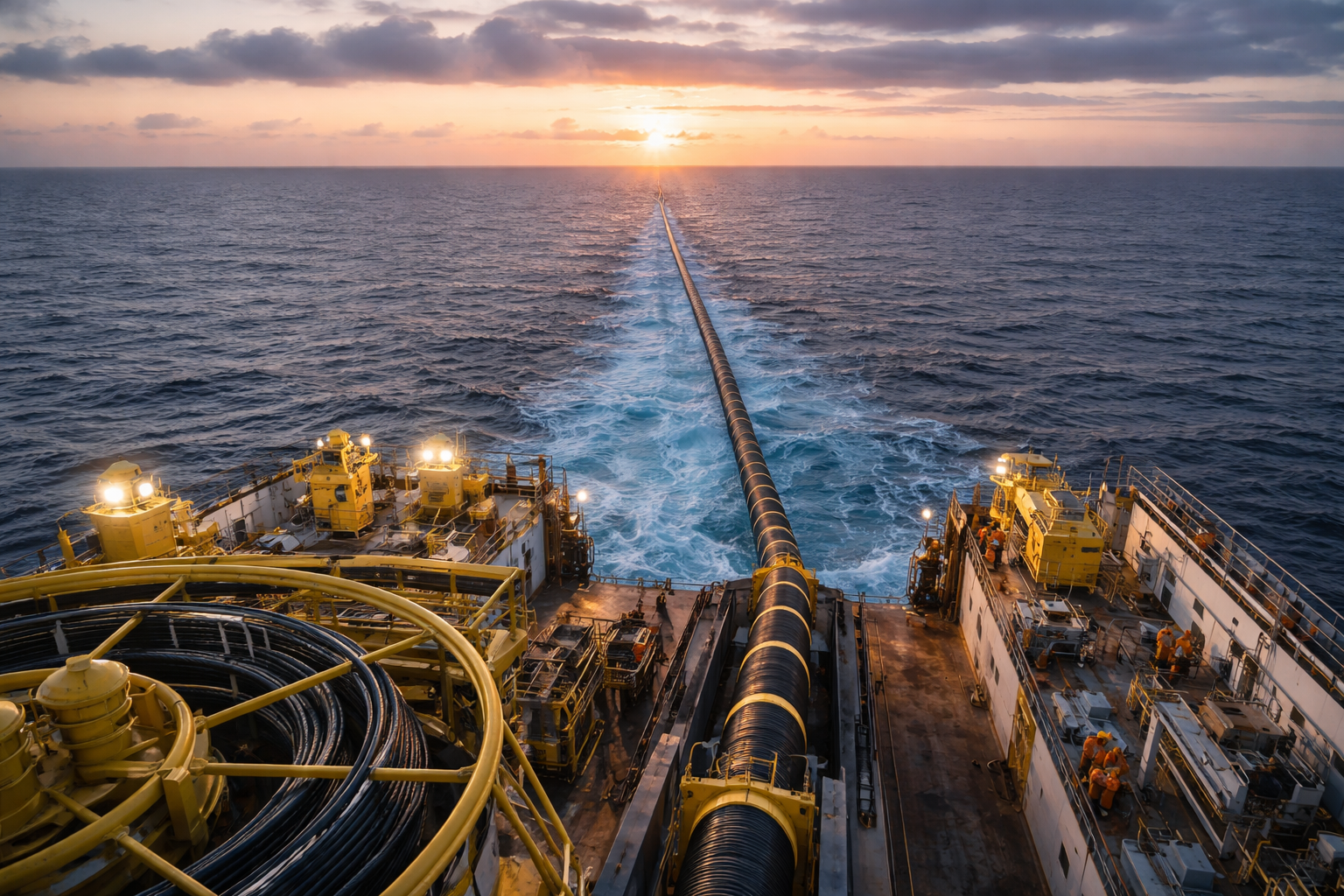
The French-flagged offshore support vessel Abeille Marengo has arrived at Heraklion, Crete, in preparation for seabed surveys along the proposed Greece–Cyprus electricity interconnector route. The vessel reached port on 27 October after sailing from Italy. It was awaiting the navigational warning needed to define the operating area, so its arrival does not establish that the surveys themselves have started.
The work forms part of the Great Sea Interconnector programme, whose first section would connect Crete and Cyprus through a long-distance high-voltage direct-current cable. Cable supplier and installer Nexans has engaged Next Geosolutions Europe for the offshore investigation. The survey route is intended to run from the Korakia area of Crete towards Cyprus, gathering the seabed information needed to refine cable alignment, installation technique and protection.
A NAVTEX warning will identify the permitted survey area and advise other shipping of the vessel’s activities. The operating arrangements described by Greek authorities call for at least 72 hours’ notice to relevant naval services before the survey starts and daily updates during operations. Other vessels are expected to maintain a separation distance of one nautical mile while the work is underway. These are navigation and coordination requirements for a constrained offshore operation, not proof that final route clearance has been obtained.
The Crete–Cyprus section is planned to span roughly 898km. Project material identifies a 525kV DC cable contract and €657m of European Connecting Europe Facility support for the link. The cable is intended to create a bidirectional electricity connection for Cyprus, which currently remains without a physical electricity interconnector to another national power system. Its total capacity and delivery timetable depend on the completed cable and converter infrastructure, rather than the survey campaign alone.
High-voltage direct current is suited to long submarine routes because alternating-current cables of comparable length have significant capacitive charging requirements. At the shore terminals, converter equipment transforms AC to DC and back, enabling the connected systems to exchange controlled power. The design must coordinate cable insulation, converters, cooling, protection and control systems. The cable’s ability to carry high voltage is only one part of achieving safe and reliable long-distance transmission.
Survey equipment will measure water depths and seabed form while identifying conditions that might change the installation route. Multibeam sonar produces bathymetric data, side-scan sonar helps locate seabed features and obstacles, and magnetic instruments can identify metallic hazards. Underwater imaging and samples complement those measurements by showing the local geology and the material in which the cable might be buried or protected. The results will determine where installation methods are technically feasible.
Deep water, steep submarine slopes and uneven terrain complicate route engineering. The cable must respect its minimum bend radius and allowable mechanical loads, and the installer has to account for the behaviour of a suspended line between the vessel and seabed. In shallow areas, trenching or protection may reduce exposure to anchors and fishing gear; in deeper sections, the preferred design may involve laying the cable directly on the seabed where burial is not possible or necessary.
Earlier Greek maritime documents described sonar, magnetic and imaging surveys together with core sampling at depths of up to about 700m. That number refers to a particular proposed sampling activity and is not the maximum water depth of the interconnector route, which is expected to cross much deeper sections. Geotechnical investigations must establish sediment strength and other ground conditions before engineers can confirm the final cable alignment or burial requirements.
French investment group Meridiam acquired a majority stake in the project company in August, alongside an agreement intended to support renewed seabed surveys. Nexans remains the supplier for the submarine cable system and has separately reported that its contractual execution schedule is being revised. The investment arrangement and contractor commitments have not removed the need for authorised offshore operations, engineering assessment and coordination with the coastal and transmission infrastructure.
Maritime jurisdiction disputes have repeatedly complicated survey work in the eastern Mediterranean. Greece and Cyprus support the project, while Turkey contests aspects of the maritime claims affecting sections of the proposed corridor. Nexans has said its coordination for the surveys is with the project promoter and the Greek and Cypriot authorities. The arrival of a vessel in Crete is therefore a tangible operational step, but it does not settle the conflicting political positions or guarantee the entire offshore work programme can proceed without interruption.
The project was already under schedule pressure before the latest mobilisation. Nexans said in January that it was working with its customer to reschedule activities, with consequences for the expected delivery date. Survey data must feed into route engineering before cable installation can be planned with sufficient confidence. Manufacturing, marine deployment, shore crossings, converter construction and testing each have their own dependencies, and delays to one element can affect the wider programme.
Once the required navigational notice is issued and offshore work is authorised, the crew can begin collecting information along the corridor. Engineers will then use the results to determine alignment, protection and the interfaces with landfall and converter works. The confirmed October milestone is the vessel’s arrival and readiness for survey preparations. Cable laying, commissioning and electricity transfer remain subsequent phases.