IN Brief:
- Construction is increasing across the 750MW first stage of Marinus Link and its associated North West Transmission Developments.
- Marinus Link will use 255km of subsea HVDC cable and 90km of underground cable between Tasmania and Victoria.
- Stage one includes converter stations at Heybridge and Hazelwood North and is scheduled for completion in 2030.
Marinus Link and TasNetworks have moved Project Marinus into its main construction phase, with transmission works under way in north-west Tasmania and manufacturing and site activity increasing for the 750MW first-stage Bass Strait interconnector.
The programme combines Marinus Link itself with the North West Transmission Developments, which will strengthen Tasmania’s onshore network around the new connection. A formal sod-turning event on 2 October followed financial close, regulatory approvals and contractor mobilisation across Tasmania and Victoria.
Stage one is designed as a 750MW high-voltage direct current connection between Heybridge in Tasmania and Hazelwood in Victoria. A later second circuit would raise total transfer capacity to 1,500MW, although current construction centres on the first 750MW link.
The cable route extends for about 345km, comprising approximately 255km of subsea HVDC cable across Bass Strait and another 90km underground through Gippsland. Fibre-optic communications cable will run alongside the electrical connection.
Converter stations at Heybridge and Hazelwood North will connect the DC cable with the alternating-current transmission systems at either end. Voltage-source converters will change AC into DC before electricity enters the interconnector and reverse that process at the receiving terminal, allowing controlled power transfer in both directions.
Bidirectional operation gives Tasmania additional import capacity when mainland generation is abundant while allowing hydro and wind output to move north when mainland demand requires it. The interconnector therefore becomes a controllable transmission path between two parts of the National Electricity Market rather than a fixed export connection for a single generating project.
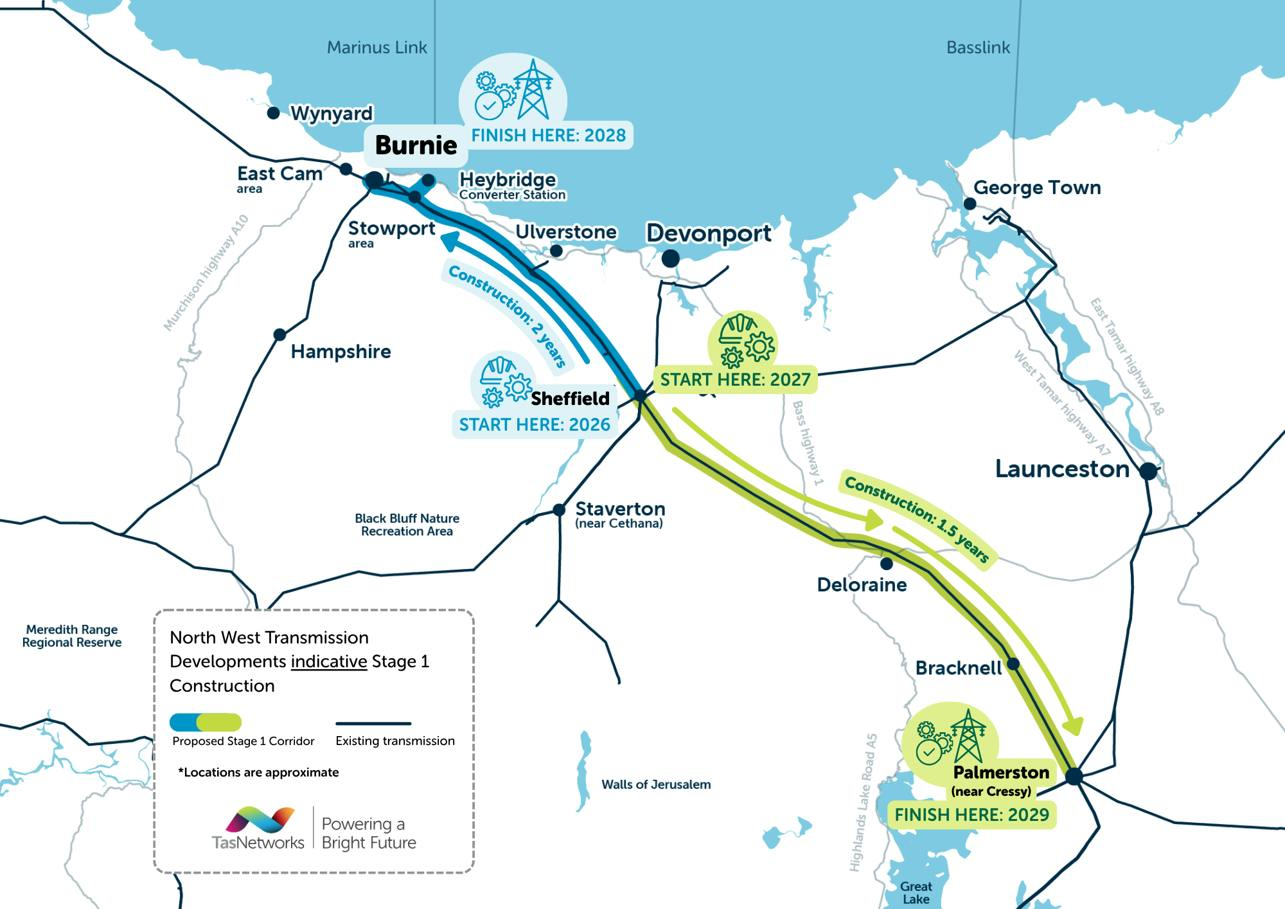
Power transferred through Marinus Link still has to move through the surrounding AC networks, which is why the North West Transmission Developments form part of the same programme. TasNetworks has begun Stage 1 works between Sheffield and Burnie, including access tracks, fencing, tower foundations and activity at Sheffield Substation.
The Tasmanian transmission stage covers around 130km and is also scheduled for service by 2030. Adding a 750MW controllable connection at Heybridge alters power flows across existing lines and substations, so the surrounding network must be capable of carrying the additional import or export without exceeding thermal, voltage or system stability limits.
Construction has also been configured around the possibility of the second 750MW circuit. Stage-one works include site preparation at the converter stations for both stages, together with horizontal directional drilling, conduits and joint pits at selected crossings that would otherwise require civil works to be repeated later.
The same principle applies to route interfaces where open excavation would be difficult or disruptive. Horizontal directional drilling is being used for shore, river and road crossings, allowing ducts to pass beneath obstacles before the cable is installed.
Along the Victorian section, the HVDC system will remain underground between the Bass Strait shore crossing and Hazelwood North rather than moving onto an overhead route. The subsea section will then be installed across Bass Strait and protected within the seabed where ground conditions permit.
Manufacturing of specialist electrical equipment is advancing in parallel with the civil works. Production of HVDC cable and converter technology is due to increase into 2027, while activity will expand at the Heybridge and Hazelwood North converter stations, the Sandy Point shore crossing and along the underground route through Gippsland.
The converter stations bring together valves, converter transformers, switchgear, cooling, control and protection systems. Their control systems must regulate active and reactive power while operating between two AC networks whose instantaneous voltage, frequency and fault conditions are managed independently.
Those interfaces make commissioning a system-wide exercise rather than a simple cable energisation. The converters, subsea and land cables, Tasmanian reinforcement works and Victorian network connection must all operate within the protection and control requirements of the National Electricity Market before commercial transfers begin.
Marinus Link received Australia’s first offshore transmission infrastructure licence in September, following separate Commonwealth, Victorian and Tasmanian environmental, planning and heritage processes. The project crosses land, coastal areas, state waters and the Bass Strait marine environment, requiring multiple approval regimes before construction could progress across the complete alignment.
Stage one is scheduled for completion in 2030. The first 750MW circuit will then provide Tasmania with another major electrical connection to Victoria alongside Basslink, while the reinforced north-west Tasmanian network carries the resulting changes in power flow between Heybridge and the wider island system.
Civil works, transmission construction, cable manufacturing and converter delivery are now proceeding in parallel, with testing and commissioning required to bring those separate packages together before the first controlled HVDC transfer across Bass Strait.