IN Brief:
- NKT now expects commercial operation of its expanded Karlskrona cable site to begin in the second quarter of 2027.
- The Swedish expansion adds offshore high voltage cable manufacturing capacity within the company's wider €2 billion investment programme.
- Additional production will support a substantial transmission backlog as European grid and offshore projects increase cable demand.
NKT has brought forward the expected commercial start of its expanded high voltage cable manufacturing capacity at Karlskrona in Sweden, with operation now scheduled to begin during the second quarter of 2027.
The update was issued at NKT’s 2026 Investor Day and moves the expansion slightly ahead of the previous timetable. Karlskrona forms a central part of the company’s wider €2 billion investment programme, which is adding manufacturing and installation capability as NKT works through a large portfolio of transmission projects.
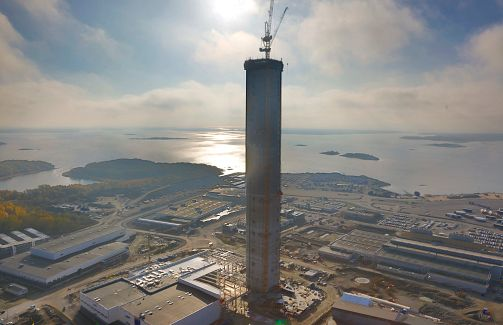
NKT expects the expansion to make Karlskrona the world’s largest offshore power cable factory. The site already produces high voltage AC and DC subsea cable systems for offshore wind and interconnector projects, and the programme adds new end-to-end production capability alongside the existing plant.
A 200 metre third extrusion tower, named NKT Crown, is one of the most visible parts of the project. Extrusion towers support the controlled application of insulation around high voltage cable cores, allowing long lengths to be manufactured with consistent material properties. The surrounding factory and harbour works are intended to increase the volume and size of cable systems that can move through production and onwards to installation vessels.
The additional capacity is being built against an unusually large order position. NKT reported a €13.5 billion Transmission backlog at the end of the first quarter of 2026, driven by projects including Western Isles, Spittal to Peterhead, and Eastern Green Link 3 in Britain. Five projects awarded through a TenneT framework, with an estimated value above €2.5 billion, were not included in that figure.
That order visibility turns factory expansion into project execution infrastructure rather than speculative capacity. HVDC projects can run for years from contract award through engineering, cable manufacture, marine installation, jointing, testing, and commissioning. Production slots therefore have to be coordinated across several programmes well before the electricity link itself enters service.
NKT’s first half update showed the wider investment programme progressing alongside Karlskrona. Additional medium voltage capacity in Denmark had been completed, while expansion in Portugal, additional high voltage capacity in Cologne, the Karlskrona project, and the second cable laying vessel NKT Eleonora were all moving through their respective programmes. Karlskrona, Cologne, and NKT Eleonora are expected to become operational in 2027.
The company is also broadening the equipment available around permanent transmission systems. During the summer, NKT delivered a reusable 400kV temporary cable system for German transmission operator Amprion, designed to maintain network capacity while substations are rebuilt or reconfigured. The project is smaller than Karlskrona’s long subsea cable programmes, but it reflects the range of cable equipment required as European grids undergo simultaneous reinforcement.
Manufacturing capacity cannot be separated from installation capability. Long subsea cable sections have to be loaded, transported, installed, protected, jointed, and tested on tightly controlled schedules. A delayed production run can move vessel mobilisation and offshore installation, while vessel availability can in turn determine how factory output is sequenced.
NKT’s second cable laying vessel is intended to increase that delivery capacity, with the company stating that NKT Eleonora will be able to transport and install 23,000 tonnes of offshore power cable. The vessel reached the water during the second quarter of 2026 and is moving through final outfitting ahead of its planned 2027 operating start.
The Karlskrona expansion also has a strategic designation under the EU Net-Zero Industry Act, which recognised the project as Europe’s first net-zero strategic project in 2025. The status reflects the role of subsea power cables in offshore generation and interconnection, where limited manufacturing capacity can affect multiple projects across different markets.
High voltage cable production also carries unusually demanding quality requirements because manufacturing defects may not become visible until a cable has been installed offshore. Long production runs, insulation cleanliness, dimensional control, factory testing, handling, storage, and load-out therefore form one continuous quality chain. Additional output only becomes useful if the expanded plant can maintain those controls while throughput increases.
Commercial operation in the second quarter of 2027 will begin the factory’s production ramp rather than mark immediate full utilisation. Machinery, processes, staff, testing, quality systems, harbour operations, and vessel interfaces will all have to settle into repeatable production while contracted projects continue to move through the plant.
NKT’s timetable has therefore shifted from construction progress to operational readiness. The factory is approaching the point at which concrete, machinery, and harbour infrastructure have to become dependable cable output, with the transmission backlog already waiting behind it.