IN Brief:
- Big Fish provides 227MW of solar capacity across approximately 400 hectares near Catania, Sicily.
- Amazon has contracted 156MW of the project through a power purchase agreement.
- Around half of the site remains in agricultural use, with panels installed up to three metres above ground.
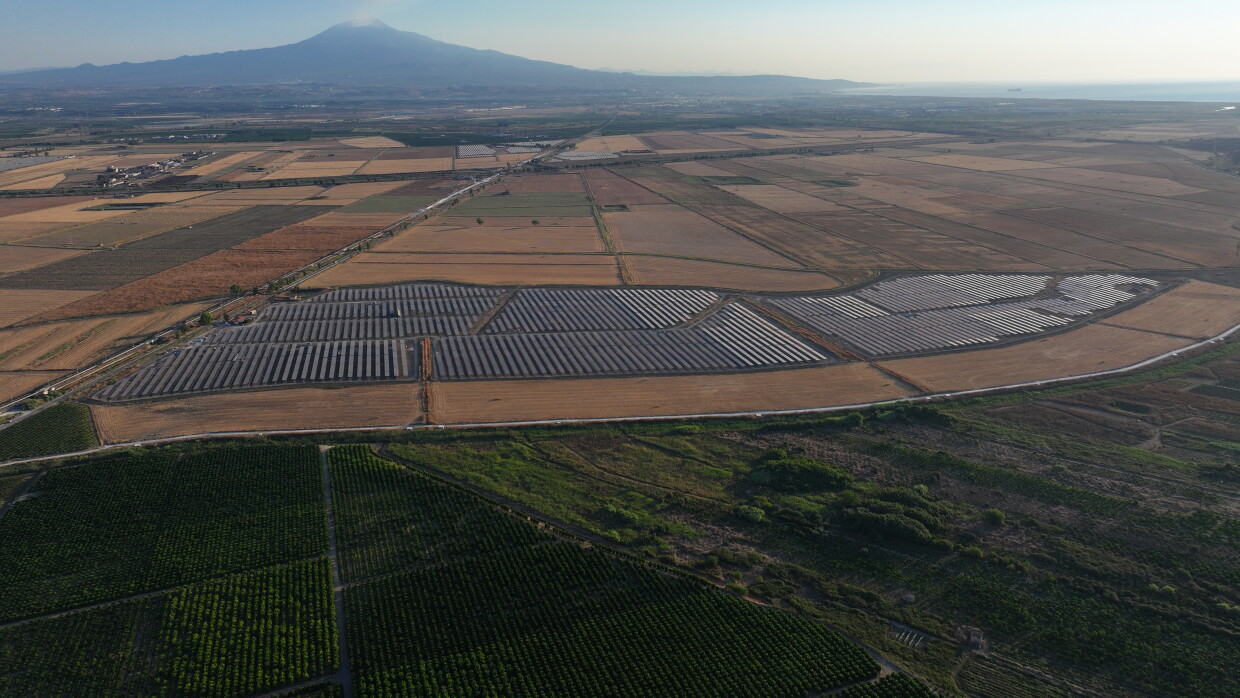
Nadara has completed the 227MW Big Fish agrivoltaic project in Sicily, bringing one of Italy’s larger combinations of solar generation and continued agricultural land use into operation.
The development is located around 40km from Mount Etna across the municipalities of Catania, Lentini and Motta Sant’Anastasia. It covers approximately 400 hectares divided into 15 areas and was built over 12 months, with more than 900 workers involved during construction.
Amazon has signed a power purchase agreement covering 156MW of the project’s capacity. The agreement provides a contracted route to market for a substantial share of Big Fish’s output while leaving the remainder of the 227MW plant under the project’s wider commercial arrangements.
The photovoltaic equipment has been designed around continued agricultural activity rather than removing farming from the site entirely. Around half of the overall area remains dedicated to agriculture, with cultivation continuing beneath and around the generating infrastructure.
Solar modules have been installed at heights of up to three metres where required to maintain access and cultivation. The agricultural design was developed with the Department of Agriculture, Food and Environment at the University of Catania, while farmers who previously worked the land continue to manage cultivation at the site.
Combining farming with a generating plant changes the layout constraints compared with a conventional ground mounted solar development. Module rows, mounting structures, access routes, cable runs and maintenance areas must accommodate agricultural equipment while retaining the electrical clearances, structural integrity and operating access required by the solar plant.
Fourteen irrigation wells have either been constructed or restored as part of the agricultural infrastructure. The site also incorporates beehives expected to produce around 4.5 tonnes of honey annually, adding another land-use activity alongside the principal functions of electricity generation and farming.
Big Fish also introduces a sizeable block of inverter connected generation to the Sicilian electricity system. Nadara’s project material identifies the Pantano d’Arci area as the connection point through Terna’s high voltage network, placing the development within the broader transmission infrastructure required to absorb new renewable output on the island.
Connection engineering is a substantial part of a plant at this scale. Hundreds of megawatts of photovoltaic generation require coordinated transformers, protection, controls and reactive power capability before export can begin. Plant controllers must keep the installation within the operating conditions set by the network operator as solar output changes throughout the day.
The agricultural use introduces another operating layer over the project’s life. Vegetation management, drainage, irrigation and the movement of machinery have to coexist with maintenance access to modules, inverters, cables and other electrical equipment. Decisions made during layout design therefore affect both farming activity and generation performance long after construction has finished.
Agrivoltaic development has gained attention partly because large solar schemes can compete with agricultural land where sites remain productive. Raising modules and adapting row layouts can preserve farming activity, although the approach introduces structural, access and operating requirements that have to be resolved for the conditions of each project.
Big Fish puts that model into operation at a scale well beyond a small demonstration site. The challenge now shifts from construction to the management of a working power station and agricultural area, with plant availability, grid compliance and land use continuing in parallel.
Nadara and Amazon have also associated the project with measures for neighbouring municipalities. Local authorities are expected to receive at least €17.25 million in services and funding over the project’s operating life, covering measures including energy efficiency work, public infrastructure improvements, monitoring systems for municipal buildings and electric vehicles for local administrations.
Plans also include the planting of 38,000 trees and maintenance work along 2.5km of public waterways. Those measures sit around the central commercial structure of the 227MW generating asset, its high voltage grid connection and the 156MW Amazon power purchase agreement.
With construction complete, the project will now be judged by operating output rather than installed hardware. The interaction between farming, maintenance and photovoltaic performance will provide a practical measure of how a large agrivoltaic scheme performs once the construction programme has left the site.