IN Brief:
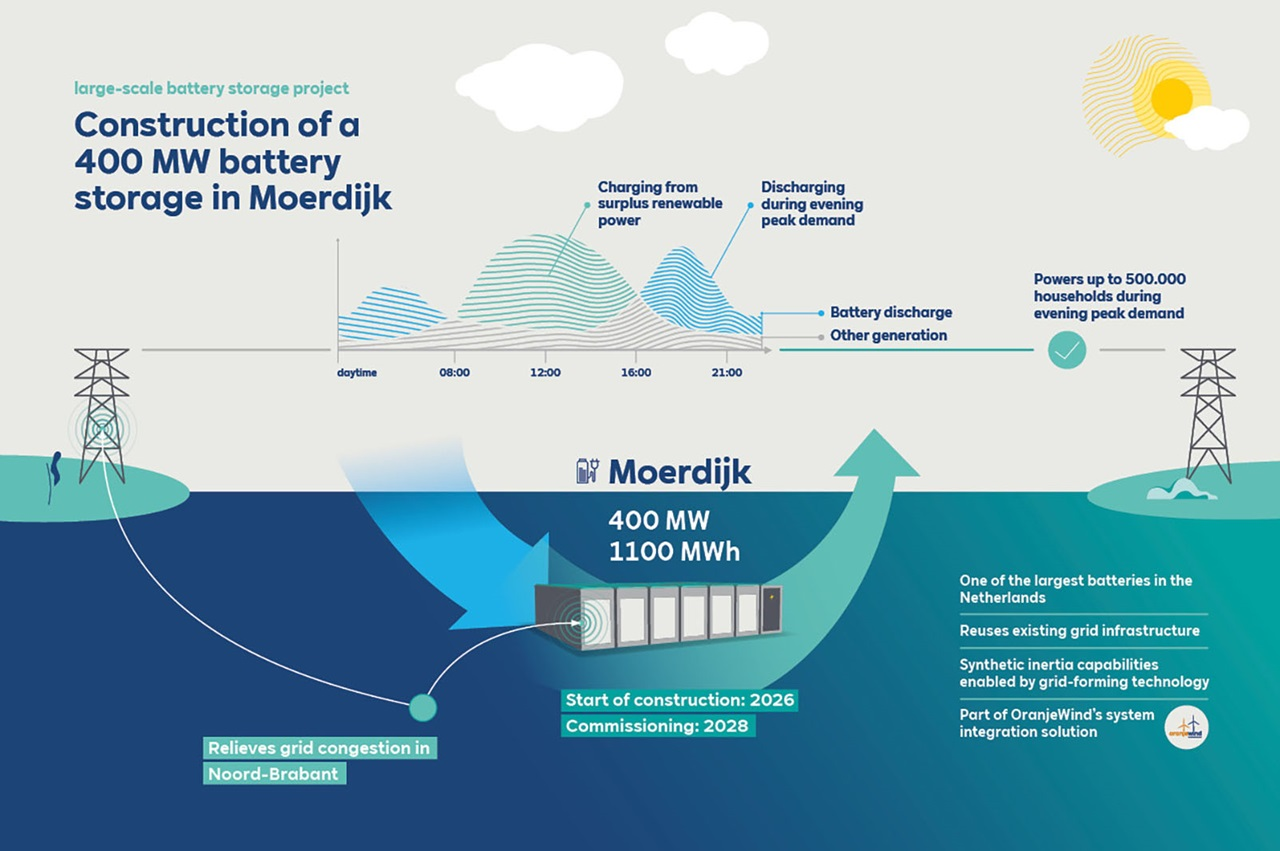
- RWE will build a 400MW/1,100MWh lithium-ion battery using 208 containers at its Moerdijk power station.
- The battery will connect through existing site infrastructure and operate under TenneT capacity steering agreements to relieve congestion.
- Commissioning is planned for Q2 2028, with the project also supporting integration of the 795MW OranjeWind offshore wind farm.
RWE has taken a final investment decision on a 400MW/1,100MWh battery energy storage system at its Moerdijk power station in the Netherlands, with commissioning scheduled for the second quarter of 2028.
The lithium-ion installation will use 208 battery containers and is designed to deliver its full output for almost three hours. It will connect through existing infrastructure at the Moerdijk site, giving the project access to an established high-voltage connection rather than requiring an entirely new grid interface.
Its operating role extends beyond electricity trading. RWE says the battery will work under capacity steering agreements with Dutch transmission system operator TenneT, allowing charging and discharging to be coordinated around network congestion in Noord-Brabant. TenneT and regional distribution operator Enexis will assess the project’s effect as part of their next congestion management review.
The system will also be capable of providing advanced grid services including instantaneous reserve. That combination gives the plant several possible operating modes, from shifting electricity between periods of different market value to responding rapidly when the wider system requires additional flexibility.
Moerdijk already hosts a 7.5MW/11MWh RWE battery that provides synthetic inertia, while another 35MW/41MWh system operates at the company’s Eemshaven power station. The new project takes those services to a different scale, combining a much larger energy reservoir with an existing generation site and transmission connection.
RWE also intends the 1.1GWh battery to support its 795MW OranjeWind offshore wind project, developed with TotalEnergies. OranjeWind entered offshore foundation installation earlier this month, while associated flexibility infrastructure is being developed onshore to manage periods when wind production and demand diverge.
Battery projects used for congestion management operate under a different set of constraints from assets driven principally by wholesale price spreads. A system may be prevented from charging when local imports are already stressing the network or asked to discharge when additional local supply can reduce power flows through constrained equipment. Connection agreements, control systems, dispatch rules, and market access therefore influence the value of the project alongside its power and energy ratings.
At 400MW, Moerdijk will be able to alter network flows quickly enough to have a material transmission-level effect. Its 1,100MWh capacity gives it close to three hours of duration at maximum power, allowing it to sustain a response across longer congestion periods than a battery designed primarily for short-duration frequency services.
The existing power station location should simplify some parts of delivery. High-capacity grid infrastructure, industrial access, operational land, and established electrical systems are already present, although the project will still require battery procurement, civil works, transformers, power conversion equipment, protection, communications, thermal management, and fire protection before the system can be energised.
Control integration will be equally important. The battery will need to reconcile TenneT instructions, reserve commitments, state-of-charge limits, market positions, equipment availability, and battery degradation constraints. A dispatch decision that is attractive commercially may not be permissible if it conflicts with a congestion-management requirement or leaves insufficient energy available for a contracted service.
Dutch grid congestion has increasingly affected both generation and electricity demand, with connection queues emerging in several regions. Storage does not replace transmission reinforcement where sustained network capacity is insufficient, but it can move demand and generation away from the periods that set local peaks and make better use of infrastructure that is constrained only during parts of the day.
The Moerdijk battery will operate within that gap between long-term network reinforcement and short-term system flexibility. Its role under capacity steering gives the project a direct operational connection to congestion relief rather than leaving its charging schedule entirely to wholesale-market signals.
RWE says it currently operates around 1.7GW of battery storage globally, with a further 3GW under construction. The Moerdijk development adds one of its larger European systems and places another major storage asset alongside conventional generation and existing high-voltage infrastructure.
Construction now has to convert the investment decision into an operating 400MW plant by Q2 2028. The defining performance measure will be how effectively its 1.1GWh of stored energy can be coordinated with TenneT’s network requirements while supporting OranjeWind and other system services without compromising battery availability or lifetime.