IN Brief:
- Volvo’s planned Mariestad energy park will initially provide around 70MW/260MWh of battery storage.
- Volvo Energy equipment will support regional grid flexibility alongside a full-scale technology test environment.
- Operation is expected during 2027, while Volvo’s proposed nearby battery-cell plant is scheduled for production after 2030.
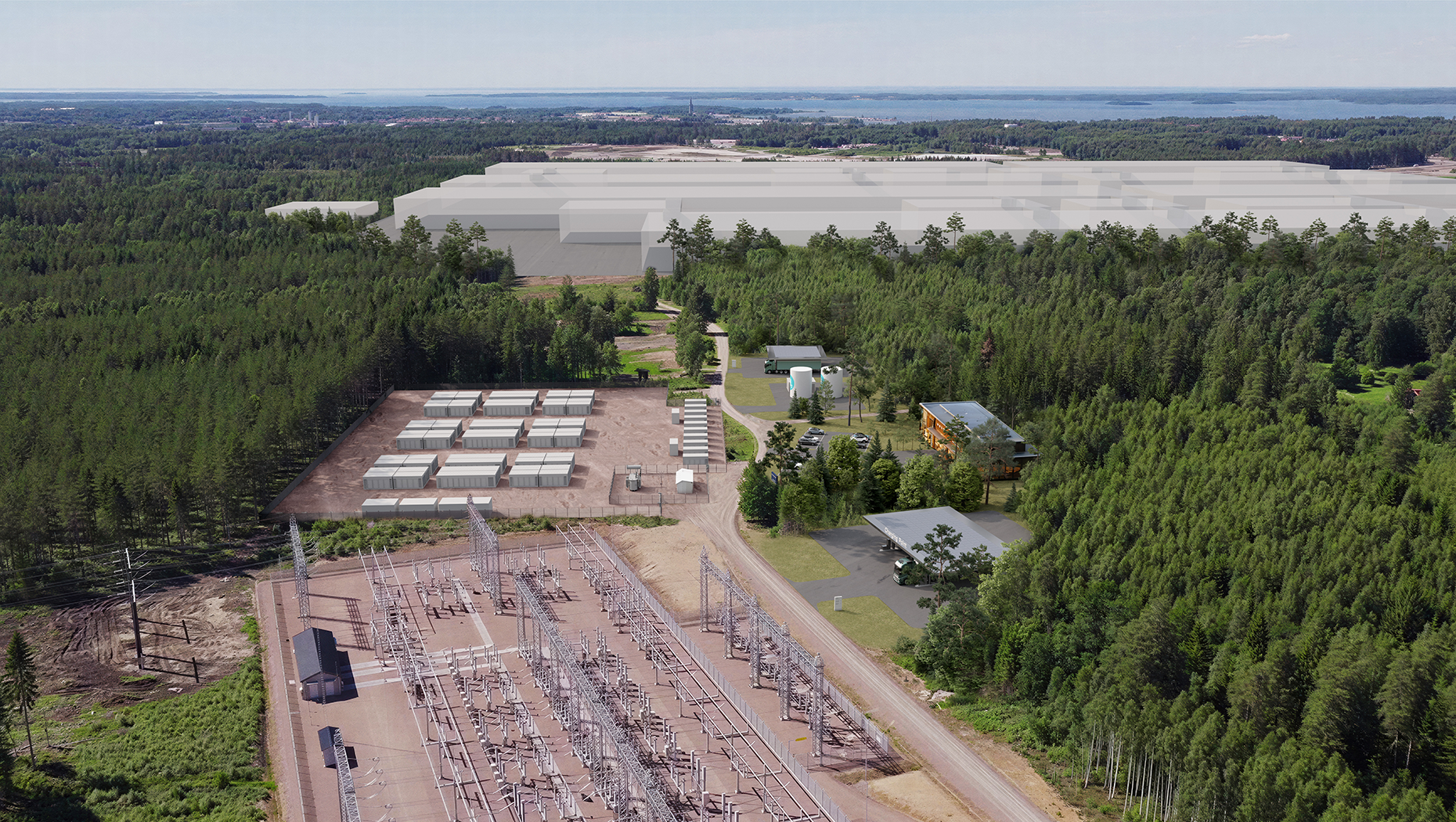
Volvo Group plans to develop a 70MW/260MWh battery energy park at Mariestad in Sweden, combining grid-scale electricity storage with a test environment intended to support development and demonstration of new energy technologies.
The project is planned close to Volvo’s intended battery-cell manufacturing site and will be developed in stages. Its first phase will use Volvo Battery Energy Storage Systems supplied through Volvo Energy, creating a substantial stationary-storage installation within an existing Swedish industrial cluster.
At the initial ratings, the battery would provide approximately 3.7 hours of stored energy at maximum discharge power. Its eventual market role will depend on grid connection conditions, control configuration, reserve-market qualification, and the commercial strategy used to determine when the system charges and discharges.
Volvo expects the battery to support grid stability in a region where the group already has substantial manufacturing activity, including its powertrain operation at Skövde. The energy park is therefore being developed alongside industrial electrical demand rather than as an isolated merchant-storage project.
The company expects the Mariestad facility to become operational during 2027. Stored electricity will be capable of flowing back into the local network when required, allowing the asset to provide flexibility while absorbing power during periods when system and market conditions support charging.
The second phase of the concept will develop the site as a real-scale demonstration and testing environment for energy solutions that could later be offered commercially. Operating equipment under real network conditions can expose control systems and hardware to market signals, cycling, connection limits, and operational events that cannot be reproduced completely in a laboratory.
Stationary storage also sits close to the wider electrification challenges facing heavy transport and industrial machinery. Battery-electric trucks and construction equipment require charging infrastructure, site electrical capacity, energy management, and increasingly sophisticated controls around when large electrical loads are permitted to operate.
A grid battery and a vehicle battery remain different engineering products. Their duty cycles, packaging, thermal management, protection, grid interfaces, and commercial objectives differ substantially, but work across cells, battery management, power conversion, charging, control, and lifecycle management can still create useful technical overlap.
Volvo’s involvement gives Mariestad an industrial-energy dimension that goes beyond conventional storage development. The group can test how stationary batteries interact with manufacturing demand and charging requirements while building operational experience in an asset class closely connected to the electrification of its principal products.
Sweden’s transmission system is simultaneously preparing for increased electricity consumption from industrial electrification, transport, and digital infrastructure. Svenska kraftnät’s long-term analysis points to the need for new generation, expanded networks, and greater flexibility if higher demand is to be accommodated without reducing security of supply.
Balancing arrangements across the Nordic system are also changing. Faster and more automated energy markets increase the requirement for assets capable of following dispatch instructions accurately, while batteries can provide several frequency and balancing products once technical qualification has been completed.
Rapid growth in storage does not guarantee permanently high ancillary-service revenues. More batteries competing in the same reserve products can reduce prices and increase the importance of wholesale trading, congestion management, and other forms of value stacking over the life of an asset.
The test environment could therefore prove as useful commercially as technically. Battery controls have to determine which service is worth providing, how much energy should be retained, and how frequently the cells should cycle, with each decision affecting both immediate revenue and long-term degradation.
The Mariestad energy park will become operational several years before Volvo’s proposed nearby battery-cell plant is expected to begin production. The manufacturing project is currently scheduled for production after 2030, giving the storage installation an independent role during the intervening years.
Its early operation could also provide practical information about local grid behaviour before much larger industrial loads are added. Storage cannot replace transmission or distribution reinforcement where sustained additional power is required, but it can reshape demand, provide reserve capability, and move energy between periods of lower and higher system utilisation.
Industrial electrification is making the boundary between factory investment and power infrastructure progressively less distinct. Large manufacturing projects depend on secure grid capacity, while batteries, flexible loads, local generation, and energy-management systems increasingly become part of the electrical design surrounding the plant.
Mariestad brings several of those elements together in one programme: stationary storage, an industrial test facility, established manufacturing, and a longer-term battery-cell investment. The first operational test arrives during 2027, when the 70MW/260MWh system is due to begin demonstrating whether the proposed flexibility and development functions work outside the planning documents.