IN Brief:
- Kawasaki has installed its 30MW-class L30A turbine at RWE's Emsland site in Lingen ahead of commissioning.
- The demonstration will test 100% hydrogen firing and continuously variable hydrogen-natural-gas mixtures.
- RWE describes the complete plant as a 34MW installation intended to build operating experience for future hydrogen-fired generation.
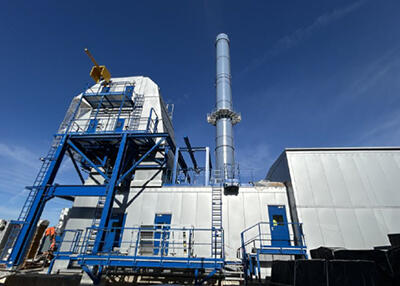
Kawasaki Heavy Industries has completed installation of its 30MW-class L30A gas turbine at RWE’s Emsland power station in Lingen, Germany, moving an industrial-scale hydrogen-to-power demonstration into the commissioning phase.
The turbine was manufactured at Kawasaki’s Akashi works in Japan before being incorporated into the generating package and installed by Kawasaki Gas Turbine Europe. Following commissioning of the turbine and associated equipment, the partners plan to demonstrate operation on 100% hydrogen and on mixtures of hydrogen and natural gas.
Kawasaki uses the 30MW-class designation for the L30A machine, while RWE describes the complete demonstration plant as a 34MW installation. The figures refer to different definitions within the same project rather than competing capacity claims.
Fuel flexibility is central to the programme. Kawasaki says the hydrogen proportion can be varied continuously between zero and 100%, allowing the plant to respond to changing hydrogen availability rather than requiring a full supply of the fuel from its first day of operation. That capability is particularly relevant while production, transport, and storage infrastructure for low-carbon hydrogen remains limited.
The demonstration sits within RWE’s wider Lingen energy hub in Lower Saxony, where electrolysis, conventional generation, and hydrogen infrastructure are being developed on the same industrial site. RWE intends the turbine to build experience in converting green hydrogen back into electricity when wind and solar output is insufficient.
The electricity-to-hydrogen-to-electricity chain carries substantial conversion losses. Electricity is consumed by electrolysers to split water, hydrogen then has to be compressed, stored, or transported, and the gas turbine converts only part of the fuel’s chemical energy back into electrical output. Its potential system role therefore rests on dispatchability and storage duration rather than round-trip efficiency.
Hydrogen can, in principle, be stored for periods much longer than conventional lithium-ion batteries economically serve in most current power markets. That creates a possible route for covering prolonged periods of low renewable output, provided sufficient hydrogen can be produced, stored, and delivered at an acceptable cost.
Combustion engineering remains a substantial technical hurdle. Hydrogen has different flame-speed and ignition characteristics from natural gas, creating issues around flashback, combustion stability, component temperatures, and nitrogen-oxide emissions. A successful demonstration must therefore cover considerably more than achieving a stable flame at one operating point.
Kawasaki’s project will have to establish repeatable starts, stable operation across different loads and fuel ratios, acceptable emissions, reliable controls, and practical maintenance requirements. RWE has previously said the plant will test hydrogen mixtures across the full fuel range, giving engineers an opportunity to examine conditions that may be more representative of early commercial deployment than continuous operation on pure hydrogen alone.
The programme is supported by Japan’s New Energy and Industrial Technology Development Organization. NEDO lists the Lingen work as an international demonstration running from 2023 to 2026, with Kawasaki as project operator, RWE Generation as the German industrial partner, and Germany’s NOW organisation involved on the government side.
RWE’s current Lingen material describes the turbine installation as an industrial-scale 34MW plant capable of operating on up to 100% hydrogen. The utility is also expanding hydrogen production and network infrastructure at the site, providing a test environment in which fuel supply and generation can be examined together.
That operating context will be as important as the turbine itself. Hydrogen handling affects pipework, detection, ventilation, emergency shutdown systems, operating procedures, and maintenance regimes, while the generating plant still has to satisfy the protection, controls, and grid requirements expected of a conventional power station.
Completing installation removes a major construction step but leaves the more demanding evidence to come. Commissioning and trial operation will determine whether variable hydrogen firing can be treated as a repeatable power-station operating task at this scale, rather than a combustion result demonstrated under narrowly controlled conditions.