IN Brief:
- RWE and TotalEnergies have started monopile installation for the 795MW OranjeWind offshore wind farm, 53km from IJmuiden.
- Sif is supplying 53 transition-piece-less foundations measuring approximately 90m long and 8m in diameter.
- OranjeWind is being developed alongside batteries, electrolysers, e-boilers, and flexible demand as a Dutch system-integration project.
RWE and TotalEnergies have installed the first monopile foundation at the 795MW OranjeWind offshore wind farm in the Dutch North Sea, starting the main offshore construction phase for a project intended to combine large-scale wind generation with flexible demand and storage.
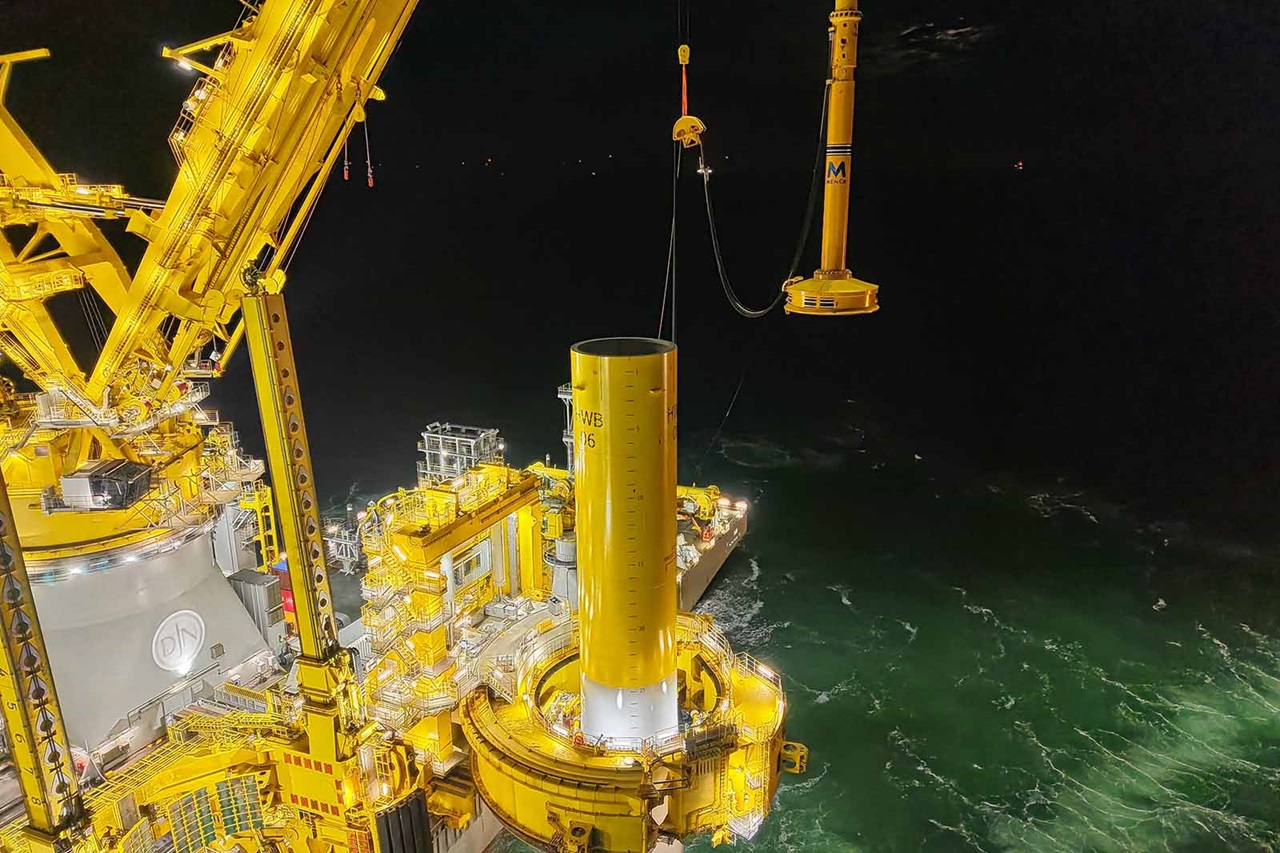
The first foundation was transported from Sif’s Maasvlakte terminal near Rotterdam to the project site, around 53km off IJmuiden, and installed by Jan De Nul’s Les Alizés. Sif is supplying all 53 monopiles, with the foundation campaign expected to finish by early 2027.
Each monopile is approximately 90m long and 8m in diameter. OranjeWind is using a transition-piece-less design, allowing the turbine tower to be bolted directly to a flange at the top of the monopile rather than relying on a separate transition structure.
The approach reduces the amount of steel used in the foundation system, although it does not remove the need for secondary structures. Main access platforms, internal cassettes, and boat landings will be attached directly to the monopiles during a separate installation campaign.
Les Alizés uses dynamic positioning and a 5,000-tonne crane with a maximum lifting height of 160m. The foundations are driven into the seabed using a hydraulic impact hammer, making vessel positioning, lift control, geotechnical conditions, and installation-load monitoring central to the work.
Underwater noise is being managed with a bubble-curtain system during piling. Compressed air creates a ring of bubbles around the installation area to absorb and reflect part of the acoustic energy generated by the hammer, while measurements outside the curtain are used to check compliance with applicable limits.
The first monopile moves OranjeWind into a more equipment-intensive phase after several years of planning and contracting. Inter-array cable installation is scheduled towards the end of 2026, followed by installation of 53 Vestas V236 turbines during 2027. Full commissioning is expected in early 2028.
At 15MW per turbine, the 53-machine array gives the project its 795MW installed capacity. RWE says annual generation should be sufficient to supply the equivalent electricity consumption of around one million Dutch households.
The project is more interesting electrically than its offshore construction sequence alone suggests. RWE and TotalEnergies have positioned OranjeWind as a system-integration project in which wind generation is developed alongside flexible consumption and storage rather than connected as an isolated source of variable power.
RWE has already commissioned a 35MW/41MWh battery at Eemshaven as part of that programme. TotalEnergies plans to use its share of OranjeWind production to support around 350MW of electrolyser projects, while the broader integration concept also includes e-boilers and smart charging.
The common objective is to shift more demand towards periods of strong renewable output. Offshore wind production varies with weather, while conventional electricity demand does not normally follow the same profile. Batteries can absorb and release energy across shorter periods, electrolysers can turn electricity into hydrogen, and controllable thermal or transport loads can provide additional flexibility.
That does not remove the need for transmission capacity. OranjeWind still depends on offshore collection systems, export infrastructure, onshore substations, protection, control, and sufficient network capacity to move hundreds of megawatts reliably. Flexible demand changes when electricity is consumed; it does not make the underlying grid optional.
The control problem is also more complicated than simply switching flexible assets on whenever the wind strengthens. Batteries have state-of-charge and degradation limits, electrolysers have industrial operating constraints, and vehicle charging depends on customer behaviour. Coordinating those assets requires forecasting, market signals, communications, and control systems capable of responding to both system conditions and commercial priorities.
OranjeWind will provide a sizeable practical test of that approach because the flexible assets are being developed around a utility-scale offshore project rather than as a small demonstration. The success of the model will depend on whether the generation and demand-side investments can be coordinated commercially and technically once the wind farm begins operating.
Before that integration question can be tested, the physical project has to be built. With 52 monopiles still to install, the immediate engineering work remains familiar offshore construction: heavy lifts, seabed piling, marine logistics, secondary steel, cables, and turbines. Commissioning will also require the export system, array cables, protection, and turbine controls to perform as one coordinated electrical installation.
The more unusual part comes later, when the 795MW wind farm has to operate as one component within a deliberately more flexible Dutch electricity system.