IN Brief:
- GE Vernova has launched the GL316c 420kV live-tank circuit breaker with a 63kA short-circuit rating.
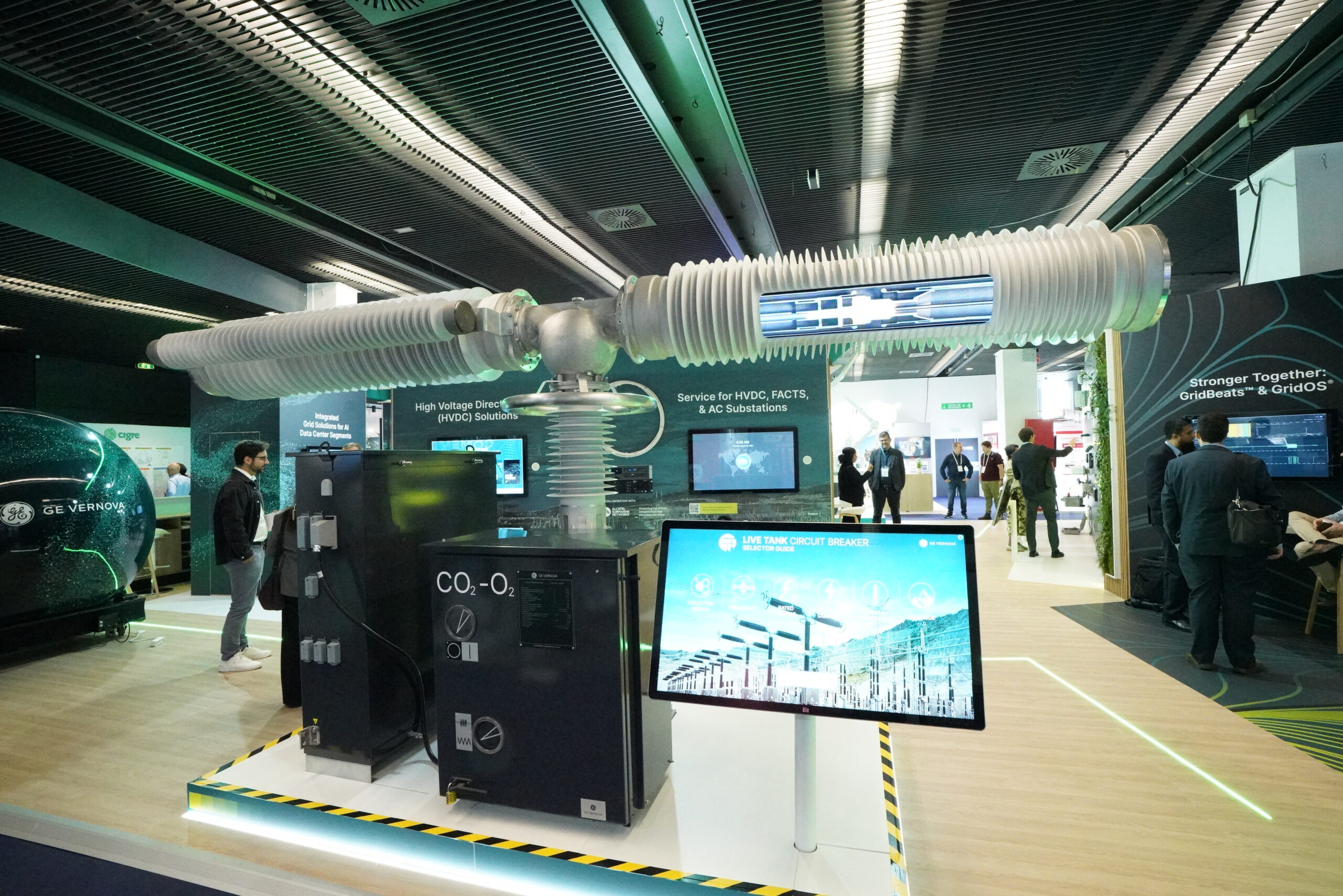
- The breaker uses a CO2/O2 gas mixture instead of SF6 and extends an earlier 50kA design.
- Manufacture is planned at Villeurbanne in France as high-voltage equipment moves towards lower-impact insulation technologies.
GE Vernova has launched a 420kV live-tank circuit breaker rated to interrupt short-circuit currents of up to 63kA, extending its SF6-free high-voltage equipment range into more demanding transmission applications.
The GL316c uses a carbon-dioxide and oxygen gas mixture in place of sulphur hexafluoride. GE Vernova unveiled a full-scale model at CIGRE Paris 2026 and plans to manufacture the equipment at its Villeurbanne facility in France.
The 63kA rating extends a 420kV, 50kA design developed through the EU-supported LIFE SF6-free HV Breaker project. Additional engineering and testing have increased the short-circuit breaking capability for networks where prospective fault currents exceed the duty of the earlier configuration.
At transmission voltage, that rating is more than a specification-sheet figure. Circuit breakers must isolate faults quickly enough to protect equipment and preserve the stability of the remaining system, while their insulation has to withstand the electrical stresses associated with normal operation and switching.
Higher fault duty widens the application range
Prospective fault current can rise where networks become more heavily interconnected or where substantial generation and transmission capacity is concentrated around a substation. Reinforcement can therefore increase the duty imposed on switchgear even where the breaker itself is not part of the newly added circuit.
A 63kA device gives planners more scope at locations where a lower-rated breaker could become a design constraint. The required rating still depends on detailed network studies, substation topology, protection philosophy, and expected future system configuration, but extending the SF6-free platform broadens the range of projects for which it can be considered.
The environmental case runs in parallel. SF6 has been used extensively in high-voltage equipment because of its dielectric and arc-quenching performance, but its high global-warming potential has pushed European utilities and manufacturers towards alternative gases and interruption technologies.
Different suppliers are taking different engineering routes. A separate 245kV development from Siemens Energy combines clean-air insulation with vacuum interruption, while GE Vernova’s 420kV design retains a gas-based interruption system using CO2 and O2.
The distinction is less important than the performance obligation. Any replacement for established SF6 equipment still has to satisfy utilities on interruption capability, dielectric strength, mechanical endurance, leakage, maintenance, installation practice, and operating reliability over a service life measured in decades.
Utility adoption will depend on lifecycle evidence
GE Vernova has moved the platform from an EU-supported 50kA development into a 63kA product planned for manufacture, narrowing the gap between demonstration hardware and routine procurement.
The next stage will depend on orders, type-test evidence, installation experience, and operating references. Transmission-system operators are cautious adopters because circuit breakers may operate relatively infrequently compared with lower-voltage switching devices, yet every commanded trip has to perform correctly under potentially severe fault conditions.
Changing insulation technology also affects more than the equipment bay. Utilities may need revised gas-handling procedures, maintenance tools, technician training, spares, documentation, and asset-management practices, particularly where legacy SF6 equipment remains in service alongside newer alternatives.
Manufacturing the GL316c at Villeurbanne gives the platform a European industrial base as network investment increases demand for high-voltage equipment. New renewable connections, interconnectors, large industrial loads, and reinforcement programmes all require substations containing breakers, disconnectors, measurement equipment, protection systems, controls, and associated civil and electrical works.
That demand is arriving while utilities are simultaneously changing technology standards. Procurement teams therefore have to secure more equipment while narrowing the future role of one of the industry’s established insulating gases.
Whole-life performance will ultimately decide whether the transition succeeds. Avoiding SF6 can reduce future requirements around leakage monitoring, recovery, recycling, and end-of-life handling, but alternative equipment still has to demonstrate stable sealing, predictable maintenance intervals, and acceptable lifecycle cost.
The GL316c now combines a 420kV rating, 63kA interruption duty, and a lower-impact gas mixture in a product intended for commercial manufacture. If field deployments confirm the expected reliability, the more significant consequence will be that SF6-free technology becomes viable not only at the edge of transmission networks, but at substations with some of their highest fault duties.