IN Brief:
- Cummins has been selected for what it describes as its largest BESS deployment to date at a major US data-centre project.
- The storage system is intended to smooth AI-driven demand changes, reduce load oscillations, and improve ride-through at the utility connection.
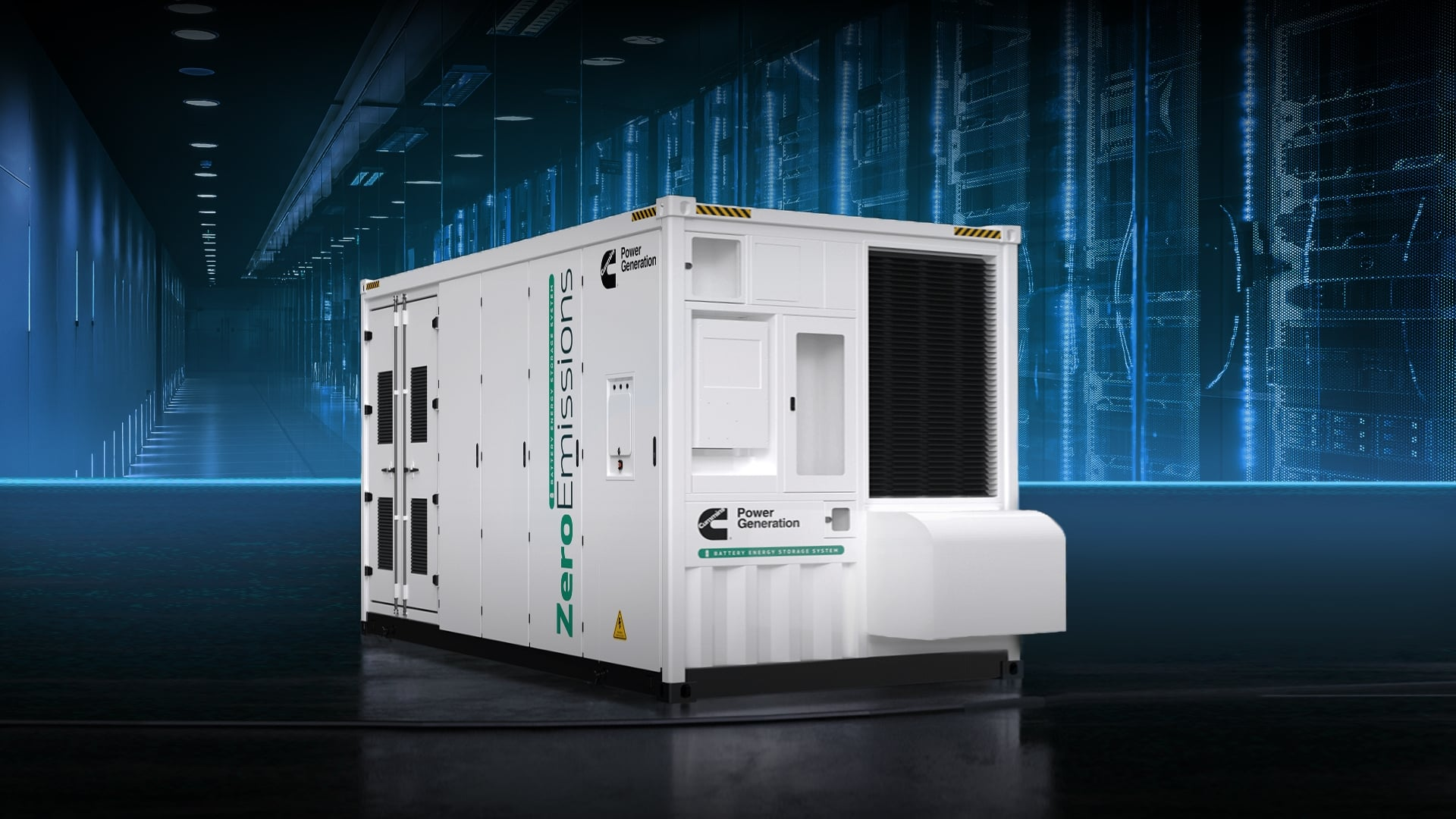
- Cummins' published data-centre BESS specification includes 5MWh nominal capacity, LFP chemistry, liquid cooling, and integration with multiple PCS and EMS platforms.
Cummins has been selected to supply battery energy storage systems for a large US data-centre project, with the installation intended to manage rapid AI-driven changes in electricity demand, reduce load oscillations, and improve ride-through performance at the utility interconnection. Cummins describes the contract as its largest BESS deployment to date, although the customer, location, and total project MW and MWh ratings have not been disclosed.
The application puts the battery directly into the data centre’s power-management architecture rather than treating storage principally as a renewable-energy or electricity-price asset. AI computing clusters can create rapid changes in demand as processors move between workloads, and those fluctuations can be difficult for the surrounding electrical system to absorb if they are transferred directly to the utility connection.
Cummins says the BESS will be able to charge and discharge rapidly to reduce demand spikes, improve power quality, and maintain a more stable load profile at the point of interconnection. In that role, the battery acts as an electrical buffer between a highly dynamic computing load and a network that generally benefits from more predictable changes in demand.
The engineering problem differs from conventional peak shaving. A data centre may have a high continuous base load while individual computing clusters change demand quickly, meaning the storage system needs sufficient power-conversion capability and sufficiently fast controls to follow short-duration changes without introducing instability of its own. State of charge then has to be managed so the battery remains available when the next significant load transition occurs.
Cummins has not disclosed the total storage capacity being installed, so its published BESS product specification should not be treated as the rating of the complete project. The company’s data-centre offering lists 5MWh nominal capacity, lithium iron phosphate chemistry, liquid cooling, and a flexible DC architecture compatible with multiple power-conversion and energy-management platforms.
Lithium iron phosphate is well established in stationary storage applications, where cycle life, thermal behaviour, safety, energy density, and cost have to be balanced against the space available. Liquid cooling provides more active temperature management across cells and modules, helping to limit thermal variation during repeated charging and discharging.
The electrical interface is at least as important as the battery chemistry. Power-conversion equipment determines how quickly the storage system can import or export AC power, while the energy-management system coordinates that capability against utility limits, data-centre demand, generator availability, battery state of charge, and site operating priorities.
Data centres already employ layered resilience architectures involving utility feeds, switchgear, uninterruptible power supplies, standby generators, and transfer systems. A utility-scale BESS introduces another controllable layer, but one capable of operating during normal conditions rather than remaining idle until a loss of supply occurs.
That distinction makes storage useful for rapid load management. Diesel or gas generator sets can provide long-duration resilience where fuel is available, but rotating plant is not normally intended to follow second-by-second changes in computing demand throughout routine operation. Battery inverters can react much faster and without repeatedly starting generation equipment.
Cummins is also positioning its BESS technology for integration with diesel and natural-gas generators and for bridge-to-grid applications. That can be useful where a data centre is being developed faster than permanent utility reinforcement, although storage does not remove the underlying energy requirement. A battery can buffer power and reshape demand, but sustained operation still requires sufficient electricity from the network, on-site generation, or another energy source.
The same limitation applies when batteries are used to manage grid constraints. A high MW rating can suppress a short demand spike even where the stored energy capacity is comparatively modest, while a prolonged utility shortfall requires much greater MWh capacity. Project design therefore has to separate power-quality and load-ramping requirements from the duration needed for genuine backup or extended bridge-to-grid operation.
Cummins lists a range of safety and interconnection standards for its data-centre BESS offering, including UL 9540A, UL 9540, UL 1973, NFPA 855, IEEE 1547, and UL 1741 SA/SB. Compliance establishes a product-level framework, but each deployment still requires site-specific protection studies, controls integration, fault analysis, commissioning, and coordination with the utility.
That work becomes more significant as individual data-centre campuses reach electrical demand measured in hundreds of megawatts. Large step changes in demand are no longer purely an internal facilities problem if they are visible at the transmission or distribution connection. Utilities increasingly have to consider how quickly those loads can ramp and what behaviour is expected during voltage or frequency disturbances.
Storage gives developers a means of shaping that behaviour rather than asking the grid to follow every computing transition directly. The battery can absorb part of a rapid reduction in site demand or supply part of an equally rapid increase, giving the utility-side load a smoother trajectory while other electrical resources respond.
The control strategy will determine how useful that capability becomes. The operator has to maintain enough energy and inverter headroom for load-management duties while preserving battery life and accommodating maintenance. Aggressive cycling can consume usable cell life, so dispatch decisions need to balance electrical performance against degradation rather than simply making the BESS respond whenever demand changes.
Cummins launched its BESS offering in May 2025, and the latest contract moves the technology into what the company says will be its largest deployment so far. More importantly, the duty assigned to the system shows how battery storage is moving deeper into critical-power engineering.
The undisclosed project rating prevents any sensible claim about how much data-centre capacity the battery can support, and that figure should remain open until Cummins or the customer publishes it. The confirmed function is more useful: the BESS is being specified to control how a highly variable AI workload interacts with the utility grid, making power quality, ramp management, and interconnection behaviour part of the data-centre storage case rather than secondary considerations.