
IN Brief:
- Hitachi Energy will invest $300m to expand transformer and component production in Hefei, China.
- The programme includes a new power transformer factory, UHV bushing capacity, and digital tap-changer manufacturing.
- The investment forms part of a $9bn global programme responding to tightening grid-equipment supply chains.
Hitachi Energy is investing $300 million to expand power transformer and component manufacturing in Hefei, Anhui Province, as demand rises for equipment used across transmission, distribution, industrial electrification, and large new electrical loads. The programme includes a new power transformer factory, an ultra-high-voltage bushing facility, and a digital production line for tap changers. It forms part of the company’s wider $9 billion global manufacturing, engineering, research, and partnership investment programme.
The Hefei expansion adds capacity at several points in the transformer value chain rather than simply increasing final assembly space. Large transformers depend on specialist insulation systems, windings, cores, bushings, tap changers, control equipment, and lengthy testing processes, with a shortage in any one area capable of delaying the completed unit. Expanding component output alongside transformer manufacturing therefore addresses both finished-equipment capacity and the parts needed to sustain it.
Hitachi Energy has operated in China for more than four decades and currently has 11 manufacturing sites in the country, supported by engineering, research, consulting, sales, and service operations. The new investment will strengthen that footprint while adding capacity intended for both Chinese demand and the company’s wider global transformer network. For grid-equipment buyers, the distinction matters because the current shortage is international rather than confined to one national market.
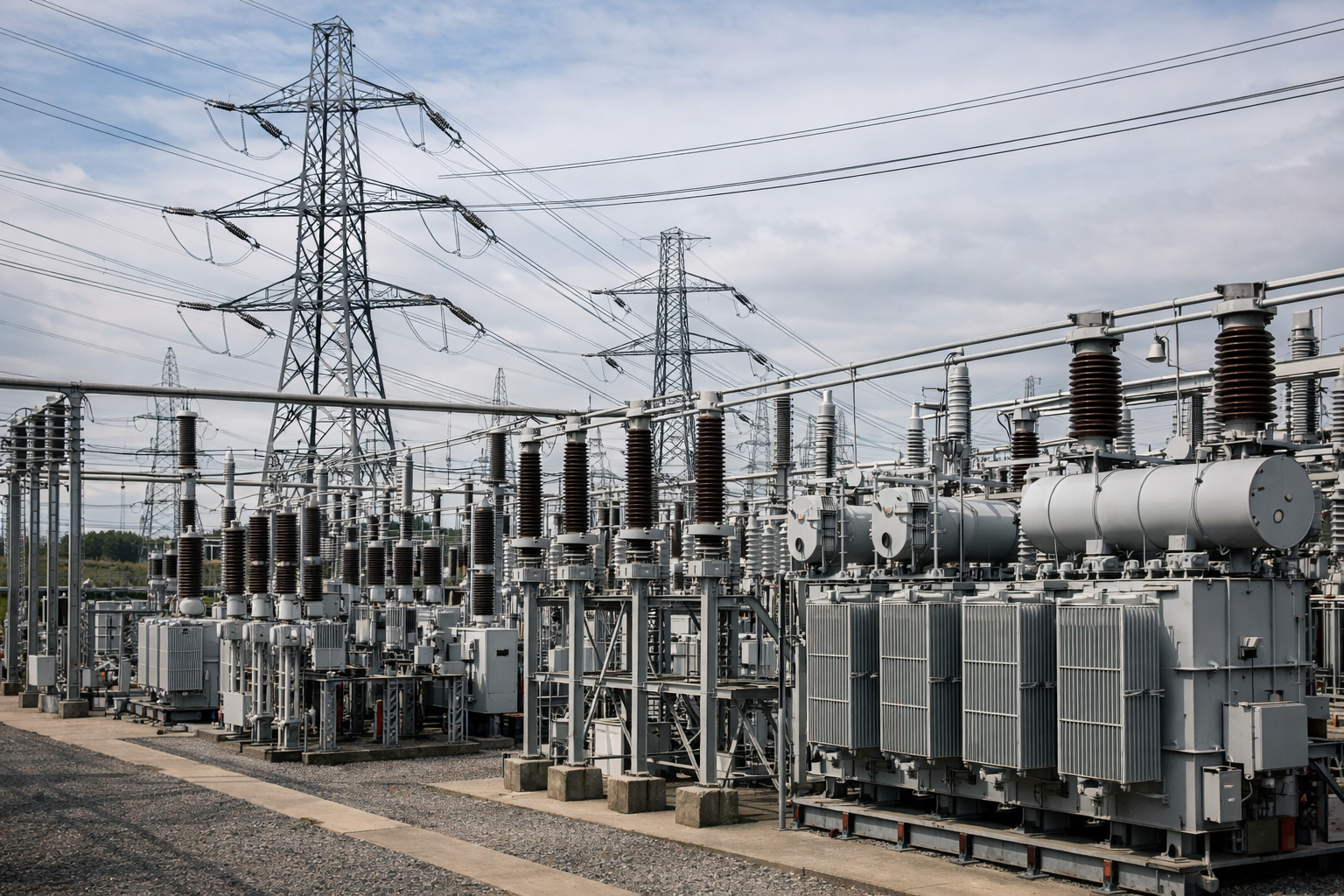
The ultra-high-voltage bushing facility gives the programme particular engineering depth. Bushings allow high-voltage conductors to pass through grounded barriers such as transformer tanks while maintaining electrical insulation and mechanical support. At transmission voltages, dielectric performance, thermal behaviour, partial-discharge characteristics, and mechanical integrity are integral to transformer reliability, so increasing bushing capacity removes one potential constraint from the production chain rather than merely adding another component line.
Tap changers perform a different but equally important role by allowing transformer ratios to be adjusted so voltage can be controlled as network conditions change. Adding digital tap-changer production alongside transformer and bushing capacity reduces dependence on a single expansion point in the supply chain. The planned digital production line also brings greater automation and manufacturing-data control into a component category where repeatability, traceability, and quality assurance directly affect long-term equipment performance.
The investment follows a series of capacity increases by grid-equipment manufacturers responding to unusually strong demand. Transmission reinforcement, renewable connections, energy storage, industrial electrification, transport, and data centres are all competing for transformers, switchgear, cables, and associated components, while the manufacturing cycle for high-voltage equipment remains measured in years rather than months. Siemens’ €300 million German switchgear expansion shows the same pressure appearing elsewhere in the high-voltage supply chain.
Transformer manufacturing is difficult to expand quickly because capacity depends on more than floor area. Plants require specialised winding and assembly equipment, high-voltage test facilities, heavy lifting capability, trained engineering and production staff, qualified suppliers, and enough component output to keep final assembly moving. New lines also have to reach the consistency expected of equipment designed to remain in service for decades, so announcing a factory is only the start of increasing usable supply.
Hitachi Energy’s $9 billion programme is consequently distributed across several regions rather than concentrated in one site. The company has been expanding transformer capacity in North America, Europe, and Asia while also increasing engineering and research resources. Hefei adds another large manufacturing node to that network and increases output in both complete transformers and the specialist components that feed final assembly.
The demand profile is broadening at the same time. Utility reinforcement remains central, but data centres and industrial projects are increasingly large power-system customers in their own right, while renewable generation and storage add further connection requirements. Grid equipment that was once procured mainly against relatively predictable network-development cycles is now being pulled simultaneously by utilities, generation developers, infrastructure operators, and private electrical loads.
That creates a supply-chain constraint with direct consequences for project schedules. A generation plant, storage facility, data centre, or industrial expansion can secure land, finance, and planning consent yet still wait for transformers and high-voltage equipment before energisation. Manufacturing capacity therefore becomes part of connection capacity in practical terms: additional grid projects cannot be delivered at the required rate unless factories can produce the hardware that sits between design approval and commissioning.
Hefei’s expansion addresses that constraint through a mixture of final-equipment and component production. The combination of transformers, UHV bushings, and tap changers gives the investment more supply-chain depth than a single product-line enlargement, while the digital tap-changer line adds a manufacturing-modernisation element. Hitachi Energy now has to convert $300 million of additional capacity into qualified output while customers are already competing for delivery slots — a harder industrial problem than simply adding another factory to the map.

