
IN Brief:
- BESS Lipnice provides 57MW of power and 120MWh of storage following a CZK400 million investment.
- The system combines ČEPS ancillary services with day-ahead and intraday trading under algorithmic control.
- SUAS is already preparing another comparable battery project at the Tisová power station site.
SUAS GROUP and EIF have commissioned the BESS Lipnice battery storage facility near Vintířov in the Sokolov region, bringing a 57MW/120MWh asset into operation after a CZK400 million investment. The system has been operating since the end of July and was formally launched on 18 August, with SUAS identifying it as the largest operational battery storage facility in Czechia. Its 120MWh capacity equates to just over two hours of discharge at the full 57MW nameplate output.
The project is designed around several revenue and system-support functions rather than a single balancing-service contract. BESS Lipnice can provide ancillary services to Czech transmission system operator ČEPS, trade on the day-ahead and intraday electricity markets, and support management of system imbalances. SUAS and EIF intend to aggregate the battery with other generation assets in the Sokolovská uhelná and SUAS portfolio as part of the group’s developing EnergyHub.
That operating model reflects a Czech storage market in which the economics of large batteries are increasingly dependent on stacking different services. EIF has said that lower prices in the balancing-services market make it difficult to justify a project of this scale on technical flexibility alone, so the operator plans to place greater emphasis on day-ahead and intraday arbitrage. Its in-house algorithmic control system will continuously assess available markets and determine where the battery can be dispatched most effectively, while retaining the option to provide balancing services when conditions are attractive.
Software, forecasting, and market access consequently sit alongside cell capacity and converter performance in determining the asset’s operating value. A 120MWh battery can shift substantial volumes of electricity within a trading day, but profitable cycling, price spreads, state of charge, degradation limits, and reserve commitments all compete for the same physical capacity. The control strategy has to decide not simply whether the battery should charge or discharge, but which service offers the strongest return while keeping the asset available for other obligations.
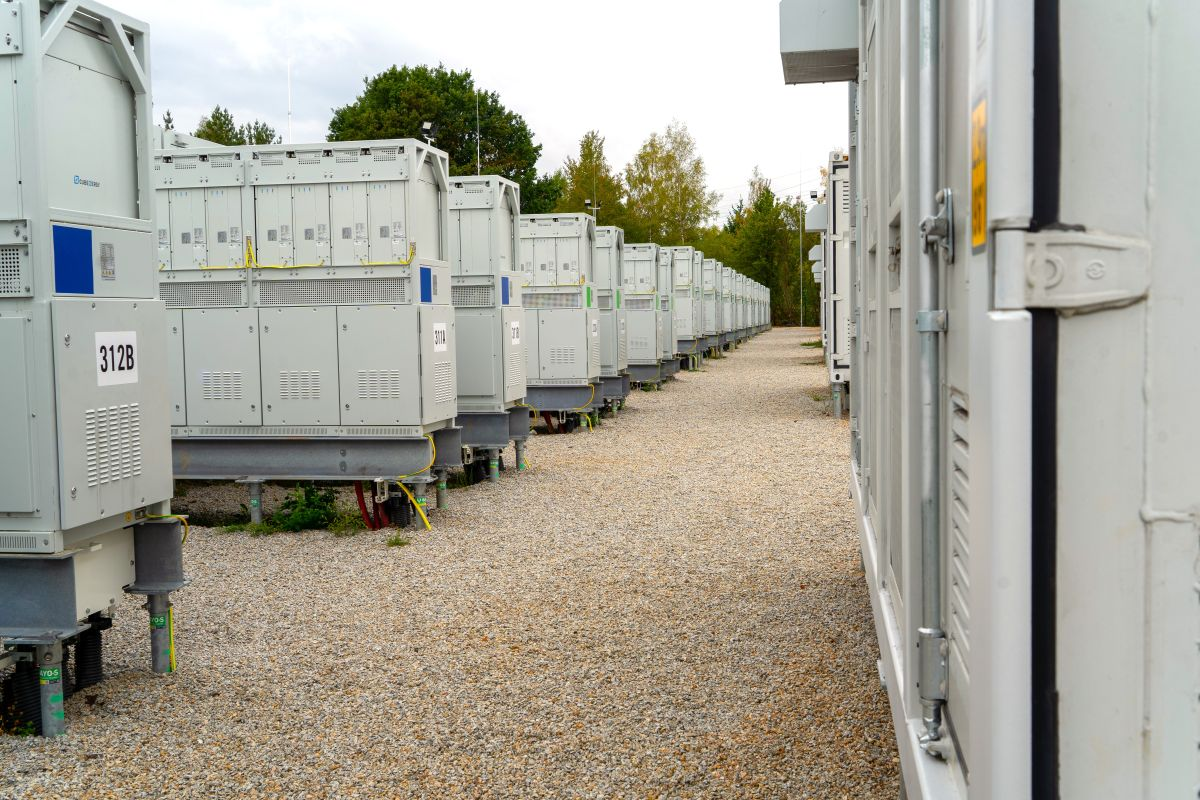
The physical delivery was substantial. General contractor IBG Česko installed technology with a total mass of more than 1,500 tonnes, comprising 144 battery cabinets, 18 power-converter assemblies, and nine transformer skids. The work also covered power and communications cabling, control-system configuration, staged energisation, and commissioning, while the completed facility incorporates continuous monitoring, multi-level protection, automatic shutdown under abnormal conditions, and an integrated fire-protection system.
The final 57MW rating is higher than the 40MW figure publicised when the project was under construction earlier this year, while the planned 120MWh energy capacity has been retained. The operating plant therefore has a higher power-to-energy ratio than originally presented, increasing the capacity available to shorter-duration flexibility markets. That additional power also gives the owners more dispatch options, although higher-output operation still has to be balanced against efficiency, thermal management, and degradation.
BESS Lipnice follows an earlier SUAS and EIF battery project at Královské Poříčí, also in the Sokolov region. That facility entered service with 7.45MWh of storage and was developed principally around grid stability, ancillary services, and intraday trading. Lipnice is a substantial scale-up of an existing operating model, bringing a much larger trading position and more demanding power-electronics, control, and asset-management requirements.
The location also reflects the restructuring of the Sokolov energy landscape. SUAS is developing storage alongside existing generation and new energy assets rather than treating batteries as isolated projects, with the EnergyHub intended to coordinate flexible resources across the group. A further battery system with similar power is already being prepared at the Tisová power station site, suggesting that Lipnice will become part of a wider portfolio rather than remain a standalone asset.
For the Czech power system, the useful test is how that commercial model behaves as more batteries enter the same markets. Fast-response storage can support frequency and balancing requirements, but a growing fleet competing for ancillary-service revenues tends to compress margins. Operators then need access to wholesale-market spreads, accurate dispatch algorithms, and enough operational flexibility to move between services without undermining technical availability.
Lipnice arrives with those functions built into its commercial plan from the outset. The asset combines a two-hour-class battery, substantial converter capacity, algorithmic dispatch, and aggregation with other power assets, giving SUAS and EIF several routes to monetise the same infrastructure. If the planned Tisová project follows, the Sokolov region will also provide an early indication of how multiple large batteries can be coordinated within a mixed generation portfolio as Czech storage capacity expands.

