
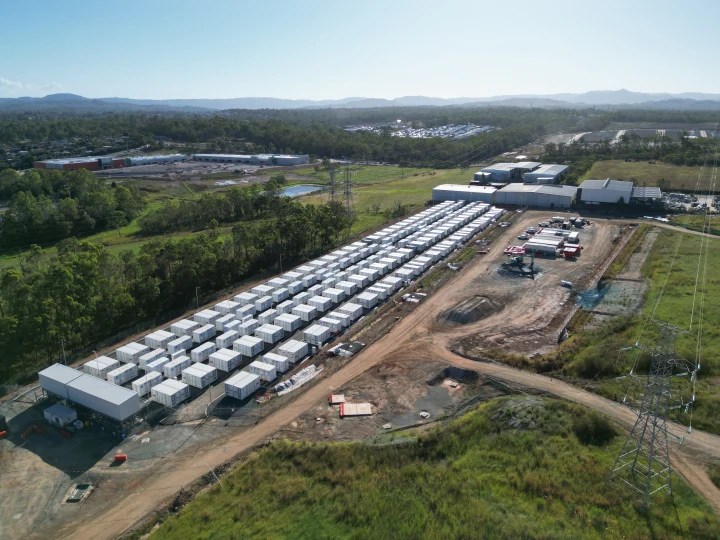
IN Brief:
- Supernode Stage 2 has entered commercial operation, while Stage 3 has secured A$469m in debt financing.
- The first three stages will total 780MW/3,074MWh beside Queensland's South Pine transmission hub.
- CATL supplies EnerC Plus systems for Stages 1 and 2 and will provide TENER S equipment for Stage 3.
Quinbrook Infrastructure Partners has moved its Supernode battery storage campus through two further delivery milestones, with Stage 2 entering commercial operation and Stage 3 reaching financial close on A$469 million of debt financing.
The first three stages of the Brendale project, north of Brisbane, are planned to provide a combined 780MW of power and 3,074MWh of storage capacity. Total project financing across those phases has reached approximately A$1.2 billion, while capacity from all three stages is covered by long-term offtake arrangements.
Supernode sits adjacent to the South Pine substation, a major node in Queensland’s transmission system and the regional reference point for marginal loss factors. The location provides access to approximately 4,000MW of connection capacity, giving the staged battery development a comparatively strong electrical position as it expands.
That connection strength is central to the project rather than a secondary site feature. Large battery systems can shift energy between periods, respond rapidly to changing system conditions, and provide ancillary services, but their usefulness is constrained where transmission capacity cannot accommodate charging and discharge at the required times.
Storage capacity scales alongside grid access
CATL has supplied its EnerC Plus battery systems for Stages 1 and 2 and will provide TENER S equipment for Stage 3. The arrangement keeps one core energy-storage supplier across the first three phases while moving the third stage onto CATL’s newer platform.
The supplier says the project has required design optimisation to fit substantial storage capacity within the available industrial land. EnerC Plus permits back-to-back installation and is specified to reduce the required footprint by approximately 20% compared with the earlier EnerC arrangement.
Its liquid-cooling system is designed to maintain an internal container temperature differential within 5°C, with the equipment designed around a 20-year operating life. Thermal control is a material engineering issue in large battery plants because uneven temperatures can accelerate cell ageing, alter performance, and make it more difficult to maintain predictable usable capacity over repeated charge and discharge cycles.
CATL will also support the asset through a long-term service agreement covering condition monitoring, performance tracking, fault response, and preventive maintenance. Once a utility-scale battery moves into commercial operation, availability and degradation increasingly determine whether the project can deliver the dispatch profile assumed in its contracts and financial model.
Stage 2 has now crossed that threshold. Commercial operation follows construction, energisation, control-system integration, testing, and the commissioning work required before the plant can begin operating against its contracted obligations.
Stage 3 is at an earlier point in the same sequence. Financial close does not represent an operational battery, but it establishes the committed debt structure required to continue procurement and construction. The A$469 million package gives the third phase a funded route through delivery rather than leaving it as another expansion proposal attached to an existing storage site.
The combined 3,074MWh planned across the first three stages is as significant as the 780MW power rating. MW defines how quickly the system can charge or discharge, while MWh describes the amount of energy available before it must recharge. The ratio between those figures shapes whether a battery is best suited to short-duration system response, peak shifting, renewable firming, or longer periods of energy delivery.
Queensland’s changing generation mix increases the value of that flexibility. High levels of rooftop and utility-scale solar can reduce daytime demand seen by conventional generators before evening consumption creates a rapid change in the system requirement. Batteries can absorb part of that daytime surplus and return energy later, provided network capacity and operating rules allow them to respond at the right location.
Supernode’s position beside South Pine therefore gives the project an advantage that additional battery containers alone cannot create. Storage does not remove the need for transmission investment, but a battery connected at a strong network node can operate with fewer of the local export constraints that can limit projects connected to weaker parts of the system.
The first three stages are also commercially supported by long-term offtake arrangements rather than depending entirely on merchant battery revenues. Contracted capacity can reduce exposure to volatile short-term spreads, although the operating value of the plant will still depend on efficiency, availability, degradation, and the ability to respond to network and market signals.
CATL and Quinbrook are considering an eight-hour storage system known as EnerQB for later Supernode development. That work remains a potential future phase and is separate from the currently financed first three stages, but it indicates that the site could eventually move beyond the shorter-duration applications dominating much of today’s battery market.
The immediate project has a more concrete set of milestones. Stage 2 is now an operating asset and Stage 3 has passed the financing point that determines whether another major block of capacity can proceed. The next measure will be physical delivery and commissioning of the third phase, followed by the operating performance of more than 3GWh of storage at one of Queensland’s most significant grid nodes.

