
IN Brief:
- ScottishPower Renewables and Masdar have installed all 95 monopile foundations and transition pieces.
- Monopiles weigh 1,200–1,800 tonnes, reach 84 metres, and measure up to 10.6 metres in diameter.
- Turbine and inter-array cable installation continues as the 1.4GW wind farm targets full operation by the end of 2026.
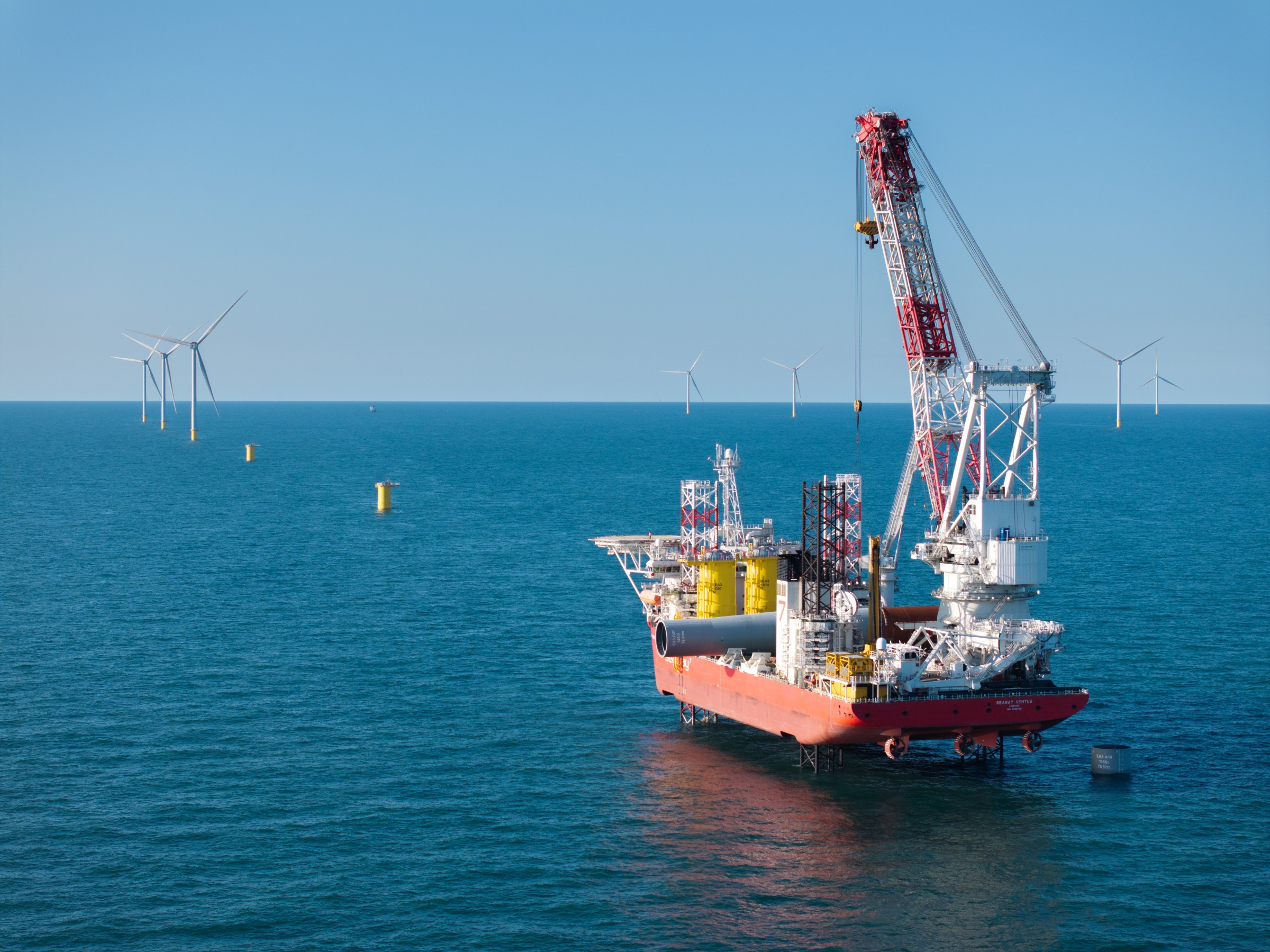
ScottishPower Renewables and Masdar have completed installation of all 95 foundations at the £4 billion East Anglia THREE offshore wind farm, ending one of the project’s heaviest marine construction phases as turbine and electrical installation continues off Suffolk.
The foundation package comprises 95 monopiles weighing between 1,200 and 1,800 tonnes, measuring 67 to 84 metres in height and reaching up to 10.6 metres in diameter. All 95 transition pieces have also been installed, completing the structural interfaces needed before turbine towers can be erected.
Each transition piece is around 20 metres high, eight metres in diameter, and weighs more than 400 tonnes. Together with the monopiles, the foundation campaign has placed more than 200,000 tonnes of steel into the offshore site.
Seaway7 delivered the installation using Seaway Ventus, with East Anglia THREE becoming the first complete foundation campaign undertaken by the jack-up vessel. Seaway7 remains on the project through installation of the inter-array cable system.
Construction shifts from foundations to the electrical system
Turbine installation has already passed the halfway point. The 1.4GW development will use 95 Siemens Gamesa turbines fitted with 115-metre blades manufactured at the company’s Hull facility, while offshore and onshore work continues towards full operation by the end of 2026.
Completing the monopiles and transition pieces removes a major structural dependency from that programme. Foundation position, verticality, installation tolerances, transition-piece alignment, and interface dimensions all have to remain within specification before towers, nacelles, and blades can be assembled above them.
The scale of the components places substantial demands on marine logistics. Monopiles up to 84 metres long and 1,800 tonnes must be transported, lifted, positioned, and driven accurately enough for the upper structure to be installed, while the jack-up vessel has to repeat the process across 95 locations within workable weather conditions.
Once those structures are in place, the project increasingly becomes an electrical integration programme. Inter-array cables connect turbines into collection circuits, routing generated electricity through the offshore network and towards the transmission infrastructure that will carry it ashore.
A completed turbine has no commercial value until its electrical route can be energised, protected, tested, and commissioned. Cable installation therefore becomes progressively more important as mechanical erection advances, with offshore construction, cable termination, testing, substations, control systems, and onshore works needing to converge around the commissioning sequence.
ScottishPower Renewables says Seaway7 is continuing inter-array cable installation following completion of the foundation campaign. The developer is also progressing the remaining offshore and onshore construction required for the wind farm to reach its year-end operating target.
East Anglia THREE also carries a substantial UK supply-chain component. ScottishPower Renewables puts domestic expenditure at almost £2 billion, including foundation design by Wood Thilsted, blade production at Siemens Gamesa’s Hull facility, vessel charters involving Norfolk-based NR Marine Services and OEG, and support from metocean and seabed specialist Partrac.
The development is supporting around 2,300 jobs during construction and is expected to create roughly 100 long-term positions in the East of England. Its foundation programme has therefore combined international offshore installation capability with design, blade manufacturing, marine services, and consultancy work sourced within the UK.
The project is owned equally by ScottishPower Renewables and Masdar and forms part of the wider strategic partnership between Iberdrola and Masdar. For the immediate construction team, however, ownership structure is less pressing than the remaining interface between mechanical completion and energisation.
Each new turbine introduces another package of tower assembly, nacelle and blade installation, internal electrical work, cable termination, control integration, testing, and commissioning. Progress can therefore become less visually dramatic after the foundations disappear beneath completed towers, even as the number of electrical interfaces being closed increases rapidly.
East Anglia THREE is expected to generate electricity equivalent to the demand of more than 1.3 million homes once its 1.4GW capacity is fully operational. That output remains dependent on the remaining turbine and cable campaigns converting the completed foundation field into an interconnected generating system.
The project has now cleared the phase dominated by monopiles and transition pieces. With turbine installation beyond halfway and inter-array cable work continuing, the delivery risk shifts towards completing, energising, and commissioning the electrical system on the timetable required for full operation before the end of the year.

