IN Brief:
- Rețele Electrice România is procuring reinforcement work on two 110kV overhead-line corridors.
- The programme covers Sitorman–Săcele–Mihai Viteazu and Tulcea Vest–Topolog.
- The stated objective is to strengthen network capacity upstream of renewable-generation connection points.
Rețele Electrice România is procuring reinforcement work on two 110kV overhead-line corridors in Dobrogea, with the programme intended to increase network capacity upstream of renewable-generation connection points. The package covers the Sitorman–Săcele–Mihai Viteazu route and the Tulcea Vest–Topolog line.
Public procurement information values the work at around RON50.7 million and describes its purpose as strengthening and increasing distribution capacity rather than carrying out like-for-like asset replacement. The two corridors form part of the regional high-voltage network through which output from connected generation must travel towards stronger points in the wider electricity system.
Dobrogea has attracted substantial renewable development because of its wind and solar resources, while parts of its electrical infrastructure were designed around a different pattern of generation and demand. Additional renewable projects can therefore expose constraints well beyond their immediate connection assets.
A generator connected at 110kV does not deliver power only as far as its nearest substation. Its output has to move through overhead lines, transformers, busbars, and upstream interfaces, each with thermal, voltage, fault-level, and operating limits that can restrict how much additional generation the network can accommodate.
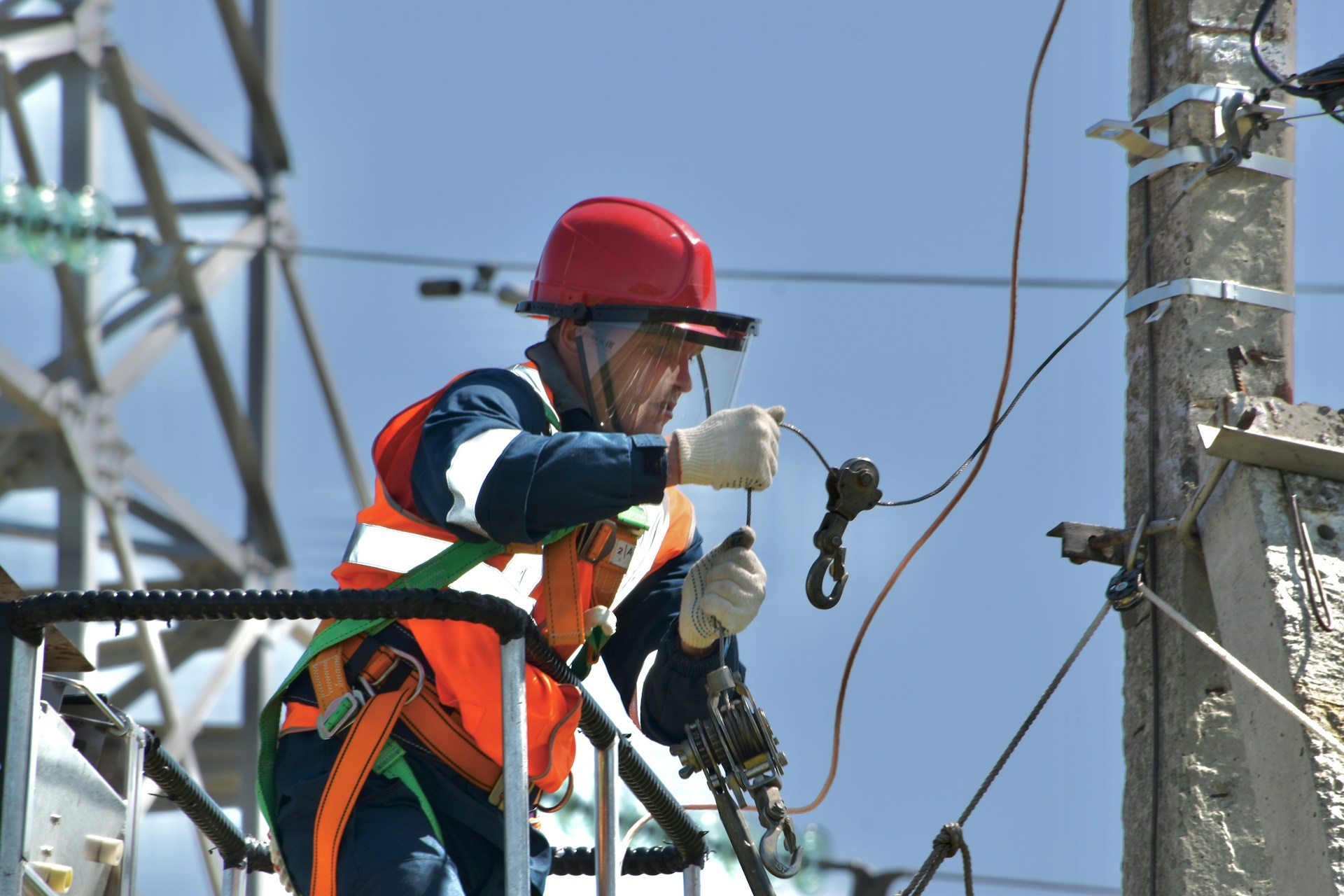
Reinforcement may consequently be required some distance from the project responsible for the extra flow. On overhead lines, the work can include reconductoring, replacement or strengthening of towers and poles, new insulators and fittings, earthing modifications, and associated changes at substations, depending on the condition and rating of the existing assets.
Rețele Electrice’s longer-term network-development documentation has already identified reinforcement and reconductoring requirements on parts of the Dobrogea 110kV system, including the Sitorman–Mihai Viteazu and Tulcea–Topolog corridors. The current procurement moves those identified requirements into a defined delivery package.
Reconductor projects can increase transfer capability while retaining an established route, avoiding some of the land, planning, and construction requirements associated with creating an entirely new line. Their practicality still depends on tower strength, electrical clearances, mechanical loading, conductor technology, and the condition of the existing infrastructure.
Construction on an operating 110kV system also has to be sequenced around outages. Circuits may need to be removed from service while conductors or structures are replaced, requiring network operators to maintain acceptable security through alternative routes and coordinate the work with other maintenance and generation conditions.
Renewable output adds another dimension to outage planning because taking a line out of service can temporarily reduce the amount of generation that the surrounding system can accept. The timing and duration of construction outages therefore affect both network security and the ability of connected plants to export electricity.
The Dobrogea works underline the distinction between installing renewable capacity and making that capacity usable by the power system. Wind turbines and photovoltaic arrays can be built relatively quickly, while upstream reinforcement can involve procurement, site access, outages, protection modifications, civil works, and commissioning across infrastructure that may already have been operating for decades.
At 110kV, the distribution network occupies an important position in that process. Although classified as distribution voltage within the Romanian system, circuits at this level can carry substantial regional power flows and interface closely with the national transmission network.
Growth in distributed generation can also reverse the direction of power through parts of an established network. Feeders developed principally to supply local demand from an upstream source may increasingly export electricity during periods of strong renewable production, altering utilisation across transformers, lines, and substations.
Those changes affect more than conductor loading. Protection coordination, voltage profiles, transformer tap operation, switching arrangements, and operating procedures may all need to be reassessed when generation becomes a significant proportion of local power flow.
Additional conductor capacity can address thermal constraints, but it does not remove every system limit. Voltage behaviour, fault levels, protection settings, transformer ratings, and the capacity of upstream transmission interfaces can continue to constrain renewable output even after an individual 110kV line has been reinforced.
The present procurement therefore represents one part of a wider integration problem rather than a generic refurbishment exercise. Its stated focus on infrastructure upstream of renewable connection points directly links the line work with generation growth already placing additional requirements on the regional network.
Further renewable capacity in Dobrogea will depend on new connection assets as well as reinforcement of established routes. On the Sitorman–Săcele–Mihai Viteazu and Tulcea Vest–Topolog corridors, that expansion is now translating into physical work on the 110kV network that carries generation away from the point where it first reaches the grid.