
IN Brief:
- A new seven-bay 380kV air-insulated switchgear installation is planned at Pulverdingen.
- Three connection bays will serve battery storage customers directly from the transmission network.
- The work forms part of wider reinforcement and renewal at the Pulverdingen transmission hub.
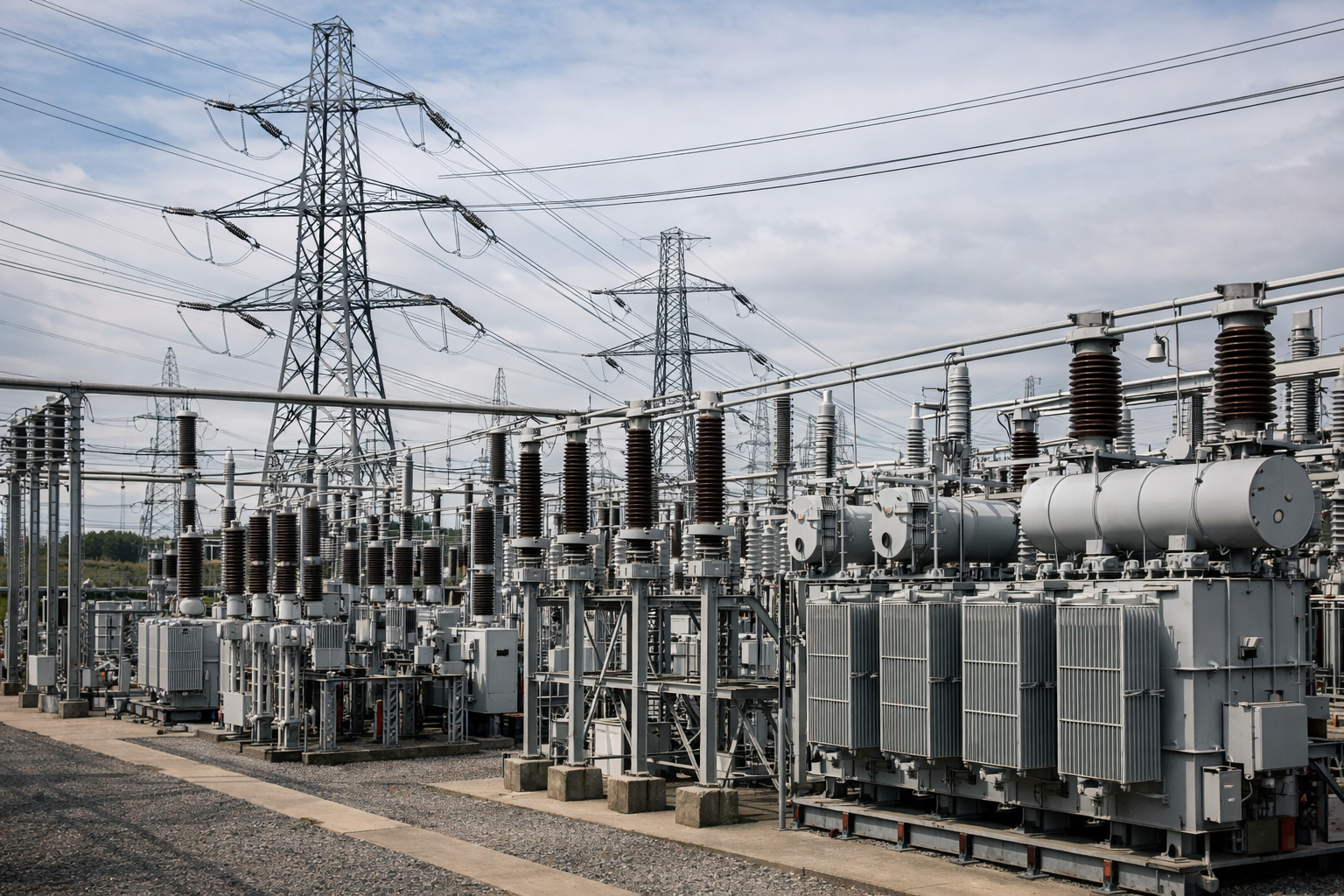
TransnetBW is procuring a new 380kV air-insulated switchgear installation at Pulverdingen, with three bays intended to connect battery storage customers directly to the transmission network. The seven-bay installation will use a double-busbar arrangement with a coupling bay and provide the equipment needed to loop existing 380kV circuits into the expanded site.
The contract extends well beyond the supply of primary switchgear. Its scope covers planning, permitting support, manufacturing and factory testing, transport, erection, commissioning, secondary systems, buildings, relay facilities, and associated civil works, creating a complete transmission connection package rather than an equipment-only order.
At 380kV, connecting storage requires coordination across protection, control, metering, switching, earthing, communications, and the operating requirements of the wider system. The battery plants will move between charging and discharging, changing from large electrical loads to sources of generation, so system studies and protection arrangements must accommodate substantial power flows in both directions.
Pulverdingen is already an established transmission node in Baden-Württemberg, where TransnetBW is undertaking a broader programme of renewal and reinforcement. The operator has said the existing 380kV switchgear can no longer be expanded in line with current technical requirements because of its age and topology, while the site needs greater short-circuit withstand, transmission capacity, and voltage-control capability.
The battery connection package is therefore being incorporated into a wider redesign of the substation rather than added to a static network asset. TransnetBW’s longer-term plans include substantial new 380kV switchgear, additional transformer capacity, phase-shifting transformers, and reactive-power equipment across an expanded site.
Increasing storage capacity is making transmission-level connection work more common as individual developments grow in power and energy rating. Smaller installations can often connect through distribution networks, but projects seeking hundreds of megawatts of import and export capability can require access to the transmission system, particularly where several schemes are concentrated around the same node.
The double-busbar layout specified at Pulverdingen will provide additional operational flexibility because circuits and customer bays can be switched between busbars while sections of equipment are maintained or isolated. At a site supporting several independently operated storage projects, that arrangement can reduce the extent to which maintenance or a single equipment outage affects every connected user.
Air-insulated switchgear also imposes physical requirements that differ from a compact gas-insulated arrangement. Electrical clearances are maintained through open-air separation, so busbars, circuit breakers, disconnectors, instrument transformers, gantries, and control equipment occupy substantial space, making civil design and equipment layout important parts of the expansion.
Storage adds further operational complexity because the electrical interface has to work across charging, discharging, standby, fault, and maintenance conditions. Protection settings must distinguish genuine network faults from permitted operating changes, while metering and control systems have to account accurately for power flowing into and out of each customer installation.
The connection architecture also determines how faults or maintenance on one battery site interact with neighbouring users. Dedicated bays allow individual installations to be isolated, but their behaviour still affects common busbars and upstream circuits, placing importance on coordinated protection, switching procedures, and system studies.
Voltage behaviour is another consideration at a major storage connection. Battery power-conversion systems can control active and reactive power within their technical limits, but those capabilities have to be coordinated with the transmission operator’s wider voltage-management strategy and the requirements applied through the connection agreement.
The current procurement follows earlier market consultation on the Pulverdingen scheme and turns the connection concept into a defined delivery package. Bids are scheduled to close in October, after which contractor selection will establish the route into detailed construction and commissioning.
Public procurement material does not identify the battery customers or give the capacities of their individual projects, so the size of the storage installations cannot be inferred from connection voltage alone. What is established is that three storage customers are now being engineered directly into the 380kV architecture at Pulverdingen.
That represents a practical change in how large batteries are beginning to appear in transmission planning. Storage is becoming part of the primary substation design itself, alongside transformers, compensation equipment, busbars, and circuits that would previously have been planned mainly around conventional generation and network transfers.
Germany’s growing renewable fleet increases the value of flexibility, but batteries can only provide it where sufficient grid capacity exists to charge and discharge them. At Pulverdingen, that constraint is being addressed in steel, switchgear, protection, and civil works at one of the highest voltage levels in the system.

