
IN Brief:
- GBM Works and CAPE Holland plan an integrated commercial Vibrojet offering from 2027.
- The technology combines vertical vibration with controlled internal water jetting to reduce monopile installation resistance.
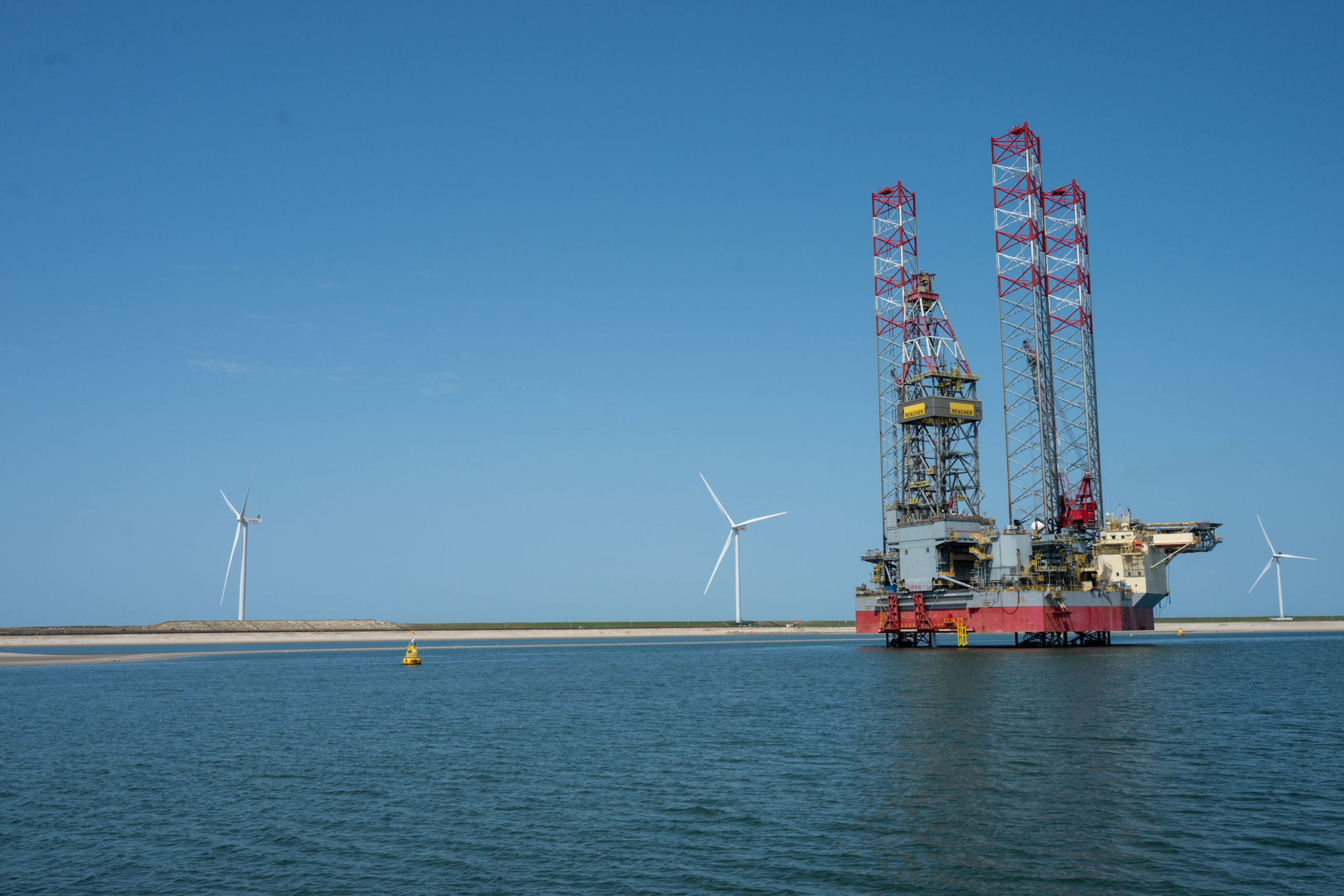
- Three full-scale foundations have already been installed using Vibrojet at Hollandse Kust West.
GBM Works and CAPE Holland have agreed to jointly develop and commercialise the Vibrojet monopile installation system, targeting an integrated offshore wind foundation offering from 2027. The method combines vibratory pile driving with controlled water jetting inside the monopile to reduce soil resistance during installation.
The memorandum of understanding follows offshore deployment at the Hollandse Kust West wind farm, where Vibrojet was used to install three full-scale monopile foundations. GBM Works will lead technology development, feasibility studies and marketing, while CAPE Holland will focus on its Vibro Lifting Technology, system integration and offshore execution.
Conventional monopile installation commonly relies on impact hammers delivering repeated high-energy blows to drive a steel foundation into the seabed. The technique is mature, but it produces underwater noise and can require mitigation systems such as bubble curtains. Larger monopiles also demand greater driving energy, heavier lifting equipment and tighter control of fatigue and installation tolerances.
Vibrojet approaches the problem by lowering resistance around the pile rather than relying entirely on impact energy. A vibratory system moves the foundation axially while controlled water jets inside the lower section temporarily disturb the surrounding soil. Reducing internal shaft resistance can make penetration more efficient under suitable ground conditions and reduce reliance on conventional hammering.
The technique has progressed through the Silent Installation of MonoPiLEs programme from laboratory and field testing into offshore demonstration. GBM Works says the technology has completed DNV Technology Qualification, while earlier work brought the system to technology readiness level 7. Those steps establish a stronger basis for commercial deployment, although project-specific qualification remains necessary.
Foundation methods are highly dependent on seabed conditions. Dense sands, stiff clays, layered geology and local obstructions can produce very different driveability behaviour, so the commercial service will include feasibility and optimisation work tailored to individual sites. A successful installation at one wind farm does not remove the need for geotechnical modelling and a site-specific execution plan elsewhere.
CAPE Holland adds experience in vibratory hammers and offshore lifting systems, giving the partnership an execution route alongside GBM Works’ technology. Developers buying a foundation package require more than an isolated tool: vessel interfaces, lifting procedures, power and hydraulic services, control systems, spares, technicians and contingencies all have to fit a construction sequence measured in expensive vessel days.
Noise performance remains one of the main reasons to pursue alternatives to impact driving. European offshore permits increasingly impose underwater noise controls intended to limit effects on marine mammals and other wildlife. A method capable of reaching design depth with lower acoustic output could reduce the amount of auxiliary mitigation equipment required, although the benefit has to be demonstrated across different soils and pile sizes.
Installation productivity will be judged just as closely. Foundation delays can hold up transition pieces, array cables, offshore substations and turbine installation, while specialist vessels are commonly committed to later campaigns. A quieter method gains little commercially if it introduces unpredictable penetration rates or requires extensive corrective work after the pile reaches depth.
The structural outcome is equally important. The installed foundation must still satisfy requirements for axial and lateral capacity, fatigue life, verticality and long-term interaction with the seabed. Any reduction in installation resistance has to be achieved without undermining the soil conditions on which the final design depends, making post-installation evidence as important as installation speed.
GBM Works has also identified potential decommissioning applications for controlled jetting, although removal would require its own validation. Offshore wind developers are increasingly expected to consider end-of-life methods during project design, so a foundation technology with a credible recovery route could carry value beyond construction if that capability is demonstrated.
The partners intend to formalise licensing and longer-term cooperation arrangements as they move towards the 2027 commercial offer. Vibrojet now has to make the transition from successful demonstration to repeatable project execution, where developers will compare it with impact driving and other low-noise methods on vessel time, soil compatibility, certification, environmental performance and cost.
Three full-scale foundations prove that the method can leave the test environment and work offshore. Commercial adoption will depend on something less dramatic but more demanding: whether the same installation logic can be reproduced across different projects without trading lower noise for higher schedule or geotechnical risk.

