
IN Brief:
- Sumitomo has acquired a 33.3% interest in the proposed Gwynt Glas floating offshore wind development.
- EDF power solutions UK and Ireland, ESB, and Sumitomo now each hold approximately one third of the project.
- Gwynt Glas is planned at up to 1.5GW, with consent applications expected from 2028 and operation targeted for the late 2030s.
Sumitomo Corporation has acquired a 33.3% interest in Gwynt Glas, joining EDF power solutions UK and Ireland and ESB as an equal partner in the proposed 1.5GW floating offshore wind development in the Celtic Sea.
The investment is Sumitomo’s first participation in a floating offshore wind project and gives each of the three developers approximately one third of Gwynt Glas. The project lies around 40 kilometres offshore and is one of the major schemes progressing from The Crown Estate’s Offshore Wind Leasing Round 5.
The change is an ownership milestone rather than a construction decision. Gwynt Glas remains at an early development stage, with consent applications expected from 2028 onwards and commercial operation targeted for the late 2030s if the technical, regulatory, commercial, and grid programmes progress successfully.
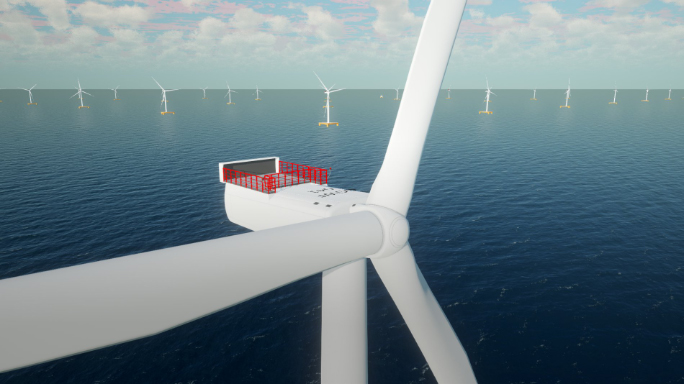
Floating offshore wind extends development into water depths where fixed-bottom foundations become increasingly difficult or expensive. Instead of installing a monopile or jacket directly into the seabed, the turbine sits on a floating structure held in position by moorings and anchors.
That changes several important engineering interfaces. The electrical export system must accommodate movement of the structure, mooring systems become major engineered packages, and ports need sufficient water depth, quayside capacity, assembly space, and marine access for floating platforms and increasingly large wind turbines.
The technology can therefore access stronger or more consistent wind resources further offshore, but it transfers complexity from seabed foundation installation into platform fabrication, moorings, dynamic cables, tow-out procedures, anchoring, and long-term offshore maintenance.
The challenge becomes particularly visible when moving from demonstration projects to gigawatt-scale arrays. One or two floating turbines can be assembled using highly bespoke procedures; a 1.5GW development requires those procedures to be repeated industrially across scores of turbine positions while controlling cost, quality, and delivery time.
Round 5 is intended to provide enough project scale to encourage that industrialisation. The Crown Estate selected three development areas in the Celtic Sea, each capable of supporting up to 1.5GW, creating a potential regional pipeline of 4.5GW if all three projects reach full development.
Such a pipeline gives ports and manufacturers a stronger basis for investment than a succession of isolated demonstration arrays. Floating foundations require substantial fabrication capacity, while turbine integration may demand large quays, storage areas, heavy lifting, deep water, and assembly sequences that differ from the fixed-bottom model used by much of Britain’s established offshore wind industry.
Ports are likely to become particularly influential because floating turbines can be assembled to a much greater extent alongside the quay before being towed offshore. That can reduce some offshore lifting requirements but transfers more activity into coastal manufacturing and integration facilities capable of handling extremely large structures.
Supply chain decisions will therefore be tied closely to project sequencing. A manufacturer considering a new floating-platform factory, or a port considering expensive infrastructure upgrades, needs confidence that several projects will follow one another rather than leaving specialised facilities underused after a single construction campaign.
Developers face the corresponding problem. Projects benefit from established fabrication and port capacity, but those facilities are difficult to justify commercially before developers can demonstrate a sufficiently bankable pipeline of contracts and consenting progress.
Gwynt Glas is consequently being developed against a market in which the technology is advancing faster than the industrial infrastructure required for full commercial deployment. Turbine technology is comparatively mature, but platform design, serial production, dynamic cabling, mooring installation, port logistics, and operating models are still being optimised at substantially smaller scales.
Sumitomo brings offshore wind investment experience accumulated through European projects since 2014, although Gwynt Glas is its first floating development. That allows experience in project finance, construction, commercial structures, and offshore operations to transfer into the project without assuming that fixed-bottom engineering can simply be copied into deeper water.
EDF power solutions and ESB have already spent several years progressing the Gwynt Glas concept and its Celtic Sea position. Adding Sumitomo broadens the capital and development base ahead of a period when surveys, environmental work, engineering studies, grid planning, supply chain engagement, and consenting expenditure are expected to increase.
Grid delivery will be one of the longer-term constraints. A 1.5GW project represents transmission-scale generation, so offshore development has to remain aligned with onshore network reinforcement and connection planning if turbines are eventually to export their full output.
The commercial environment remains equally important. A project seeking operation in the late 2030s will make major investment decisions against future support arrangements, turbine prices, financing costs, port availability, supply chain capacity, and grid schedules that are not fixed today.
Sumitomo’s acquisition does not resolve those uncertainties, but it puts a third experienced developer behind one of the Celtic Sea’s largest proposed projects. The next several years will determine whether the partnership can convert a 1.5GW lease opportunity into consented engineering, contracted manufacturing capacity, port investment, and ultimately turbines operating in water too deep for Britain’s conventional offshore wind model.

