IN Brief:
- Windyhill's first phase will provide 200MW/400MWh of battery storage near Glasgow, with commissioning expected in early 2028.
- Mitie is delivering the 132kV grid connection, civil works, electrical balance of plant, and long-term maintenance.
- A second 200MW/400MWh phase is planned, giving the completed development potential capacity of 400MW/800MWh.
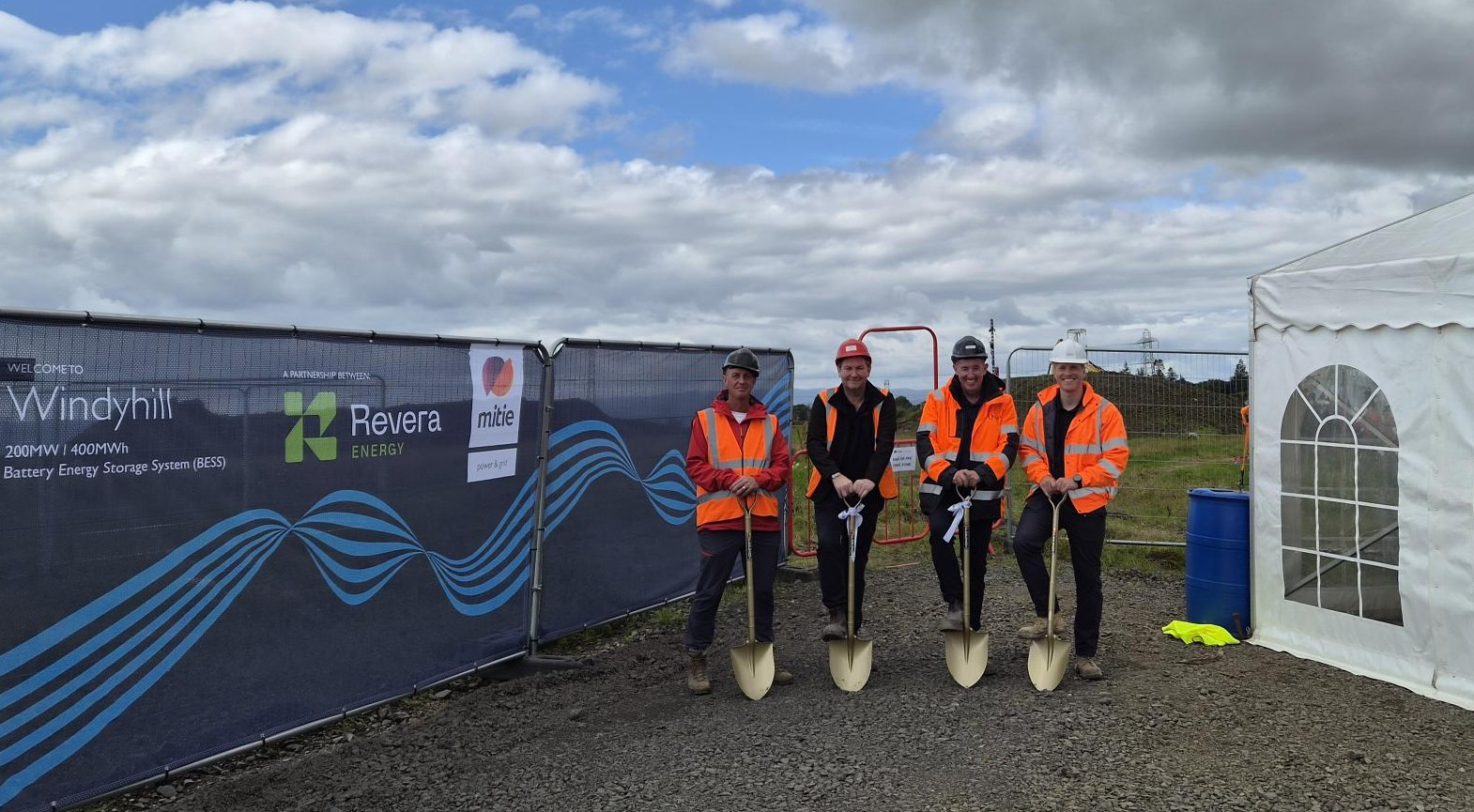
Construction has started on the first 200MW/400MWh phase of the Windyhill battery energy storage development near Glasgow, moving the project from investment and preparation into high-voltage electrical delivery.
Mitie is working with Revera Energy on the Bearsden development and will design and build its 132kV grid connection alongside the civil works and electrical balance of plant. The contractor is also due to provide long-term maintenance once the project enters service.
Revera will supply the battery energy storage system itself. A second phase of equal size is planned, giving Windyhill the potential to reach 400MW of power and 800MWh of stored energy if both stages are completed.
The first phase has a nominal two-hour duration at maximum output, allowing the site to discharge its rated 200MW for approximately two hours before the stored energy is exhausted. That configuration has become common across large British battery projects as developers seek assets capable of participating in several electricity and balancing markets rather than relying on short-duration frequency response alone.
The 132kV connection is central to that capability. Battery containers and inverters determine how energy is stored and converted, but the high-voltage infrastructure around them determines whether that energy can be transferred to and from the grid safely, predictably, and within the operating limits set by the network.
Windyhill will therefore require considerably more than battery enclosures. Transformers, switchgear, protection systems, cabling, earthing, auxiliary supplies, controls, communications equipment, foundations, drainage, access arrangements, and commissioning work all sit around the storage technology itself.
Protection coordination is particularly important on a large battery connection because the asset can switch between importing and exporting power. Electrical settings and control systems have to distinguish between legitimate changes in operating mode and network faults while ensuring that the installation responds correctly to voltage, frequency, and other system conditions.
Battery sites also depend heavily on converter controls. Unlike a conventional rotating generator, a battery exchanges power with the network through power electronics, allowing active and reactive power to be controlled rapidly but placing considerable importance on software, communications, operating limits, and the performance of the inverter system.
The Scottish location gives Windyhill an additional system context. Scotland has substantial wind generation and regularly exports power towards larger demand centres further south, making transmission capacity an important constraint when renewable output is high.
Battery storage cannot substitute for the transmission reinforcements required to move sustained volumes of electricity across the country, but flexible assets can absorb energy during some periods when generation exceeds immediate demand or local export capability and return it when conditions change.
The economic value of the plant will therefore depend on more than its 400MWh headline capacity. Location, charging strategy, wholesale-price spreads, balancing opportunities, capacity-market revenues, network conditions, cycling limits, degradation, and availability will all affect how frequently the asset operates and what services it provides.
Britain’s battery market has already moved significantly beyond the early projects developed around sub-second frequency response. Sites are increasingly being built at hundreds of megawatts, with longer durations intended to widen the range of possible operating strategies as renewable generation becomes a larger part of the power system.
That scale changes the construction requirement. A 200MW connection is substantial electrical infrastructure in its own right, and coordination between battery delivery, civil works, transformers, switchgear, protection, control, energisation, and network testing becomes a significant project-management exercise.
Mitie expects the first phase to be completed in early 2028, with around 60 jobs supported during construction. The company’s Power & Grid operation says it has already delivered more than 40 battery storage projects, giving Windyhill a degree of repeatability despite the larger individual rating.
Long-term maintenance will become equally important once construction ends. Battery modules, thermal-management systems, converters, transformers, switchgear, communications equipment, and auxiliary systems all have different maintenance requirements and failure modes, while declining battery capacity has to be managed over the operating life of the site.
The planned second phase would double Windyhill’s power and energy ratings while retaining the same two-hour relationship between the two. Its delivery remains separate from the first phase, so the 400MW/800MWh figure represents potential completed capacity rather than capacity currently under construction.
For phase one, however, the engineering programme is now physical rather than prospective. The project has entered the period in which a 200MW flexible asset has to be turned from battery specifications and connection agreements into working 132kV infrastructure capable of moving 400MWh through the grid when the power system calls for it.