IN Brief:
- Two T-class offshore wind installation vessels have been ordered from COSCO Shipping Offshore in Qidong.
- Cadeler values the combined construction contracts at approximately €805 million, with deliveries scheduled for 2030 and 2031.
- The investment extends a fleet programme designed around increasingly large offshore turbine and foundation packages.
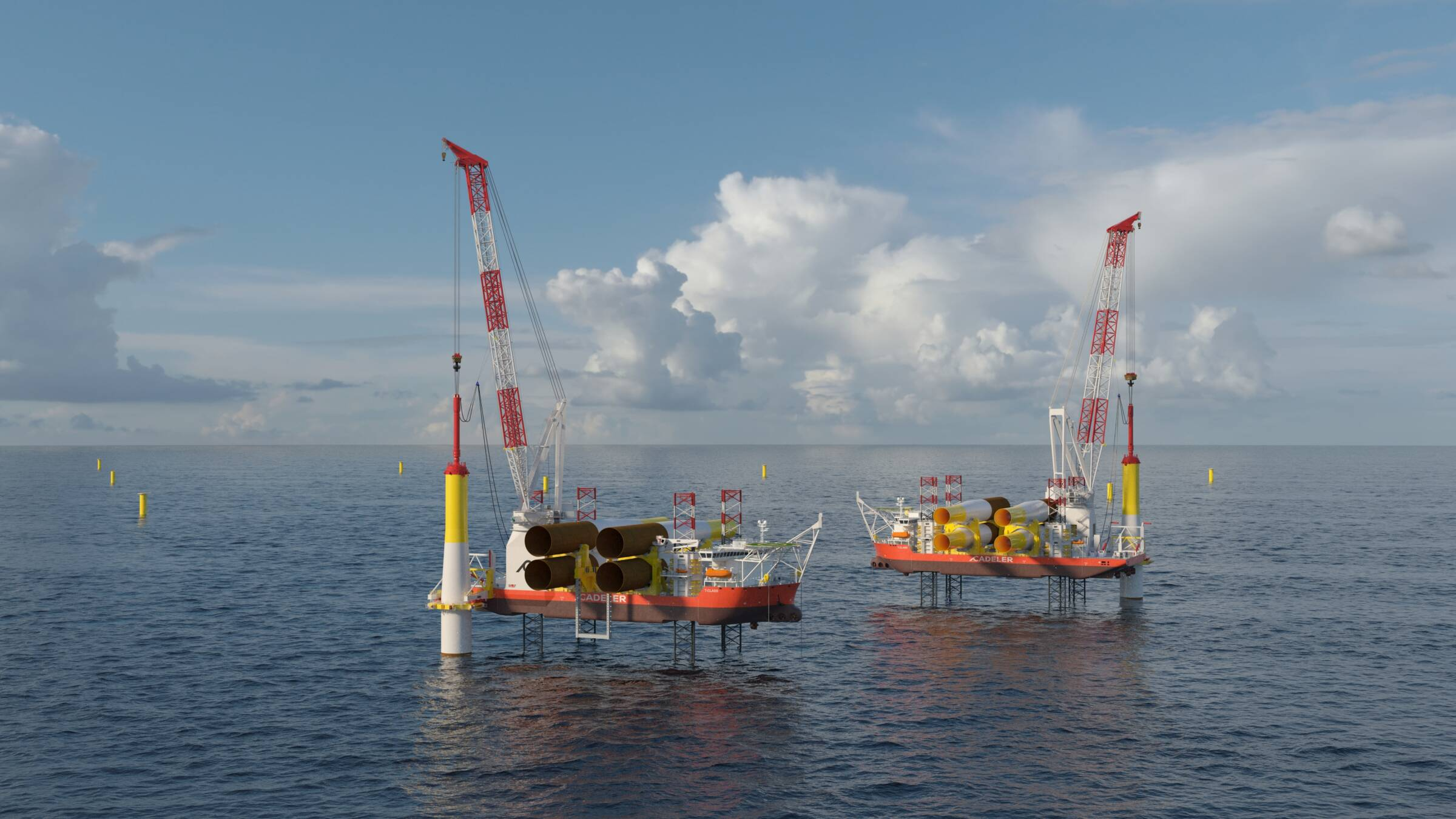
Cadeler has committed approximately €805 million to two new T-class offshore wind installation vessels, extending its fleet expansion into the next decade as turbine and foundation packages continue to increase in size.
The contractor has signed firm construction contracts with COSCO Shipping Offshore’s shipyard in Qidong, China, with deliveries scheduled for 2030 and 2031. Cadeler had already secured equity financing for the investment earlier in 2026 and says discussions with potential customers about future deployment are under way.
The T-class vessels are intended to handle increasingly demanding offshore installation work and will add another purpose-built design to a fleet already used for turbine transport and installation, foundation campaigns, and operations and maintenance. Detailed dimensions and lifting specifications have not yet been disclosed in the announcement, but Cadeler describes the class as its largest and most capable to date.
The order reflects a problem that has grown with offshore wind itself. Larger turbines reduce the number of positions needed for a given project capacity, but individual components become heavier and harder to transport, lift, position, and install. Monopiles, transition pieces, nacelles, towers, blades, and associated tooling have all increased in scale as projects have moved towards higher-rated machines.
Installation vessels have to be designed ahead of the equipment they will eventually handle. A ship delivered in 2030 cannot be specified only for turbine and foundation packages already entering service today; its commercial value depends on remaining useful across projects contracted several years after delivery.
That exposes vessel owners to technology risk. Turbine ratings, rotor diameters, foundation concepts, port strategies, and installation methods can all change while a major newbuild is being designed and constructed, yet the vessel still has to arrive with enough crane capacity, deck space, stability, and operating envelope to compete for work throughout its economic life.
Cadeler’s current campaigns show how quickly component dimensions are already moving. Its A-class vessel Wind Ally is involved in the foundation programme at the 2.9GW Hornsea 3 project in UK waters, where the contractor is responsible for transport and installation across a large monopile package. The first complete monopile foundation was installed in May, moving the project into sustained offshore construction.
Hornsea 3 shipments have included monopiles more than 105 metres long and weighing above 2,300 tonnes. Components on that scale place pressure on every part of the logistics chain, from fabrication and port marshalling to load-out, sea fastening, transport, lifting, positioning, and installation.
Vessel capability is therefore directly linked to the capacity of yards and ports as well as to turbine design. A crane may be able to lift a heavier component, but the project still requires suitable quays, storage areas, water depth, transport routes, lifting frames, and marine coordination before the vessel can begin its offshore work.
The two T-class ships also deepen Cadeler’s relationship with COSCO Shipping Offshore, which has built several vessels in the contractor’s expansion programme. Repeated use of the same shipyard can reduce interface risk because design processes, project controls, and quality expectations are already familiar, although a twin-vessel order at this value remains a substantial construction programme.
The commercial risk runs in both directions. Insufficient investment in specialist vessels can leave otherwise mature offshore projects competing for a limited number of installation slots, while excessive fleet investment can leave expensive assets underused if projects are delayed by permitting, financing, grid connections, turbine availability, or changes in government support.
Developers therefore need visibility of future vessel capability long before offshore construction begins, and vessel owners need enough confidence in the project pipeline to commit capital several years before revenue starts. That relationship has become more important as offshore wind projects expand in size and their installation campaigns occupy specialist vessels for longer periods.
Cadeler’s 2030 and 2031 delivery dates place the new vessels beyond the immediate European construction cycle and into a period when projects now moving through leasing, consenting, and procurement could reach offshore installation. The orders are consequently a long-term capacity decision rather than a response to one identified contract.
The company says customer discussions have already started, but utilisation will ultimately depend on which projects convert development rights into financed construction programmes. Offshore wind has a substantial announced pipeline; specialist vessels earn their return only when turbines, foundations, ports, cables, and grid infrastructure are sufficiently advanced to put steel offshore.
By ordering both T-class vessels now, Cadeler is committing capital before that future workload is fully visible. The engineering rationale is straightforward — offshore components are getting larger — but the commercial outcome will depend on whether the project pipeline keeps pace with the installation fleet being built to serve it.