
IN Brief:
- Mayr is applying industrial safety-brake designs to pitch and yaw systems using increasingly sophisticated servo-drive architectures.
- Relevant brake products are rated by the manufacturer down to -40°C, while EN 81-44 places defined requirements on wind turbine service lifts.
- Sensorless brake monitoring can feed switching-condition data into remote maintenance systems and digital twins.
mayr power transmission is bringing application-specific safety brakes and condition-monitoring equipment to WindEnergy 2026 as wind turbine pitch and yaw systems place greater demands on drive components, maintenance procedures, and functional safety.
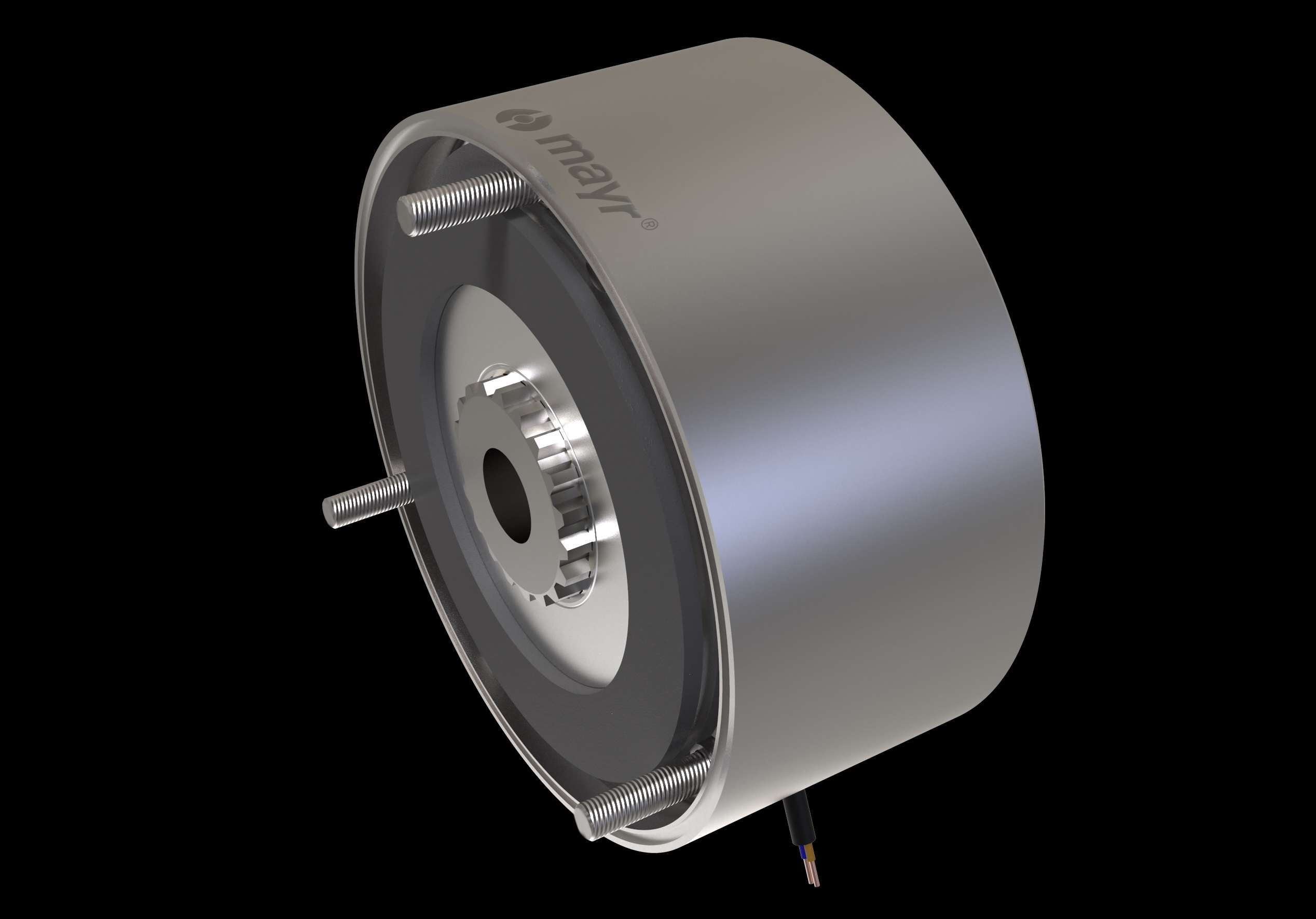
The German manufacturer’s display includes its ROBA-stop M pitch brake, further servo-motor brake variants for pitch applications, safety brakes for yaw drives, and the ROBA brake-checker monitoring module. The equipment is aimed at systems in which electromechanical brakes have to provide predictable holding or stopping behaviour across wide temperature ranges and repeated maintenance cycles.
Pitch drives alter the angle of turbine blades, while yaw drives rotate the nacelle to maintain alignment with the wind. Both functions increasingly use controlled servo-drive architectures, and mayr says servo motors are becoming more common in yaw systems that have historically used less sophisticated drive arrangements.
The change alters the duty placed on the brake. A brake may have to hold a drivetrain when power is removed, respond consistently after long periods without movement, tolerate vibration and temperature variation, and remain safe when adjacent drive equipment is dismantled for maintenance. Low inertia can also matter where the brake is mounted directly on a servo motor because additional rotating mass affects dynamic performance.
Mayr’s ROBA-stop M pitch brake is an application-optimised version of its established spring-applied safety-brake platform. The company also offers ROBA servostop brakes for installation on either side of a servo motor, with variants specified for temperatures up to 120°C and designed to limit additional mass inertia.
For A-side flange arrangements, the ROBA alphastop provides another option where the motor has an extended shaft or the brake incorporates a suitable shaft arrangement. That configuration creates a maintenance issue: removing the motor can also remove the brake that normally secures the drivetrain, requiring other measures to prevent unintended blade or nacelle movement.
The ROBA topstop addresses that condition by remaining with the machine when the motor is removed. Mayr offers modular versions with mounting flanges intended to simplify integration into existing drive arrangements, allowing the brake to continue holding the drivetrain in the de-energised state while motor work is carried out.
The company is also using WindEnergy to highlight the effect of EN 81-44 on wind turbine service lifts. The standard concerns permanently installed lifting appliances used to transport people and goods inside wind turbines and includes requirements associated with safe access, rescue, and evacuation. Mayr’s pitch and yaw brakes are separate applications, but its broader wind portfolio includes braking equipment for service lifts covered by the standard.
Environmental capability is one of the manufacturer’s points of emphasis. Mayr says relevant brake products are rated for operation down to -40°C and that it uses an in-house climate chamber for testing. The company positions that margin against the low-temperature requirements applicable to wind turbine lifting equipment, where components may have to operate reliably in conditions well below those encountered in conventional indoor machinery.
Monitoring is the other main strand of the display. The ROBA brake-checker is designed to determine brake switching condition without adding a separate mechanical sensor at the brake. It evaluates electrical behaviour associated with operation of the electromagnetic brake and provides a signal that can be used by the machine control system.
Mayr says the resulting data can help identify developing conditions including insufficient supply voltage, voltage drop on feed lines, rising coil temperature, increased wear, and enlargement of the operating air gap. The objective is to detect a change in switching behaviour before the brake reaches a condition in which it no longer engages correctly.
That approach complements conventional wear checks rather than eliminating them. Mechanical safety components still require inspection and maintenance, but an additional indication of switching condition can give technicians a more focused reason to investigate a particular circuit, brake, or installation before a scheduled service becomes an unplanned intervention.
The company’s ROBA gateway can make the monitoring data available to networked maintenance systems, including remote-service platforms and digital twins. In a wind turbine, that places a comparatively traditional component alongside condition data from bearings, converters, lubrication systems, gearboxes, generators, and other monitored equipment.
The usefulness of the data depends on whether it supports a maintenance decision. Wind operators already receive large numbers of alarms and condition indicators, so an additional brake signal only earns its place if it can distinguish normal variation from a developing fault and help identify the likely cause.
Mayr manufactures from its headquarters in Mauerstetten and from operations in Poland, India, and China, using common test arrangements to maintain product consistency between sites. Its WindEnergy presentation therefore combines two strands of turbine engineering that are becoming increasingly difficult to separate: mechanical safety components still have to fail safely, but operators also expect them to provide enough operating data to support planned maintenance across large fleets.

