
IN Brief:
- Construction has begun on a two-hour 10MW/20MWh substation battery system.
- Four BESS5000 containers will provide peak management and time-shifting capability.
- Handover is planned for October after connection, commissioning, and acceptance testing.
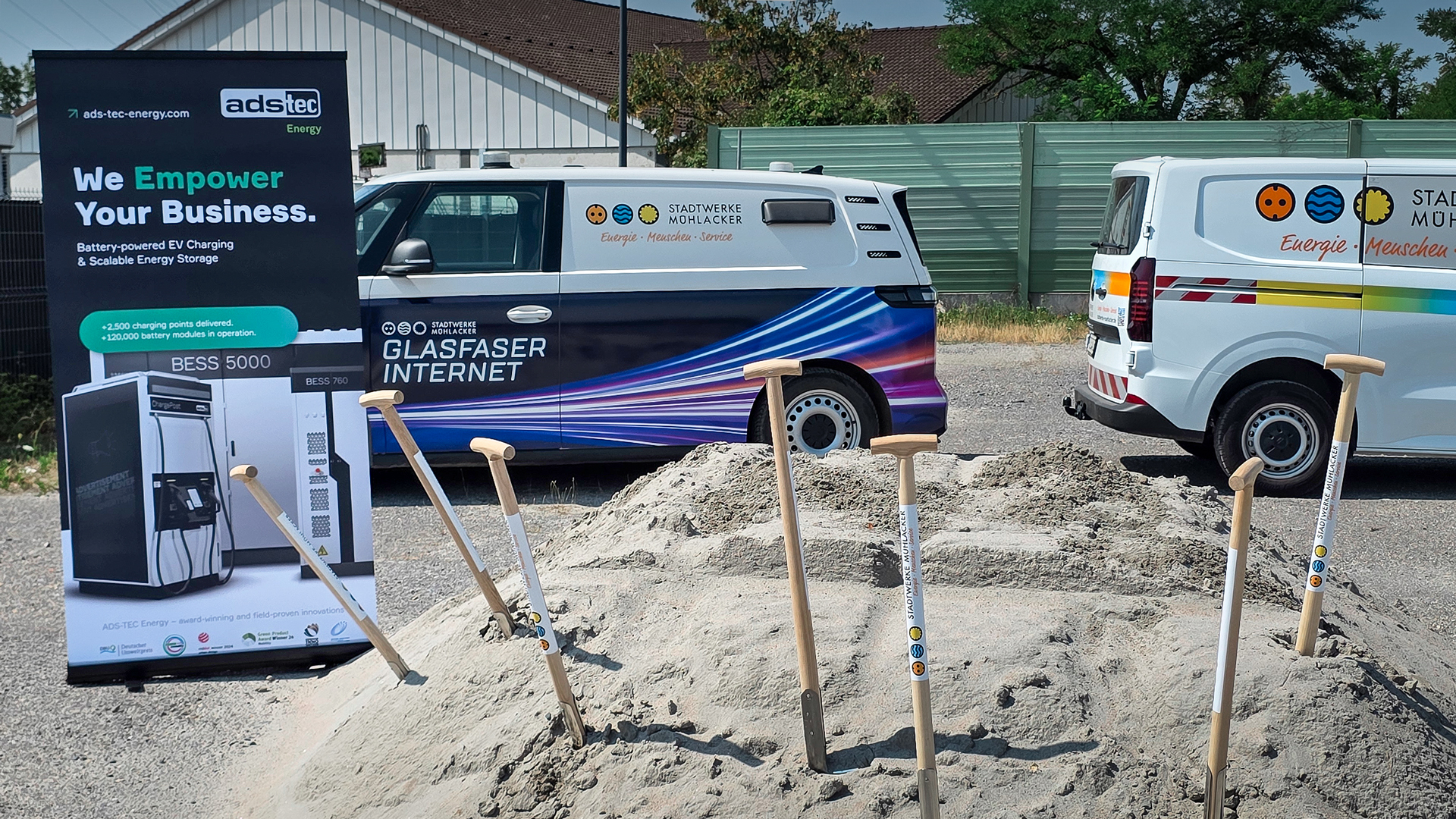
ADS-TEC Energy has started construction of a 10MW/20MWh battery energy storage system at Stadtwerke Mühlacker’s substation in Baden-Württemberg. The project has moved from the partnership announced in January to physical delivery, with handover to the municipal utility planned for October 2026.
The installation will use four BESS5000 container systems, each rated at approximately 2.5MW and 5MWh. Delivery is planned during the summer, and all four containers are scheduled to be installed on the same day. ADS-TEC Energy is responsible for overall planning, implementation, and system integration.
At the stated rating, the plant has a two-hour storage duration. It is designed to shave peak loads and shift electricity consumption over time, giving the utility a controllable asset for reducing short-duration network stress and responding to changing market conditions. The system is also intended to support local grid stability as demand rises from electric mobility, heat pumps, and digital infrastructure.
The substation location places the battery close to the point where flexibility can influence network operation. Rather than serving only an adjacent renewable generator, the asset can respond to the combined behaviour of local demand and supply. That creates potential uses across peak management, energy trading, and ancillary services, subject to the final market and control arrangements.
The four BESS5000 units use lithium iron phosphate cells in outdoor, liquid-cooled containers. Published specifications give each unit a nominal capacity of 5,015kWh and a power rating of 2,500kW, with an IP55 enclosure and an operating range from -20°C to 45°C. The platform communicates through Modbus TCP and carries certifications including IEC 62619, UN 38.3, UL 1973, and UL 9540A.
Municipal ownership places particular emphasis on thermal management, fire behaviour, protection coordination, communications, availability, maintenance access, and warranty conditions. The storage plant must also be integrated with substation protection and control without creating ambiguity during faults or planned outages. Safe operation depends on the complete site design, not only the container specification.
ADS-TEC Energy is supplying the development, integration, and operating concept from Germany. The company presents the project as a lifecycle arrangement covering planning through long-term operation rather than a container supply contract. That reduces the number of interfaces between designer, equipment supplier, integrator, and operator, while leaving performance responsibilities to be defined clearly once the plant is energised.
Construction is a distinct milestone from the January announcement. Groundworks, cable routes, foundations, auxiliary supplies, communications, fire-safety provisions, and grid-integration checks must be completed before the containers arrive. Installing all four units in one day can limit disruption, but it places greater pressure on the readiness of the civil and electrical balance of plant.
A two-hour battery occupies a competitive part of the storage market. It is long enough to move energy across short intraday peaks and provide useful local flexibility, but it is not intended to cover prolonged renewable shortfalls. Commercial performance will depend on combining several services without increasing cycling and degradation beyond the assumptions used in the operating model.
Germany’s municipal utilities combine local network, energy supply, transport, and public-service responsibilities in different configurations, giving them detailed knowledge of local load growth. A utility-owned battery can be planned around those conditions rather than relying entirely on wholesale-market revenue. Regulated network uses and commercial trading still have to remain properly separated.
The dispatch strategy will determine whether the nominal 20MWh capacity produces useful system value. Charging to reduce a forecast evening peak, reserving headroom for grid services, and responding to market prices can compete for the same stored energy. The control system must prioritise services, respect network limits, and preserve battery life, with transparent performance reporting for the owner.
Commissioning will have to verify battery capacity, power response, protection behaviour, communications, thermal control, and emergency functions before acceptance. The tests must also confirm that the utility’s control systems can dispatch the plant without exceeding substation limits or conflicting with other operating priorities. Early performance data will establish the baseline used for warranty and maintenance decisions.
The October programme leaves little room for delay in container delivery or grid-interface work. Civil completion, cable termination, control integration, and utility witness testing have to converge within the same schedule. A containerised design shortens some site work, but it does not remove the dependencies between equipment supply, network access, and final energisation.
Handover in October leaves a short delivery period between construction start and planned operation. Container delivery, grid connection, commissioning, control-system testing, and acceptance remain on the critical path. Completion to schedule would give Stadtwerke Mühlacker a practical reference for integrating a medium-scale, two-hour battery directly into municipal distribution infrastructure.

