
IN Brief:
- M Group has secured a £110 million SP Energy Networks overhead line contract.
- The project will refurbish more than 70km of the 400kV Strathaven–Smeaton route.
- Almost one million metres of higher capacity conductor will replace ageing components.
M Group has secured a £110 million contract to refurbish the 400kV overhead line between Strathaven and Smeaton in central and southern Scotland.
Extending for more than 70km from South Lanarkshire to East Lothian, the route forms one of the principal electricity corridors between Glasgow and Edinburgh.
The programme will replace key components installed when the line was constructed during the 1960s. Almost one million metres of higher capacity conductor will be deployed as part of the complete refurbishment.
SP Energy Networks awarded the work through its £5.4 billion transmission framework, under which 19 companies have been selected to support a wider £12 billion investment programme.
The framework provides for up to £3 billion of new and refurbished overhead lines and £2.4 billion of new or upgraded substations. Its initial term is five years, with an option to extend the arrangements to ten years.
Seventeen of the 19 preferred contractors are headquartered in the UK or Ireland. The wider programme is expected to support 1,000 direct jobs and tens of thousands of positions across the supply chain.
SP Energy Networks operates more than 4,500km of overhead transmission line, 600km of underground cable, and over 150 substations across central and southern Scotland. It also operates subsea high voltage links and is developing two offshore transmission routes along Britain’s east coast.
Refurbishing the Strathaven–Smeaton line will require replacement of conductors and associated components while maintaining a secure transmission system. Detailed delivery will depend on outage sequencing, access, temporary works, lifting plans, weather, and coordination with other network projects.
Reconductoring increases capacity within an established route
Replacing an existing line can provide additional transfer capability without creating an entirely new corridor. Existing tower positions, wayleaves, and planning history provide advantages, although structures and foundations must be assessed against the mechanical loads imposed by replacement conductors.
Higher capacity conductors can alter weight, tension, sag, thermal behaviour, and wind or ice loading. Clearances to ground, buildings, roads, railways, vegetation, and crossing infrastructure must remain compliant throughout the operating temperature range.
The refurbishment is also likely to involve insulators, fittings, spacers, dampers, earth wires, and other hardware exposed to decades of service. Condition information gathered during preparation and construction will determine which components can remain and which require replacement.
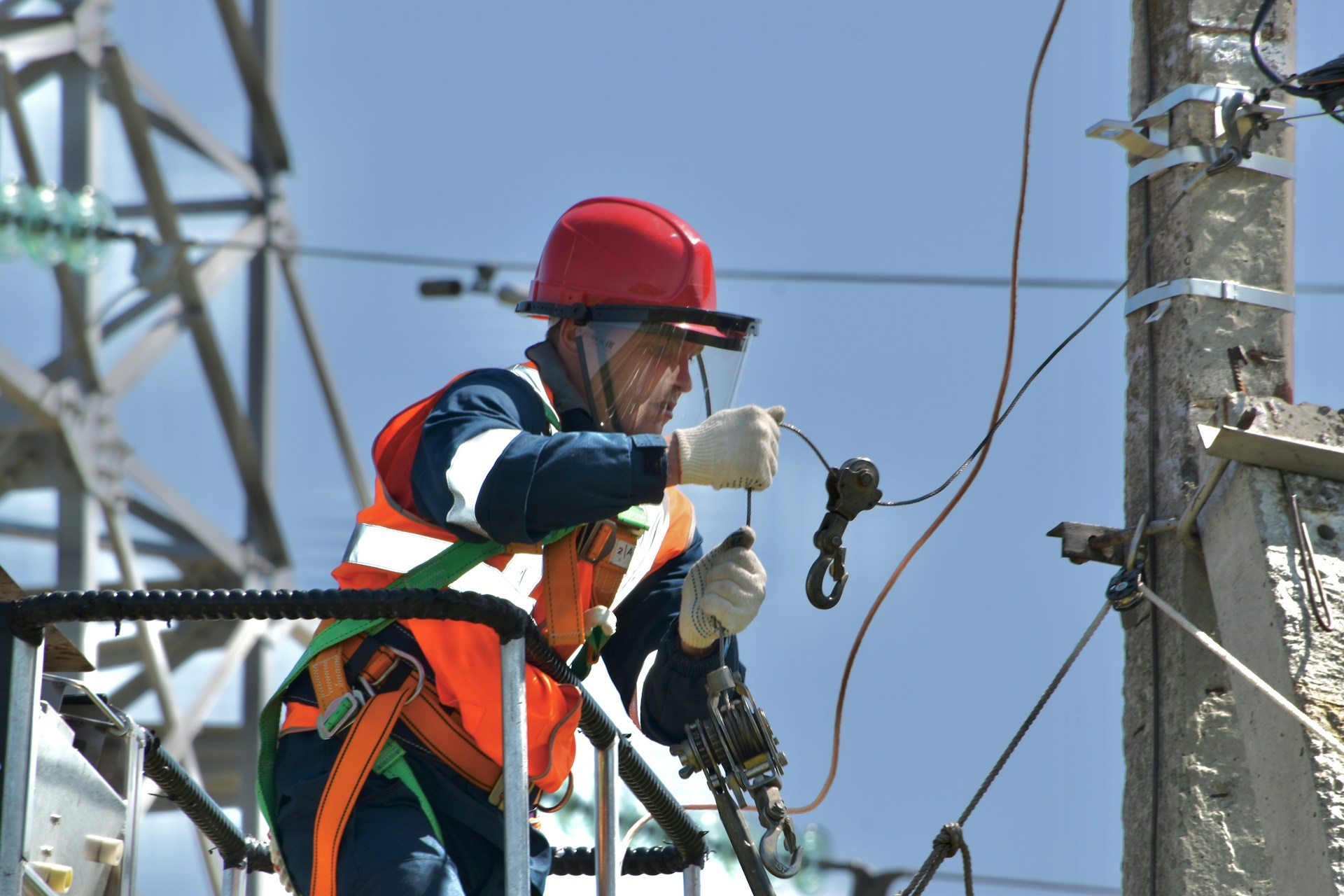
Overhead line work creates a complex interface between electrical isolation and physical access. Teams must establish safe working zones around adjacent live circuits, induced voltages, temporary earthing, lifting operations, road crossings, and work at height.
Outage planning becomes more difficult where the circuit forms part of a heavily used transmission boundary. Removing equipment from service can temporarily reduce the amount of generation that can be transferred even though the completed work is intended to increase capacity.
Those constraints already carry a substantial cost, with NESO forecasting approximately £3.2 billion of constraint management expenditure in the year to July 2027.
Scottish wind generation frequently exceeds the capacity available to move all output towards demand centres farther south. When network boundaries become constrained, generation may be reduced on one side while alternative output or demand response is arranged elsewhere.
Additional conductor capacity can relieve part of that pressure, although the benefit depends on the full electrical path. Substations, transformers, protection systems, neighbouring circuits, and downstream boundaries must all accommodate the higher transfer level.
Protection settings and system models will need updating before energisation. Changes in conductor impedance and circuit rating can affect load flow assumptions, fault levels, distance protection zones, thermal limits, and operating procedures.
Construction sequencing must also align with the availability of conductor, fittings, access equipment, specialist lineworkers, protection engineers, and commissioning staff. Almost one million metres of conductor represents a substantial logistics programme before drums, pulling equipment, and temporary protection at crossings are considered.
The long term framework gives suppliers greater visibility than individual project awards. Manufacturers and contractors can invest in people, vehicles, tooling, depots, digital systems, and training where the expected workload extends across several years.
That continuity will be required as British transmission owners pursue reinforcement programmes concurrently. New overhead lines, offshore links, substations, and cable projects are competing for transformers, switchgear, conductors, civil contractors, and high voltage commissioning capability.
The Strathaven–Smeaton award moves one established corridor into detailed refurbishment. Successful delivery will depend on increasing its rating while managing the temporary system restrictions created as six decades of line equipment are progressively removed and replaced.

