
IN Brief:
- Researchers have assessed geomagnetically induced currents during the May 2024 G5 storm.
- Modelled currents reached approximately 68A at Landulph and exceeded 50A at five substations.
- A national network of direct monitors could improve transformer limits, forecasting, and operating procedures.
British Antarctic Survey-led researchers have called for expanded direct monitoring of geomagnetically induced currents across Britain’s electricity transmission system.
The recommendation follows analysis of the severe geomagnetic storm that reached the highest G5 category in May 2024. Alongside widespread auroral activity, the event provided a substantial test case for models used to estimate currents entering grounded high-voltage networks.
Modelling placed the maximum geomagnetically induced current at approximately 68A at the Landulph primary substation in Cornwall. Five substations in coastal areas of Wales, Cornwall, East Anglia, and elsewhere were estimated to have experienced currents of at least 50A, with sustained periods above 15A at several locations.
Although the storm did not cause regional electricity outages in Britain, currents above roughly 50A per phase can begin to affect transformer behaviour, depending on their magnitude, duration, transformer design, loading, and wider system conditions. A single national threshold cannot accurately represent the tolerance of every unit.
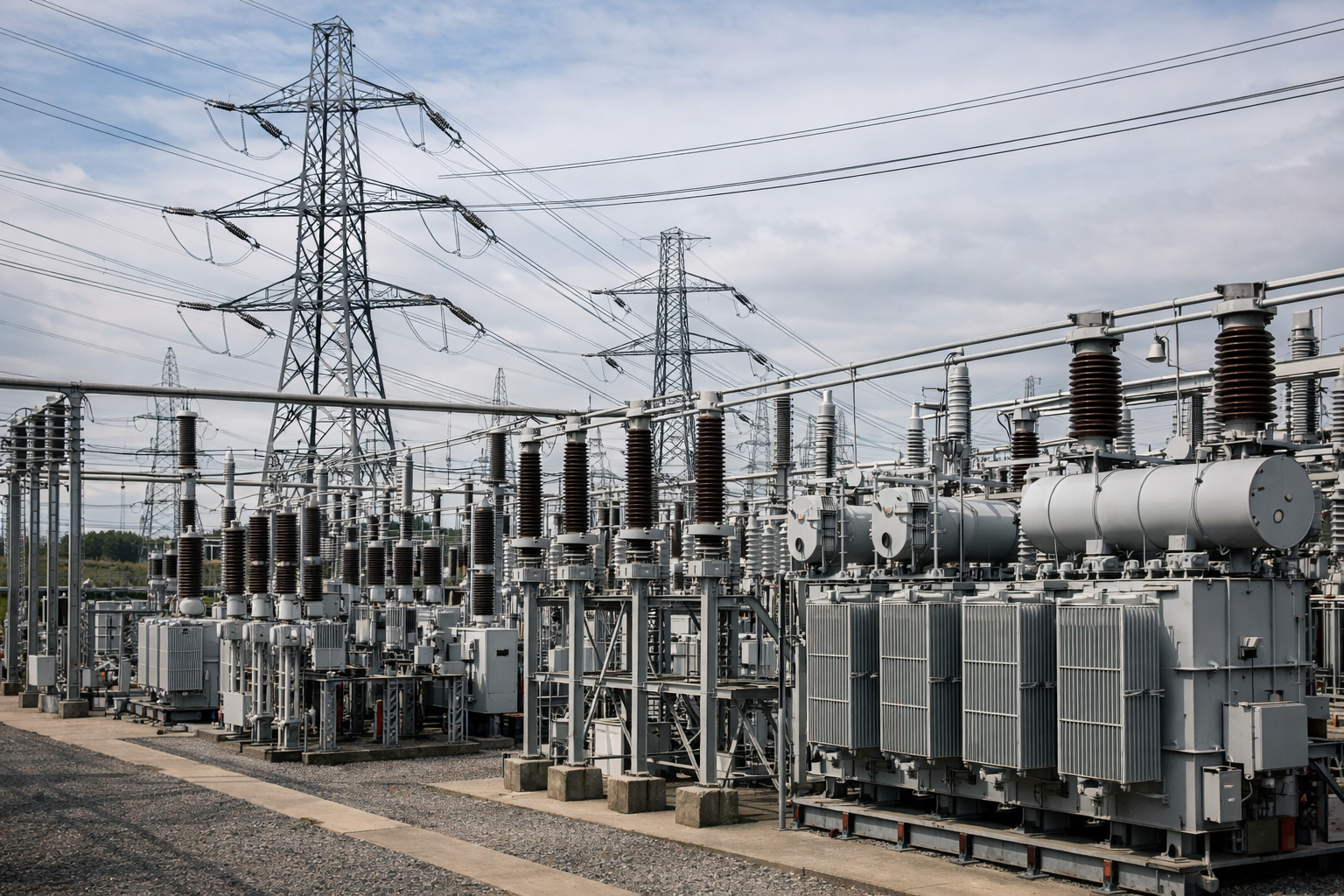
Geomagnetically induced currents are quasi-direct currents produced when changes in the Earth’s magnetic field create electric fields across the ground. They enter the transmission network through grounded transformer neutrals and flow along conductors, with their distribution shaped by geology, line orientation, network topology, and transformer winding arrangements.
Once direct current enters a transformer winding, it can shift the operating point of the magnetic core and cause half-cycle saturation. Increased reactive-power demand, harmonic currents, vibration, heating, protection operation, and voltage instability may follow under sufficiently severe conditions.
Measured data would strengthen operational models
Britain currently relies heavily on modelling to estimate geomagnetically induced currents at individual substations. Those models combine space-weather observations, geoelectric-field calculations, network topology, and transformer data, but direct measurements are needed to test whether the assumptions reproduce actual current paths.
The researchers have proposed a monitoring programme involving approximately 80 to 100 instruments. Neutral-current sensors installed at selected transformers could provide time-stamped measurements for comparison with forecasts, system conditions, and calculated current levels.
Coverage would need to reflect regional geology and network structure rather than distribute instruments uniformly. Coastal effects, conductive ground, line direction, transformer connections, and changes in network topology all influence where the highest currents develop during a geomagnetic disturbance.
Measurements could support transformer-specific operating limits by showing how individual designs respond to different current magnitudes and durations. Operators would then be able to move beyond broad thresholds that may be overly conservative for some assets and insufficient for others.
Direct data would also strengthen post-event engineering by allowing current measurements to be compared with voltage behaviour, reactive-power demand, harmonics, temperatures, dissolved-gas analysis, vibration, and protection records. Relationships between electrical stress and transformer condition could then be established from actual events.
Ofgem’s independent examination of grid operation during extreme heat addressed a different physical hazard, but both programmes involve system-wide events capable of affecting several assets at once and requiring advance operating procedures rather than isolated equipment responses.
Forecasting would remain essential because monitoring confirms conditions only after a storm has begun. Spacecraft observations can provide warning of incoming solar material, while ground-based magnetic measurements refine estimates of the electric field and the likely currents within the network.
Possible operating responses include changing topology, reducing the loading of vulnerable transformers, increasing reactive reserves, postponing planned maintenance, and placing additional generation or compensation equipment in service. Each action carries operational costs and must be supported by sufficient confidence in both the forecast and the relevant asset limits.
New overhead lines, offshore connections, and transformers will alter the system’s exposure over time, while lower operation of synchronous generation may reduce the reactive support available during a disturbance. Models and operating plans therefore need to evolve as the physical network and generation mix change.
A national monitoring system would not prevent geomagnetic currents, but it would provide the measurements required to validate models, refine transformer limits, and identify the most exposed assets. The May 2024 storm supplied a valuable test without causing a major failure; a stronger event may leave considerably less margin for uncertainty.

