
IN Brief:
- Aarsleff has secured a DKK3.7 billion design-and-build contract covering Bornholm Energy Island’s two principal onshore facilities.
- The programme includes 68,000m² of converter and high-voltage buildings across Bornholm and Høje Taastrup.
- The infrastructure will connect up to 3GW of Baltic offshore wind to Denmark and Germany through an integrated HVDC system.
Per Aarsleff has secured the design-and-build contract for the onshore facilities serving Bornholm Energy Island, placing a DKK3.7 billion package of converter buildings, high-voltage infrastructure, civil works, and technical installations into delivery.
Awarded by Danish transmission system operator Energinet, the contract covers two sites with distinct roles in the wider transmission programme. The larger facility will be built in southern Bornholm, where electricity from planned Baltic Sea wind farms will be converted and directed towards Germany and the Danish mainland, while a second installation at Høje Taastrup will provide the mainland interface west of Copenhagen.
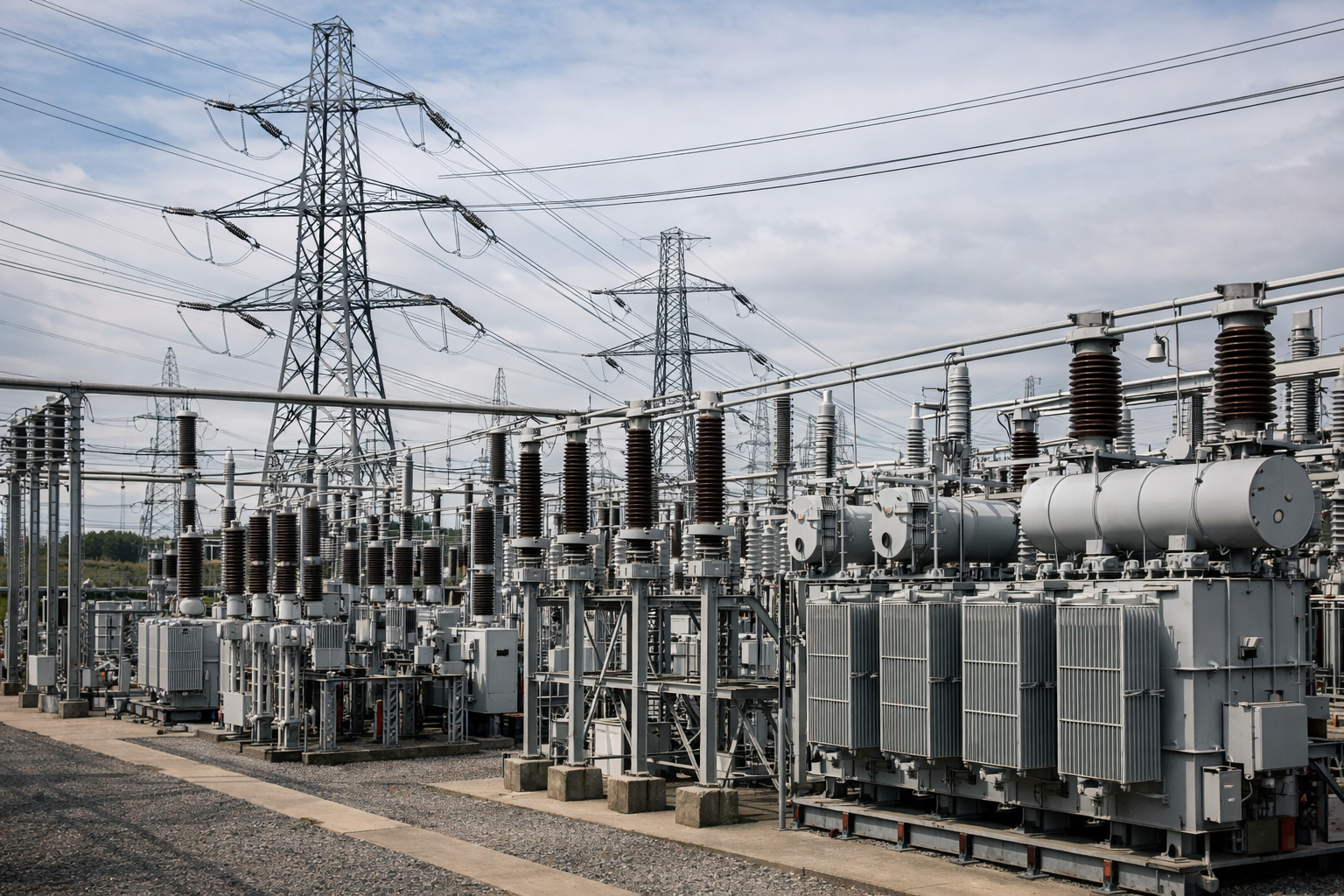
Across approximately 110 hectares on Bornholm, Aarsleff will construct 51,000m² of buildings, including concrete and steel halls for power converters and a 400kV high-voltage substation. Roads, landscaping, planting, drainage, and stormwater ponds are included, with four principal halls forming the dominant structures and an architectural treatment informed by the island’s rocky landscape.
Two further halls at Høje Taastrup will provide around 17,000m² of floor space on a 23-hectare site. The package includes associated infrastructure, landscaping, and services, creating the point through which converted power will enter the wider Danish transmission system.
A substantial share of the work will be delivered within the Aarsleff group. Concrete elements are due to be prefabricated at the company’s production facility in Poland, Wicotec Kirkebjerg will undertake technical installations, Artelia is supporting the design-and-build contract, and C.F. Møller Architects is responsible for the buildings and landscape design.
Design work is scheduled to begin on 1 August 2026, followed by initial earthworks and concrete construction around the end of 2027 and beginning of 2028. The two facilities are expected to be handed over during 2030 and 2031, subject to the standard procurement standstill period and subsequent programme controls.
HVDC delivery moves onto land
Although the contract centres on buildings and civil infrastructure, the facilities will house some of the most technically demanding equipment within the Danish-German energy island programme. Bornholm Energy Island is being developed jointly by Energinet and German transmission operator 50Hertz to collect up to 3GW of offshore wind generation and connect the two national systems through 525kV high-voltage direct-current links.
The completed scheme will combine renewable collection, power conversion, cross-border transmission, and electricity trading within a coordinated electrical system. Offshore generation will arrive through export circuits before being converted for long-distance transmission, divided between national networks, monitored, protected, and dispatched according to changing system conditions.
Converter halls must accommodate equipment with substantial structural, thermal, electrical, and maintenance requirements. Converter transformers, valve systems, reactors, cooling equipment, auxiliary supplies, protection, controls, and communications all require safe clearances, ventilation, fire protection, lifting access, and service routes that remain usable throughout the operating life.
Building design and electrical installation therefore have to progress as one programme. Foundations, embedded services, cable routes, equipment openings, earthing, fire compartmentation, and access arrangements cannot be finalised independently of the converter design, while late changes to electrical plant can alter structural requirements or delay installation.
Comparable coordination is already shaping Britain’s Eastern Green Link 2 programme, where converter stations and subsea HVDC infrastructure are being delivered together to transfer renewable electricity from northern generation centres towards demand further south.
Bornholm introduces the additional complexity of a cross-border system. Rather than functioning solely as a wind-farm export route, the project will also operate as an interconnector between Denmark and Germany, requiring controls capable of balancing changing wind output, commercial transfers, network conditions, maintenance outages, and equipment faults without treating each function as a separate installation.
Because converter stations produce and absorb reactive power, generate harmonics, and interact closely with surrounding AC networks, their design must include filtering, voltage control, protection coordination, and detailed electromagnetic studies. Equipment must remain stable during faults and switching events, while control systems need to prevent interactions between the converter terminals and connected generation.
The 400kV installation adds another interface between converter operation and the wider transmission network. Busbar configuration, circuit-breaker duties, instrument transformers, protection zones, earthing arrangements, and operational access must all be integrated with the converter station’s requirements and the switching philosophy adopted by Energinet.
Carbon performance was included as a competitive parameter in the procurement, bringing embodied carbon, material selection, transport, construction methods, and building operation into a contract whose principal purpose remains electrical. Prefabrication may improve repeatability and reduce some site activity, although the final environmental result will depend on design choices, logistics, and execution across both locations.
Construction sequencing will need to preserve the delivery windows for large transformers, converter components, and high-voltage equipment, much of which will arrive through specialist logistics routes and require heavy lifting. Delays to structural completion, access roads, drainage, or internal services could prevent factory-completed plant from reaching installation and commissioning on schedule.
Commissioning will extend beyond individual equipment tests. Protection, controls, telecommunications, cooling systems, auxiliary supplies, and converter functions will have to be verified across both national systems before the interconnector and offshore collection network can enter service.
The award moves Bornholm Energy Island from system planning into physical delivery of its principal land interfaces. Converter technology will carry the power, but the programme now depends on two precisely coordinated construction sites being ready to receive, connect, protect, and maintain equipment central to future Baltic transmission flows.

