IN Brief:
- KNIPEX has introduced a seven-part photovoltaic tool case for preparing and assembling MC4 solar connections.
- The set combines factory-calibrated crimping, conductor stripping, cable cutting, dies, locators, and connector assembly tools.
- Consistent DC connection preparation is becoming more significant as commercial rooftop systems grow in size and operating voltage.
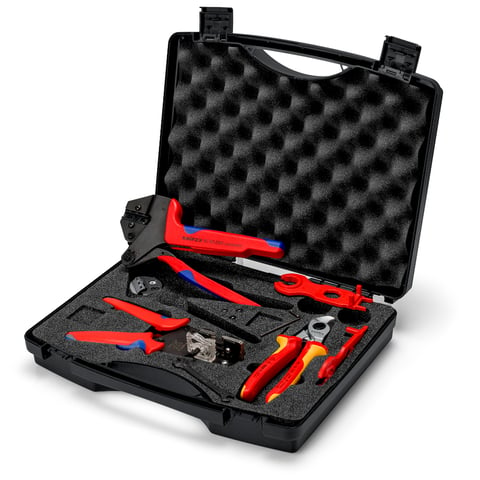
KNIPEX has introduced a dedicated photovoltaic tool case combining the equipment required to cut, strip, crimp, and assemble MC4 solar cable connections.
Contained within an impact-resistant plastic case with a fitted foam insert, the 97 91 04 V01 set includes seven components. Its central tool is the 97 43 200 A crimp-system plier, which accepts interchangeable dies and has its crimping pressure set and calibrated at the factory.
The supplied die and locator cover MC4 contacts for conductor sizes of 2.5mm², 4mm², and 6mm². A precision insulation stripper uses adapted blades for 1.5mm², 2.5mm², 4mm², and 6mm² conductors, while the cable shears can cut copper cable up to 15mm in diameter.
Assembly tools for tightening MC4 cable glands and releasing connector-housing locks are also included. Dedicated recesses provide space for two dies and two locators, allowing the case to be adapted for other approved photovoltaic connection formats when compatible components are available.
Although solar DC connection work appears mechanically straightforward, each termination depends on several controlled stages. Cable must be cut cleanly, insulation removed without damaging strands, the conductor inserted to the correct depth, and the contact crimped with the specified geometry and force. The contact must then be seated fully before the gland is tightened to provide sealing and strain relief.
Variation at any stage can increase electrical resistance or reduce environmental protection. Unlike an accessible AC terminal inspected during routine maintenance, a solar connector may remain beneath modules or within densely routed cable systems for many years, exposed to temperature cycling, ultraviolet radiation, moisture, movement, and sustained DC voltage.
Repeatable tooling reduces assembly variation but does not remove the need to match the complete connector system. MC4 is a registered trademark of Stäubli Electrical Connectors, and visually similar photovoltaic connectors are not automatically interchangeable. Contacts, housings, seals, cable dimensions, dies, and assembly torque must remain compatible with the specified system.
As commercial rooftop arrays grow, a single project may contain hundreds or thousands of field-made connections. Even a low individual defect rate can produce several latent faults across a large installation, making standardised preparation, tool control, calibration, inspection, and traceable commissioning essential to long-term performance.
Industrial rooftop programmes, including three recently completed Scottish installations, show how individual systems are increasing in size and how developers are aggregating several sites into operating portfolios. Connection quality then affects availability, insurance conditions, maintenance costs, and confidence in projected energy yield across multiple assets.
DC faults can be difficult to locate because strings remain energised whenever modules receive light. Poor connections may behave normally at lower current before heating under stronger irradiance, while intermittent defects can change with temperature or movement. Thermography, insulation testing, string-current comparison, and monitoring data can assist diagnosis, but preventing the defect during assembly remains preferable.
Tool management extends beyond purchasing a dedicated case. Crimpers should be inspected and maintained, dies checked for wear or contamination, and damaged tools removed from service. Operators need to recognise acceptable crimps, correct strip length, complete contact insertion, seal position, and connector engagement rather than relying solely on the final audible click.
The fitted case keeps matched tools and dies together while making missing components visible before work begins, reducing the likelihood of general-purpose pliers or unsuitable stripping equipment being substituted on site. Product specifications are available through the KNIPEX photovoltaic tool-case page. Higher-voltage, larger-capacity solar systems increasingly require field assembly to follow the same disciplined quality controls expected in factory production.