IN Brief:
- Nexans has completed a 3,000-metre deep-water sea trial on a 525kV MI HVDC subsea cable system.
- The test covered both installation and post-recovery validation, including electrical testing 30% above typical industry standards.
- The milestone supports work on the Great Sea Interconnector, where planned cable routes cross some of the deepest waters in the Mediterranean.
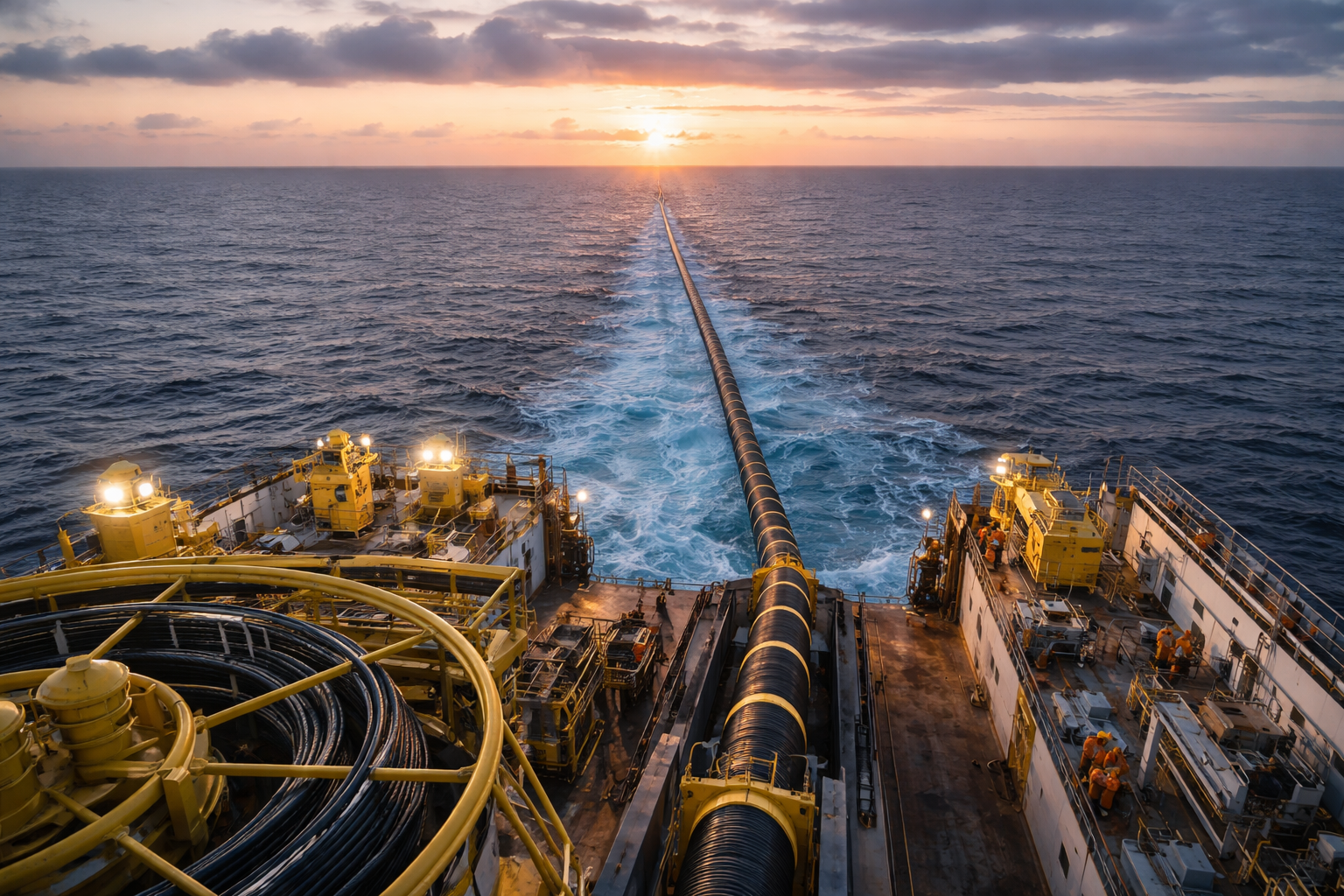
Nexans has set a new depth record for subsea power transmission after installing and testing a 525kV mass-impregnated HVDC cable at 3,000 metres during a deep-water sea trial. The exercise included a cable joint and was carried out as part of the company’s work on the Great Sea Interconnector for Greek transmission operator IPTO.
The company said the cable section was installed and tested at depth, then recovered for post-trial validation. Electrical testing and visual inspection confirmed the integrity of the cable system, with post-trial high-voltage tests performed at 30% above typical industry standards. Nexans said the recovered cable showed no remarks following inspection.
That matters because the Greece-Cyprus section of the Great Sea Interconnector is one of the most challenging subsea transmission routes now under development. Nexans’ 2023 contract for the project described the route as running across the Mediterranean seabed at depths of more than 3,000 metres. The first phase is designed to exchange up to 1,000 MW between the connected systems, with capability to increase to 2,000 MW later.
The latest result also builds directly on Nexans’ previous record. In December 2025, the company said it achieved a 2,150-metre installation depth on the Tyrrhenian Link project in Italy. Moving from that benchmark to a fully tested 3,000-metre sea trial in just a few months marks a significant technical step in qualification for very deep-water HVDC links.
Pascal Radue, executive vice president, PWR-Transmission at Nexans, said: “Reaching 3,000 meters sets a new benchmark for deep-water subsea power transmission. Combined with the 2,150-meter world-record installation achieved on the Tyrrhenian Link just months ago, this milestone demonstrates Nexans’ unmatched experience in mass-impregnated HVDC technology. It reflects decades of engineering expertise and the exceptional capabilities of our teams, who continue to push the boundaries of what is technically possible in subsea power transmission.”
The trial does not remove all execution risk from the Great Sea Interconnector, but it does address one of the most demanding engineering questions on the route: whether a 525kV MI HVDC cable system with a joint can be installed, recovered, and electrically validated after exposure to full ultra-deepwater conditions. For a project intended to link Cyprus to neighbouring systems and extend high-capacity transmission across the eastern Mediterranean, that is a useful result to have in the bag before main works intensify.