IN Brief:
- Electrical Safety First has opened entries for its Safety Innovation Award 2026.
- The award is free to enter and accepts projects, products, and prototypes from individuals and organisations.
- Previous winners include lithium-ion battery safety, hob shut-off, smart socket, alarm gateway, and device-integrated fire protection innovations.
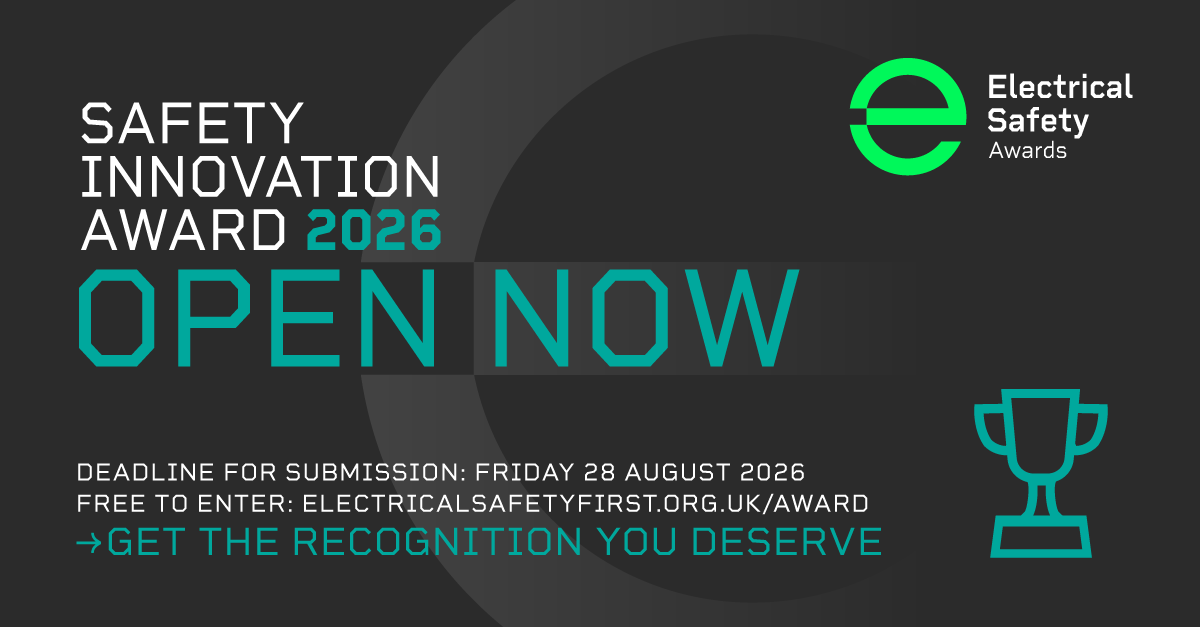
Electrical Safety First has opened entries for its Safety Innovation Award 2026, inviting individuals and organisations to submit products, projects, and prototypes designed to improve protection against electrical hazards.
The award is free to enter and accepts innovations at different stages of development. Entrants do not need to have completed a finished commercial product; concepts, projects, and prototype-stage ideas can also be submitted.
Entries close on Friday 28 August 2026. The winner will be announced at Electrical Safety First’s annual Electrical Product Safety Conference on Thursday 26 November at Church House, London, where shortlisted finalists will also be showcased.
The award provides a platform for innovators to present safety-focused ideas to retailers, manufacturers, distributors, policymakers, product-safety specialists, and the public. The winner will have the opportunity to present their innovation at the conference, alongside wider promotional support from Electrical Safety First.
Previous winners show the breadth of hazards now sitting across electrical products and installations. Flair Solutions’ E:BAG, the 2025 winner, was developed to contain and extinguish fires caused by lithium-ion batteries. The SafeBatt project, led by The Faraday Institution, has also been recognised for work on lithium-ion battery safety, including failure modes, propagation mechanisms, thermal runaway, modelling, and engagement with government bodies and first responders.
Other past winners include HobSensus, a Prefect Controls device that switches off unattended hobs and alerts residents to potential fires, and Connected Innovations’ socket-outlet technology, which detects heat build-up in plugs and nearby wiring before cutting power. Earlier recipients also include Aico’s SmartLINK Gateway and E-Bulb, a device-integrated fire protection product designed to detect and extinguish fires at source.
The 2026 award opens as electrical safety becomes more complex across domestic, commercial, and community settings. Buildings are carrying more chargers, batteries, connected appliances, power electronics, sensors, small mobility devices, and distributed energy technologies. Safety practice is therefore moving beyond conventional installation quality into product design, monitoring, thermal behaviour, user behaviour, maintenance, and lifecycle management.
Lithium-ion battery risk remains one of the clearest examples. E-bikes, scooters, tools, consumer electronics, and storage products have increased the number of battery-powered devices being charged and stored in homes, workplaces, communal areas, and commercial premises. Safety depends on cell quality, charger compatibility, thermal runaway behaviour, containment, user guidance, product standards, repair practices, and end-of-life handling.
Electrification is also changing the protection requirements inside installations. EV charging, heat pumps, battery storage, solar PV, and inverter-led equipment can alter leakage currents, fault characteristics, circuit design, inspection requirements, and device selection. Protection equipment is already adapting at the installation edge, including recent three-phase bi-directional RCBO developments designed for systems where current flow and leakage characteristics are becoming less straightforward.
Innovation in electrical safety often begins before standards, procurement routes, and mainstream product adoption have fully adjusted to new risks. Emerging hazards can appear first in incident data, recalls, laboratory testing, insurance evidence, fire-service experience, or installer feedback. Turning that evidence into a safer product or system usually requires technical validation, practical usability, early stakeholder engagement, and clear alignment with real operating conditions.
The product-safety environment is also becoming harder to police. Connected devices, online marketplaces, imported electrical goods, retrofit electrification, battery-powered mobility equipment, and repair markets all complicate responsibility across manufacturers, distributors, installers, landlords, and users. Effective safety innovation increasingly has to work across that whole chain, combining hardware, controls, detection, standards, guidance, and intervention.
Electrical Safety First’s award gives those ideas a route into a sector-facing assessment process. The strongest entries are likely to connect a clearly evidenced hazard with a practical method of prevention, detection, containment, shut-off, or user alerting.
Entries for the 2026 Safety Innovation Award can be submitted through Electrical Safety First’s award page.