IN Brief:
- The UK already has extensive underground cabling, but most of it sits in distribution networks, urban routes, or selected landscape schemes.
- High-voltage underground transmission can reduce visual impact, but it brings higher cost, larger civil works, more complex repair, and harder system operation over long distances.
- Overhead lines remain central to transmission planning, while undergrounding is used where the local, landscape, or engineering case is strong enough to justify it.
Across towns, cities, business parks, housing estates, and local distribution networks, underground electricity infrastructure is already part of normal engineering practice. London is being rewired through deep tunnels, Dorset has removed pylons from a protected landscape, and many lower-voltage distribution circuits are routinely buried beneath roads, pavements, verges, and private land.
At transmission level, however, the balance changes sharply. England and Wales have around 4,500 miles of overhead transmission line and just over 900 miles of underground transmission cable, with more than 22,000 pylons forming part of the high-voltage system. In National Grid’s distribution areas in the Midlands, south-west England, and south Wales, the picture reverses, with around 83,900 miles of underground cable and 60,000 miles of overhead line.
Because distribution and transmission perform different jobs, the same cabling decision cannot be carried across the system without changing the engineering case. Distribution networks carry power at lower voltages into communities, commercial sites, and individual premises, while the transmission system moves bulk electricity over longer distances at 275kV and 400kV before it is stepped down through substations. A buried cable serving a local load is not the same proposition as a high-capacity route crossing counties.
Where underground cables already fit
Where undergrounding is used most intensively, the surrounding constraints usually make the case. Dense urban areas rarely offer practical routes for large overhead transmission infrastructure, and repeated street-level cable works can be disruptive for traffic, residents, businesses, utilities, and public services. National Grid’s London Power Tunnels programme reflects that logic, with high-voltage circuits housed in deep tunnels so capacity can be added and maintained beneath one of the most constrained electrical environments in the country.
In protected landscapes, undergrounding can also carry a stronger public and environmental case. The Dorset Visual Impact Provision project replaced part of a 1960s high-voltage overhead transmission line with underground cables, removing 22 pylons over an 8.8km stretch between Winterbourne Abbas and Corton Ridge. The scheme used 108km of cable, brought 5,000 tonnes of cable to site, and required complex construction across rolling downland close to the Jurassic Coast World Heritage Site.
Although these examples show undergrounding working at transmission level, they also show why it is used selectively. London’s tunnels are a response to urban density and long-term access needs, while Dorset’s project was designed to restore a specific landscape where the visual benefit was judged strong enough to support the cost and engineering complexity. Neither example turns undergrounding into a default answer for every long rural route.
Recent work by Ramboll and Deloitte has reinforced that distinction. Cable ploughing, which places cable through a narrower slit in a more continuous operation than conventional cut-and-cover trenching, can reduce some construction impacts and cost. Even so, the method remains several times more expensive than overhead lines for transmission-scale work, with average build costs estimated at around 3.5 to five times higher depending on capacity.
Why long-distance transmission changes the calculation
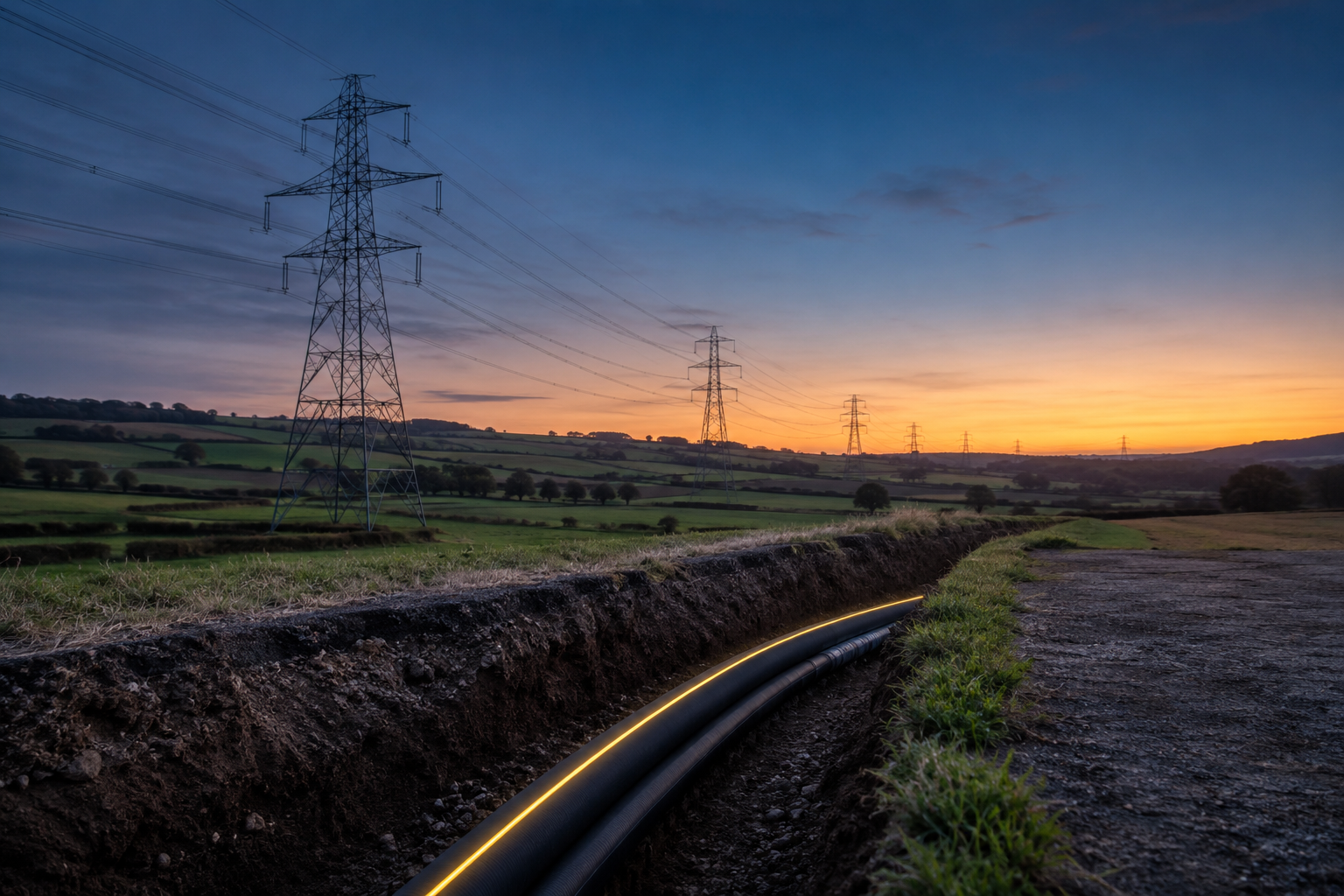
At high voltage, a cable route becomes a substantial engineered system rather than an overhead conductor placed out of sight. An overhead line uses air as part of its insulation system, with conductors suspended from towers and separated by clearance distances from the ground, other conductors, buildings, vegetation, and public access. A buried transmission cable needs solid insulation, mechanical protection, jointing, route preparation, thermal design, and access arrangements for future testing and repair.
Because underground cables transfer heat differently from overhead conductors, their installation can require wider construction corridors than the finished surface suggests. Long routes may need trenches, haul roads, joint bays, construction compounds, sealing-end compounds where underground cable transitions back to overhead line, and carefully specified backfill to control thermal performance. The permanent visual impact may be lower, but the construction phase can affect soil, drainage, vegetation, archaeology, agricultural operations, and access across a wide corridor.
Electrical behaviour adds another constraint, particularly on long AC routes where capacitance and reactive power have to be managed. Underground faults are also harder to locate and repair, as testing, excavation, cable replacement, reinstatement, and recommissioning can all be required before a circuit returns to service. By contrast, overhead assets are visually exposed, but inspection, access, and component replacement can often be more direct.
Cable ploughing has entered the debate because it appears to offer a narrower and faster form of underground installation. Its use at transmission scale remains constrained by ground conditions, cable size, voltage level, bending radius, thermal backfill requirements, and the practical availability of suitable equipment. Hard ground, rock, steep slopes, sensitive hydrology, peat, archaeology, and existing buried services can all push a project back towards more conventional civil works.
Policy already reflects selective use rather than blanket preference. Overhead lines remain the strong starting presumption for electricity network infrastructure in general, while nationally designated landscapes reverse that presumption where harm cannot be avoided by rerouting. The Bill Discount Scheme, with eligible households near new transmission infrastructure due to receive up to £250 a year, adds a more standardised benefit mechanism for communities hosting visible national assets.
Although community benefit cannot settle every objection, it recognises that transmission routes impose local consequences for national capacity. Good routing, careful design, environmental mitigation, construction management, and clear eligibility rules still matter. Compensation only carries weight when it sits alongside credible route selection and a transparent explanation of why overhead, underground, or subsea options have been chosen.
Current transmission programmes are advancing against a wider build-out of clean generation, storage, interconnection, data-centre load, and industrial electrification. National Grid has submitted £4.5bn of transmission re-opener proposals to Ofgem, covering reinforcement and upgrade work intended to support low-carbon generation, major industrial users, data centres, and wider resilience. New circuits, uprated assets, substations, converters, and control equipment are all being pulled into the same delivery programme.
On existing routes, the same capacity pressure is visible in asset renewal as well as new build. A 40km overhead route between Mannington and Nursling is being refurbished through reconductoring across 115 pylons, steelwork upgrades, fitting replacement, access planning, and outage coordination. Even where the corridor already exists, maintaining transmission capacity requires physical work through rural, suburban, and transport-adjacent environments.
A workable approach therefore needs more than a simple preference for visible or invisible infrastructure. Undergrounding should remain available where urban density, protected landscapes, local impact, or project-specific engineering conditions support the case. Overhead lines will remain central where high capacity, lower cost, shorter delivery, easier inspection, and proven performance carry greater system value. Between those positions sits the practical work of route refinement, local mitigation, community benefit, and construction discipline.
As clean power moves from target-setting into construction, the grid debate is becoming more physical and less abstract. Britain will continue to bury cables in the right places, and it will continue to build overhead lines where transmission scale demands it. The stronger test is whether those choices are made with enough technical clarity, local honesty, and delivery focus to keep the power system moving.