IN Brief:
- PowerStack 3.0 uses modular power conversion, solar, charging and microgrid configurations for commercial and industrial installations.
- Sungrow claims up to 99.2% maximum converter efficiency, more than 92% round-trip system efficiency and configurable two-hour or four-hour storage durations.
- The system introduces claimed zero-millisecond islanding, wider environmental ratings and AI assisted design, commissioning and maintenance tools.
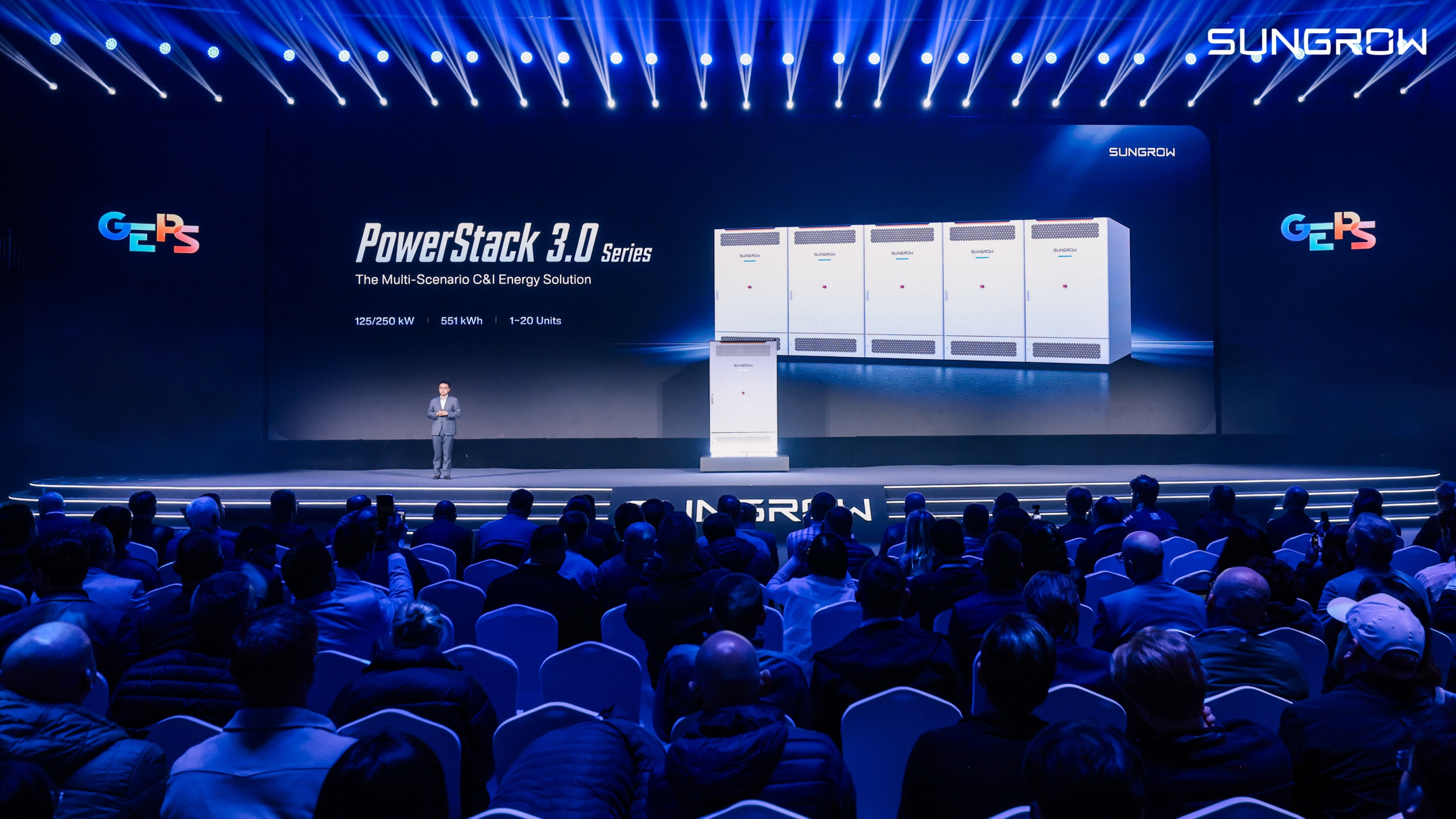
Sungrow has launched PowerStack 3.0, a modular commercial and industrial battery storage platform combining power conversion, solar input, vehicle charging and microgrid functions. Introduced at the Global Energy Pioneer Summit in Hefei on 11 November, the series is built around interchangeable functional modules rather than a single fixed equipment arrangement. The company is marketing it internationally, although it has not identified an initial UK installation.
The platform uses four module categories: power conversion system (PCS), solar, charging and microgrid. By selecting combinations of these modules, a project can be configured for standalone storage, photovoltaic generation with storage, or an installation that also serves vehicle chargers. Sungrow offers two-hour and four-hour storage configurations. The difference concerns the amount of energy available relative to converter output, not a promise that every connected load can be supplied for the same period.
In the photovoltaic configuration, Sungrow says the solar module makes use of the storage PCS for DC-coupled integration, removing the need for a separate inverter in the arrangement it describes. The version combining photovoltaic generation, storage and charging is also designed around a common DC architecture. Actual energy flows, the allowable voltage range, isolation equipment and protection settings will depend on the design of the complete installation and the detailed product documentation.
Sungrow also offers a microgrid module intended to support critical loads when the external network supply is interrupted. The company claims a zero-millisecond transition from grid-connected to islanded operation without a separate static transfer switch cabinet. That performance claim relates to the manufacturer’s specified arrangement; continuity of supply in practice will also depend on available stored energy, load characteristics, protective coordination and the configuration used at the site.
The system uses a silicon carbide PCS which Sungrow says achieves maximum conversion efficiency of 99.2%. Its stated round-trip efficiency exceeds 92%, using 684Ah battery cells. Those figures describe different losses: converter efficiency relates to the power electronics, while round-trip efficiency measures the energy returned following a charge-discharge cycle under specified conditions. Sungrow has not published a universal site performance guarantee encompassing every operating duty and auxiliary load.
Sungrow specifies energy density of up to 256kWh per square metre and says the new system can reduce the footprint of a 5MWh installation by 43% compared with the previous generation. The equipment can be arranged side by side, back to back or face to face, with up to 20 units connected in parallel. These headline figures describe the manufacturer’s product configurations. Final site layouts must still allow for access, clearances, fire safety provisions and any additional electrical plant required by the connection design.
Footprint and integration figures will be especially dependent on the chosen installation. A site adding storage to existing solar generation may have different switchgear, cabling and transformer requirements from a new project combining storage and vehicle chargers. A microgrid operating in islanded mode also needs an arrangement for controlling loads and maintaining suitable voltage and frequency. Sungrow has described functional modules and maximum performance figures, but has not disclosed a complete application design for every configuration in the launch material.
Environmental specifications include IP55 ingress protection, C5 corrosion protection and an operating temperature range from minus 30°C to 50°C. Sungrow also claims tolerance of up to 30% grid harmonics, although the release does not define the full test conditions behind that figure. Three-level fuse protection and a four-layer fire safety concept are identified as parts of the product design. Their relevance to an individual installation will depend on compliance documentation, local fire engineering and the selected system arrangement.
The Bubbly software assistant is intended to support design, commissioning, operating control and maintenance. Sungrow claims that it can generate a proposed layout and financial calculations in 30 seconds using satellite imagery and three-dimensional modelling, and assist with commissioning data validation in three minutes. The company says the monitoring system can identify more than 30 risks, while its dispatch optimisation could increase returns by over 12% compared with conventional self-consumption operation. These results are manufacturer claims rather than independently verified outcomes across different sites.
PowerStack 3.0 is intended for installations requiring different combinations of solar generation, electrical storage, charging and local resilience. Sungrow has published headline efficiency, footprint and environmental figures, but the final scope of a project will depend on converter ratings, the protection design, physical access and regional installation requirements. A first UK reference project, delivery timetable and site-specific performance data have not been disclosed. Those details will determine how the configurable system is applied beyond the launch configurations.