IN Brief:
- Sineng supplied 6.9MW central PCS MV stations for a 150MW/300MWh section of the Burgas BESS.
- Each turnkey station combines four central PCS units, a transformer, and ring main unit, with four-quadrant reactive-power and grid-forming capability.
- The wider 602MWh facility is intended to provide balancing, reserve, and energy-shifting services on Bulgaria’s electricity system.
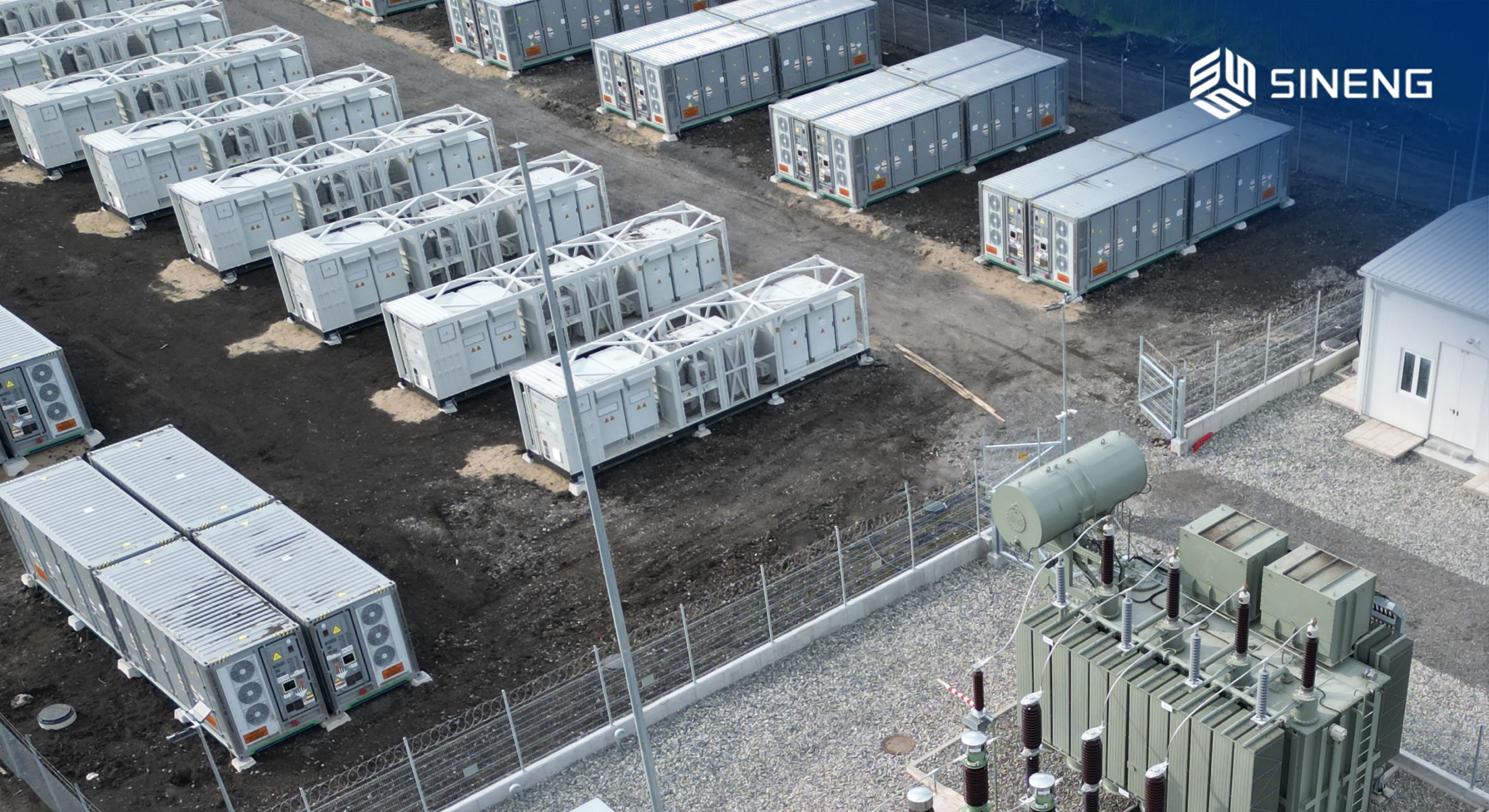
Sineng Electric has supplied 6.9MW central power-conversion-system medium-voltage stations for a 150MW/300MWh section of the Burgas battery energy storage project in Bulgaria, part of a wider operating facility with a reported total capacity of 602MWh.
The project was executed by Solarpro Technology as EPC and operations-and-maintenance contractor. Sineng says the Burgas installation increases Bulgaria’s energy-storage capacity by around 10%, with the plant intended to support renewable integration and provide additional balancing capability on the national electricity system.
Sineng’s electrical package combines four EH-1725-HA-UD central PCS units with a transformer and ring main unit in each 6.9MW turnkey station. Integrating conversion, transformation, and medium-voltage switching into one package reduces the number of interfaces that have to be engineered and commissioned between the battery blocks and the grid connection.
The supplier says the design cuts parallel connections by 50% compared with an alternative arrangement and supports applications with storage durations from one to eight hours. The Burgas block itself is rated at 150MW/300MWh, giving it a nominal two-hour energy-to-power ratio.
More significant for the grid interface is the PCS control capability. Sineng specifies four-quadrant reactive-power operation and grid-forming functionality, allowing the conversion system to provide more than straightforward active-power charging and discharging.
Grid-forming control is attracting greater attention as electricity systems connect more generation and storage through power electronics. Conventional grid-following converters synchronise to an existing voltage and frequency reference, whereas a grid-forming converter can be controlled to establish a voltage waveform and contribute to system strength.
That does not make a battery an automatic substitute for every characteristic of a synchronous generator. Performance depends on control design, protection settings, available stored energy, fault-current behaviour, and the wider network, but the capability gives system operators another source of fast voltage and frequency support as inverter-based resources increase.
The Burgas facility is also intended to participate in Frequency Containment Reserves and automatic Frequency Restoration Reserves, alongside peak shaving and load shifting. These services place different demands on the plant even though they use the same battery and power-conversion hardware.
Frequency services require rapid and accurate changes in active power in response to system conditions. Load shifting, by contrast, involves moving energy over longer periods, charging when electricity is more readily available and discharging later when demand, congestion, or market conditions make stored energy more valuable.
A nominal two-hour system has enough energy to sustain rated output far longer than a typical fast frequency-response event, although the operator cannot assume the entire battery is available for every service simultaneously. State of charge, degradation limits, reserve commitments, and commercial schedules all affect how much power can be offered at any particular time.
The PCS sits at the centre of those decisions from an electrical perspective. Battery cells determine stored energy, but the conversion system determines how that energy is exchanged with the AC network, including active power, reactive power, ramp rate, fault response, and compliance with the site’s connection requirements.
Reliability therefore depends on more than cell performance. Thermal management, control software, transformer loading, protection coordination, communications, and the maintainability of the PCS all influence plant availability, particularly where large blocks of battery capacity are concentrated behind central conversion equipment.
Centralised architecture can reduce equipment count and simplify some electrical interfaces, but it can also place more capacity behind each conversion block. Modular design becomes important because a failed subassembly should be repairable without removing an unnecessarily large proportion of the plant from service.
For Bulgaria, the wider significance of the 602MWh facility lies in controllability rather than stored energy alone. Wind and solar generation can change quickly or produce strongly during periods when demand is weaker, leaving the power system to manage larger movements in balancing requirements.
Storage can absorb some of that energy and return it later, while fast power electronics can respond to shorter system deviations. Reactive-power and grid-forming functions add a separate layer by allowing the electrical interface to support voltage and system behaviour rather than acting solely as an energy-transfer device.
The Burgas project also reflects a wider move towards pre-integrated storage electrical packages. Instead of treating batteries, PCS equipment, transformers, and switchgear as entirely separate site-engineering packages, suppliers are combining more functions before delivery, reducing the number of interfaces that must be resolved during installation and commissioning.
That approach can shorten site work, but operational performance remains the decisive test. Availability, conversion efficiency, reserve response, thermal behaviour, and the ability to maintain grid-forming operation under real network conditions will determine whether the project’s electrical specification translates into dependable system value.