IN Brief:
- Two polyethylene cable ducts, each almost 1,800 metres long and 800 millimetres in diameter, have been installed beneath the Suffolk coastline.
- Horizontal directional drilling allowed the ducts to be installed beneath the coastal environment without excavating an open trench across the beach.
- The ducts will accommodate export cables for the 960 MW East Anglia TWO offshore wind farm, which is targeting operation in late 2028.
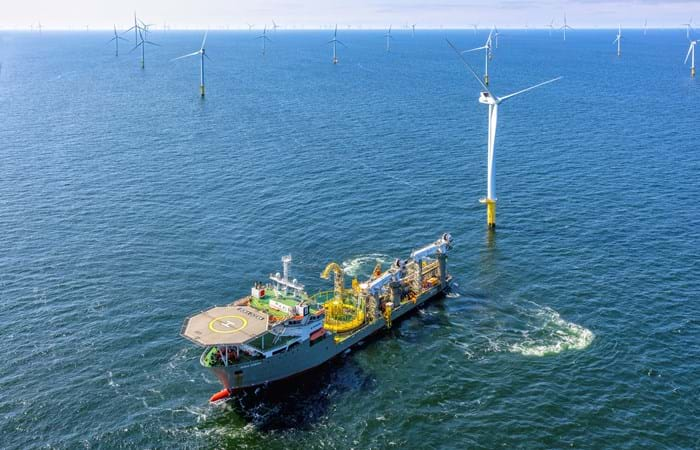
ScottishPower Renewables has completed the installation of two cable ducts beneath the Suffolk coastline for the 960 MW East Anglia TWO offshore wind farm, establishing protected routes through which its high-voltage export cables will subsequently be installed.
Each duct measures almost 1,800 metres in length and 800 millimetres in diameter. The installation used horizontal directional drilling, with the polyethylene ducts pulled through drilled routes beneath the coastline and seabed rather than installed in an open trench across the beach.
ScottishPower describes the operation as a global engineering first involving the longest continuous individual sections of extruded polyethylene duct used in this type of installation. That description is the developer’s claim and refers to the duct installation, not to the capacity or operating performance of the future electrical connection.
The landfall forms part of the approximately £4 billion East Anglia TWO project in the southern North Sea. The planned wind farm has a generating capacity of 960 MW, with commercial operation targeted for late 2028. That timetable concerns the wider generating project and must not be mistaken for completion of the export cable system.
Horizontal directional drilling allows infrastructure to be routed beneath obstacles and sensitive areas from controlled drilling locations. A pilot bore establishes the intended route, which is then enlarged sufficiently to accommodate a duct. The drilling plan must reflect ground conditions, route geometry and the mechanical properties of the material to be installed.
The dimensions of the East Anglia TWO ducts make installation a substantial engineering exercise. A continuous polyethylene section approaching 1.8 kilometres in length is difficult to handle, and the pulling forces involved must remain within the material’s allowable limits. Friction along the bore and changes in direction can increase the force required during installation.
Bending is another important constraint. The duct route must avoid curvature that would exceed the material’s permissible bending radius or compromise the bore. Accurate surveying, pullback planning and monitoring are therefore relevant to achieving a usable route for the later cable works.
The stated 800 millimetre measurement is the diameter of each protective duct. It does not describe the diameter of an electrical conductor, the operating voltage of the export system or the volume of electricity that the completed wind farm will generate.
The future export cables will be more complex assemblies incorporating electrical conductors, insulation, screening and protective layers. They must transfer high-voltage alternating current from offshore electrical infrastructure towards the onshore grid connection while satisfying thermal, mechanical and dielectric requirements.
The ducts establish a controlled transition beneath the shore through which those cables can be pulled. They also separate the cables from direct contact with surrounding ground along the ducted section. The condition and geometry of the duct routes will influence the installation method selected for the electrical circuits.
The technique avoids an open excavation along the selected beach crossing, although drilling activities, temporary construction compounds and the handling of long duct sections still create worksite impacts that must be managed. It would be inappropriate to assign a numerical environmental benefit to this method without a project-specific assessment.
Cable pulling will constitute a separate construction stage. Installers must control cable tension and sidewall pressure, protect the outer sheath and respect the minimum permitted bending radius. The long duct sections and their installed profile will influence the selection of installation equipment and the sequence of work.
Once cable installation is complete, terminations and associated high-voltage equipment will require testing and integration with the offshore and onshore electrical systems. Energisation can occur only after the relevant construction, commissioning, protection and operational procedures have been completed.
In a cable system, conductor heating influences the maximum permissible electrical loading. Cable construction, surrounding thermal conditions and whether the circuit is installed in a duct or directly buried can all affect its heat dissipation. These considerations have to be accounted for in the eventual export cable engineering.
The landfall ducts themselves are civil engineering assets, but their successful installation is a prerequisite for the electrical infrastructure needed to move offshore wind generation onto the power network. Completing this stage helps reduce one specific construction dependency without establishing that the project is ready to export electricity.
Offshore wind developments involve interdependent programmes for foundations, turbines, inter-array cables, offshore substations, export cables and onshore grid works. Slippage in one element can affect the ability to bring generating equipment into service, even where other parts of a project have already been completed.
ScottishPower’s announcement confirms the two long ducts are in place. It does not confirm installation or energisation of the export cables that will eventually occupy them. The next relevant milestones are the cable pull, termination and testing activities and their integration with the wider East Anglia TWO construction programme.
The completed landfall is therefore a significant physical progress point for East Anglia TWO, while the technical and regulatory work required for electricity transmission and commercial wind farm operation remains ahead of the project.