
IN Brief:
- Russelectric has highlighted an Advanced Microgrid Controls Solution for critical facility power resilience.
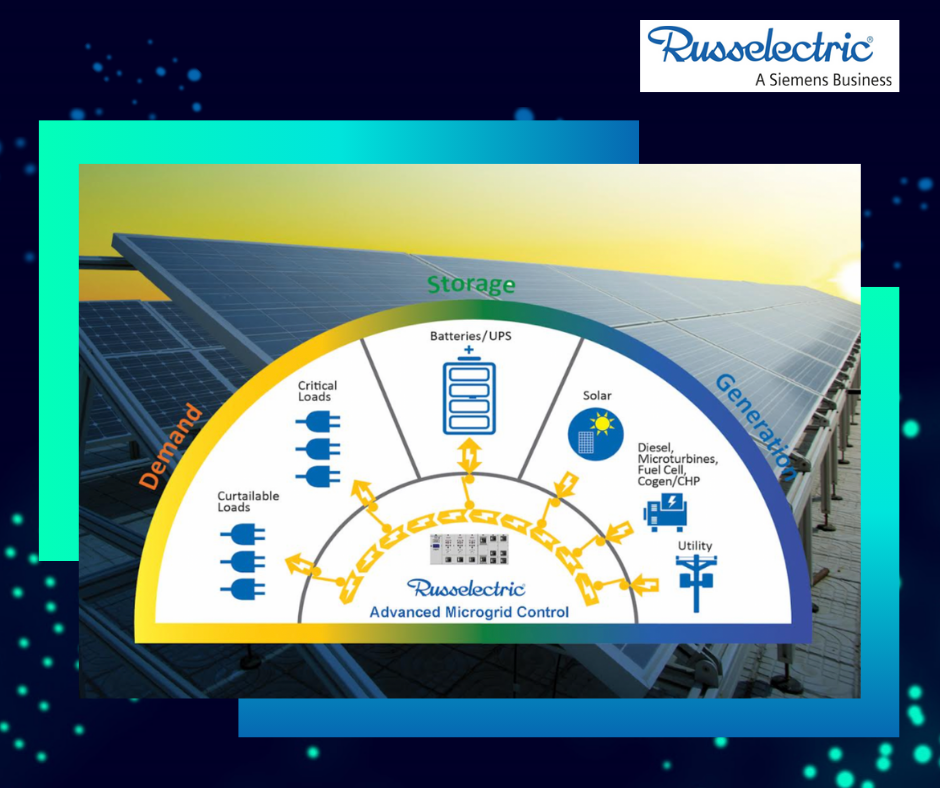
- The platform integrates transfer switches, switchgear, power controllers, generators, battery backup, PV, and facility loads.
- Dynamic islanding, black start, and grid resynchronisation support continuity during outages and abnormal grid conditions.
Russelectric, A Siemens Business, has highlighted its Advanced Microgrid Controls Solution, an integrated hardware and software platform designed to strengthen facility power management and resilience across critical sectors.
The platform combines transfer switches, switchgear, and power controllers to integrate on-site demand and generation assets. It connects and optimises generators, battery backup, photovoltaic arrays, and facility loads, allowing distributed energy resources to operate as part of a coordinated power system rather than as isolated assets.
The system is designed for critical facilities where outage performance, power quality, and operational continuity carry direct safety or business consequences. Healthcare facilities are a primary application, alongside data centres, telecommunications, water treatment, defence facilities, and other sites where electrical failure can disrupt essential services.
Key functions include dynamic islanding, fast decoupling from the grid, automatic black start of backup generators, and grid resynchronisation. The system can also support energy cost reduction and carbon reduction where local generation, battery storage, and load management are coordinated with grid supply.
Further product information is available through Siemens’ Russelectric power systems and controls page.
Critical facility power design is moving beyond the traditional separation between normal supply and emergency backup. Standby generators and automatic transfer switches remain essential, but microgrid control brings backup power, local generation, storage, and grid supply into a more coordinated operating model.
Resilience is one driver. Grid disturbances, severe weather, cyber risk, and local network constraints have increased the value of power systems that can isolate cleanly, maintain priority loads, and resynchronise safely. Energy complexity is another. Facilities are adding PV, batteries, combined heat and power, EV charging, and flexible loads, creating more dynamic electrical environments inside the site boundary.
Microgrid controls operate at the point where those requirements meet. They manage protective relays, breaker status, generator synchronisation, load priorities, battery operation, and utility interconnection rules. During a grid loss event, fast and stable transition into islanded operation can reduce disruption to sensitive equipment and critical processes.
The same integrated systems thinking is becoming more common across grid and facility infrastructure. The expanded AC grid alliance between Hitachi Energy and Samsung C&T reflects growing demand for combined electrical system design and delivery at project scale. Facility microgrids apply the same principle locally, bringing power control, switching, protection, generation, storage, and monitoring into one engineered system.
Transfer switches and switchgear remain central to that performance. A microgrid controller depends on electrical equipment that can isolate, transfer, synchronise, and reconnect safely. Medium- and low-voltage equipment ratings, short-circuit withstand, selective coordination, bypass arrangements, earthing, and maintainability all remain fundamental to a resilient design.
Monitoring and control add the operational layer. Real-time device status, connection updates, simulations, and SCADA integration give facilities better visibility before, during, and after abnormal grid events. In a hospital, data centre, or industrial process environment, that visibility can reduce the risk of failed transfers, overloaded circuits, or uncoordinated generator response.
Russelectric’s lifecycle support model covers engineering, design assistance, project management, manufacturing, testing, installation, commissioning, and 24-hour factory field service. That breadth reflects the level of detail required in microgrid delivery, where facility load studies, utility interconnection requirements, protection settings, black start sequencing, operating modes, and maintenance strategy all need to be resolved before the system can be relied on in service.
Critical power systems are increasingly being designed as controllable, multi-asset microgrids rather than separate layers of backup equipment. The practical value sits in whether those assets can operate with the grid during normal conditions, separate from it during abnormal conditions, and return safely when supply is restored.

