IN Brief:
- Planning permission is now in place for Long Lane, Chesterfield, and High Marnham substations.
- The associated overhead circuits will be uprated from 275kV operation to 400kV.
- The reinforcement uses existing transmission routes while adding new high-voltage switching infrastructure.
National Grid has secured planning permission for three new 400kV substations required to reinforce the transmission network between South Yorkshire, Derbyshire, and Nottinghamshire. The approvals support the planned uprating of existing overhead circuits from 275kV operation to 400kV.
The new facilities will be built at Long Lane in Rotherham, near Chesterfield, and at High Marnham in Nottinghamshire. High Marnham received planning approval in June, while the Long Lane and Chesterfield schemes were approved by their respective local authorities in July.
The three substations form part of two closely linked transmission projects: Brinsworth to Chesterfield and Chesterfield to High Marnham. Together, they will allow National Grid to increase the operating voltage of the existing overhead-line corridor while retaining much of the established route.
That distinction matters because uprating an existing corridor can increase transfer capability without requiring an entirely new line between the same points. It does not, however, turn a 275kV system into a 400kV network through a simple change in operating instructions. Substations, insulation, line interfaces, protection, clearances, and associated equipment all have to be capable of handling the higher voltage.
National Grid says the overhead lines involved were originally consented for 400kV operation in the 1960s but have so far operated at 275kV. The planned work will use that existing infrastructure while adding the new substations and undertaking the modifications required to bring the circuits into service at their higher design voltage.
At Long Lane, a new substation east of the existing Brinsworth area will provide the switching infrastructure needed for the Brinsworth-to-Chesterfield section. Chesterfield will become the interface between the two uprated sections, while High Marnham will form the southern end of the reinforcement and provide a connection point for other planned transmission works.
The existing 275kV substations at Chesterfield and High Marnham are expected to be decommissioned after the new 400kV facilities are completed. Brinsworth’s existing substation will remain operational alongside the new Long Lane facility. That creates a staged transition in which new primary plant has to be built, tested, and connected without unnecessarily compromising the availability of the existing network.
Higher transmission voltage reduces the current required to transfer a given amount of power. Because resistive losses rise with the square of current, moving bulk power at 400kV can carry significantly more energy efficiently than operating the same general corridor at 275kV, provided the conductors and associated equipment remain within their thermal, electrical, and mechanical limits.
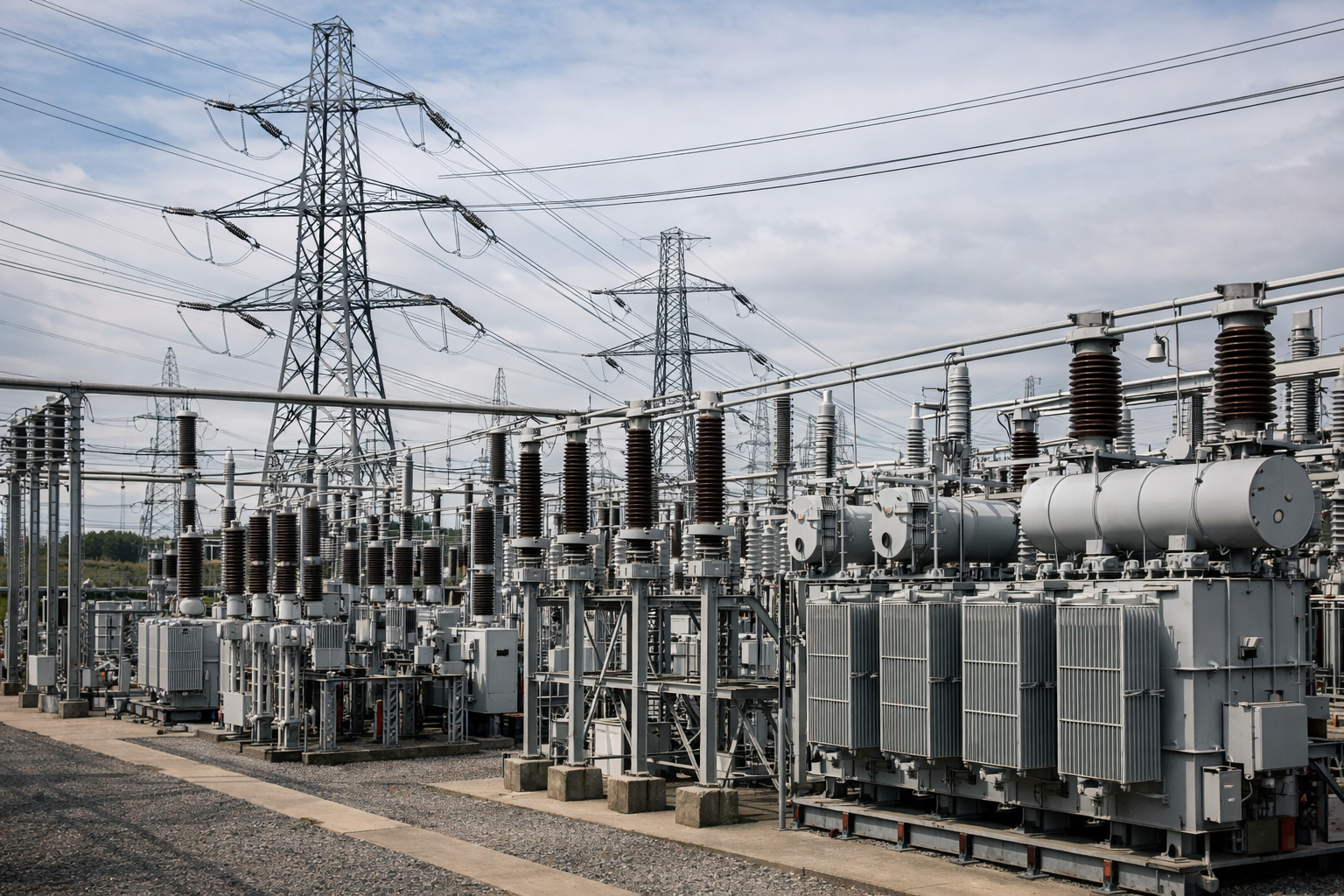
The substations are therefore central to the reinforcement rather than secondary pieces of infrastructure. They contain the switchgear, busbars, protection systems, instrument transformers, control equipment, and other plant required to isolate faults and control power flows across the network. Their design also has to provide safe clearances appropriate to 400kV equipment and allow maintenance without creating unacceptable system outages.
Protection coordination becomes more complex as network topology changes. Relays have to distinguish rapidly between faults on different parts of the system and issue trip commands to the correct circuit breakers, while communications between substations allow schemes such as intertripping and differential protection to operate across longer sections of the network.
Construction will also require careful outage planning. Existing circuits cannot simply be disconnected for extended periods whenever civil or electrical work reaches an interface point. National Grid must coordinate temporary configurations, planned outages, commissioning tests, and final energisation around wider transmission-system requirements.
The projects are part of the Great Grid Upgrade, a wider programme intended to increase the capacity of England and Wales’ transmission system as electricity demand and renewable generation rise. New generation is increasingly connecting in locations that differ from the historic geography of large thermal power stations, while electrification is adding demand in transport, heating, industry, and digital infrastructure.
That combination changes not only how much electricity the transmission network carries, but where it has to move. Reinforcing existing corridors can therefore provide useful capacity alongside entirely new transmission routes, particularly where towers and conductors were designed with higher-voltage operation in mind.
Planning permission removes one important constraint, but procurement and engineering remain ahead. Detailed design, civil works, switchgear installation, protection and control integration, overhead-line modifications, outage coordination, testing, and commissioning all have to be completed before the uprated corridor can operate at 400kV.
The approvals make the route substantially more deliverable; they do not put another megawatt across it. The value of Long Lane, Chesterfield, and High Marnham will be established when the new primary plant is energised and the existing transmission corridor can finally operate at the voltage for which much of it was originally intended.