IN Brief:
- USCALE surveyed 1,213 German fleet decision-makers on charging and electrification plans.
- High vehicle cost fell as the largest hurdle from 52% in 2024 to 29% in 2026.
- Charging management software, scalability, and integration with fleet management systems are becoming central requirements.
USCALE has published findings from its 2026 Fleet Charging Study, based on interviews with 1,213 fleet decision-makers across Germany.
The study examined depot charging, IT integration, roadside charging services, fleet electrification priorities, and charging management systems. Of the decision-makers surveyed, 873 were actively electrifying fleets, while 340 had not yet started.
The findings suggest that Germany’s fleet charging market is shifting from early cost barriers toward practical implementation constraints. High vehicle cost was identified as the largest hurdle by 29% of companies in 2026, down from 52% in USCALE’s 2024 survey. Other overriding priorities were cited by 41% of participants, making them the largest current barrier.
Just over half of respondents, at 56%, said they have a long-term fleet electrification strategy. A slightly smaller proportion, 48%, said they are investing incrementally to stay flexible as charging technology develops. The figures point to a market that is no longer waiting for EV adoption to become plausible, while still cautious about committing too early to infrastructure and software architectures.
Scalability was the most important decision-making factor when expanding AC and DC charging solutions, followed by system interface and technical features. The software layer is also changing. Fleet management software was a key criterion in 2024, but the 2026 survey shows greater focus on charging management software.
Most companies surveyed, at 44%, wanted charging management software integrated into fleet management systems. Among large companies, that figure rose to 56%. A further 21% wanted fleet management systems integrated into charging management software, while 22% preferred separate solutions.
The public charging section of the survey showed a split between price and system integration. Price and network coverage were primary decision factors, particularly among smaller companies and fleets with HGVs. Roaming networks, oil companies, and charge point operators were broadly tied in usage preference, while OEM roaming offers had a lower preference share of 10%.
Germany’s fleet market is therefore moving from a vehicle-adoption question toward an infrastructure and software challenge. The early test was whether fleets could afford electric vehicles and whether enough charging points existed. The next test is whether vehicles, depot chargers, public networks, energy systems, and software platforms can operate as one manageable system.
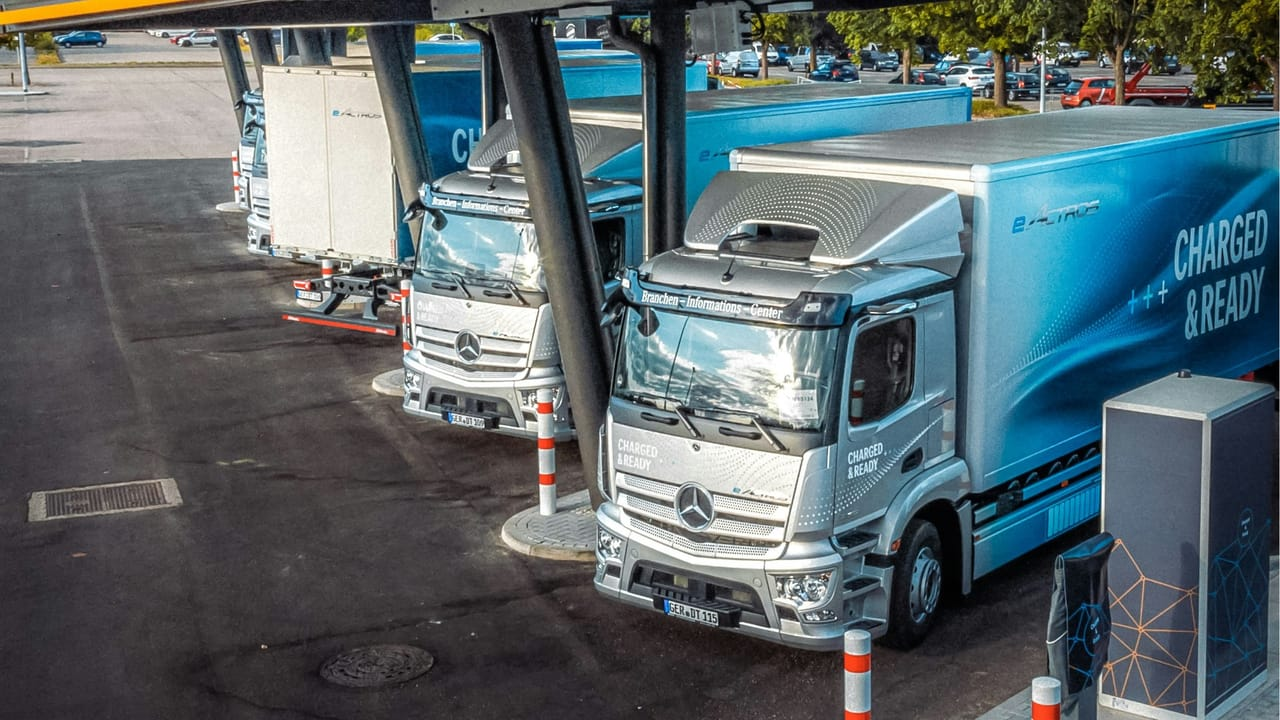
Depot charging is especially demanding because it sits at the junction of electrical infrastructure, fleet scheduling, site operations, and energy cost control. AC charging may be sufficient for lower-utilisation vehicles with predictable overnight dwell times. DC charging becomes more important for higher-mileage vehicles, heavier duty cycles, and vehicles with limited stop windows.
The same electrical constraints are appearing in other charging markets. UK work on motorway charging grid support has shown how connection capacity and upgrade costs can become limiting factors even when demand for charging is clear. Fleet depots face a similar operating reality: charger installation is only part of the work, while capacity, controls, load management, and usage profile determine whether the system functions economically.
Charging management software is becoming central because fleets need to control when vehicles charge, how much power they draw, which assets take priority, and how charging costs are assigned. Larger fleets also need data integration with route planning, driver management, maintenance systems, depot operations, and energy procurement.
The division between integrating charging management into fleet management, or fleet management into charging management, is more than a software preference. It reflects where companies see operational control sitting. Logistics-led businesses may want charging to become a module inside fleet operations, while energy-led or depot-intensive businesses may want charging software to become the central control layer for vehicles, chargers, tariffs, and site loads.
Public charging adds another layer. Fleets need price visibility, route coverage, reliable authorisation, and usable invoice data. Charging networks that compete purely on access may struggle where CPOs can offer better pricing and stronger system integration. Roaming providers, meanwhile, need pricing and data quality to support fleet operations at scale.
The German study indicates that electrification is no longer held back only by vehicle economics. It is becoming a systems-engineering task involving depots, grid connections, IT architecture, public charging contracts, and fleet operations. Companies that treat charging as infrastructure, software, and energy management combined will be better placed to scale electric fleets reliably.