IN Brief:
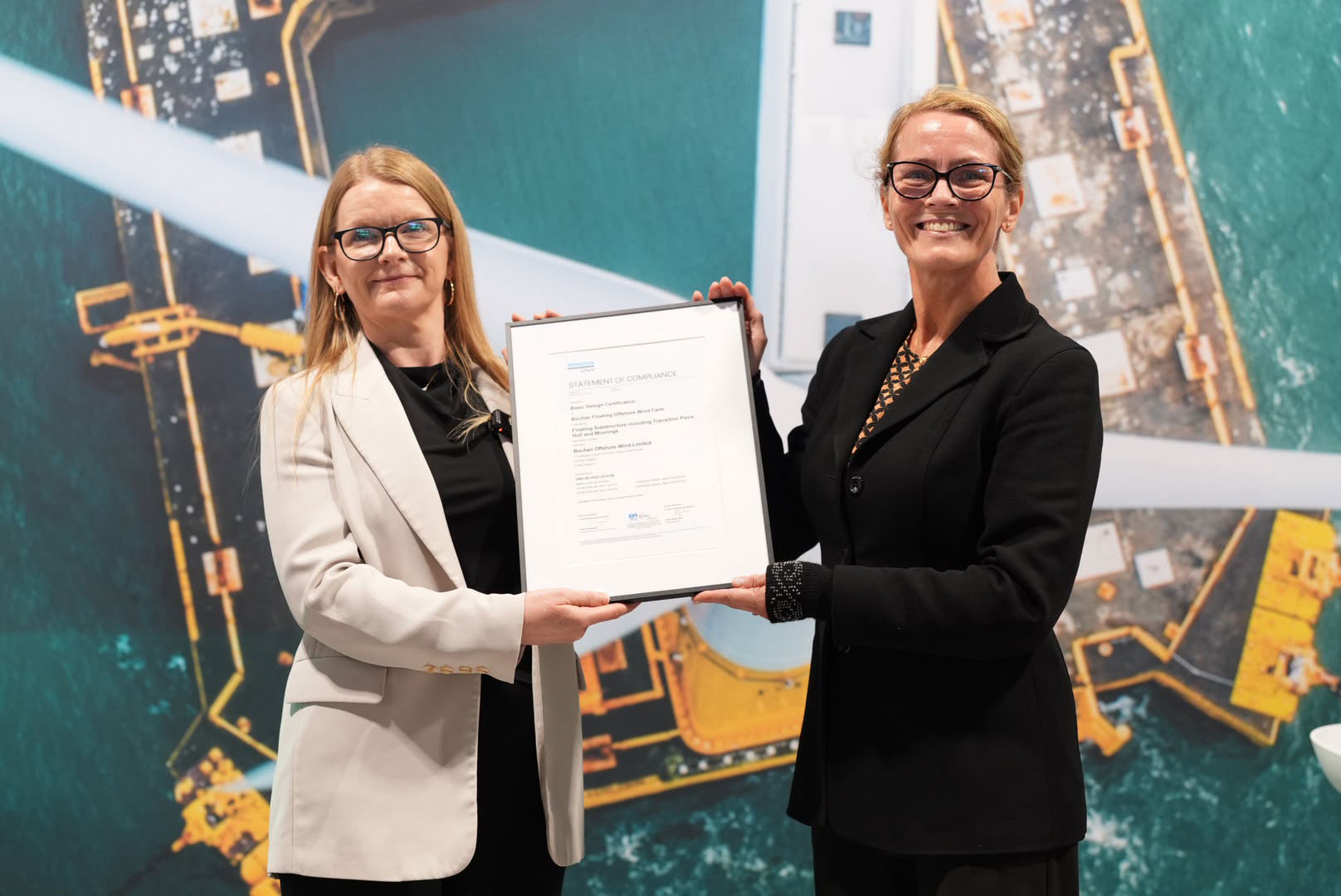
- DNV has awarded Basic Design Certification to the concrete floating foundation developed for Buchan Offshore Wind.
- The Damping Pool design uses a central water filled opening to reduce motion as waves act on the floating structure.
- Buchan plans up to 70 turbines and intends to manufacture concrete foundations in Scotland if the project proceeds.
Buchan Offshore Wind has secured DNV Basic Design Certification for the concrete floating foundation selected for its roughly 960MW project off north east Scotland, providing independent assessment of the version of BW Ideol’s Damping Pool technology developed for the Buchan site.
The project is being developed around 75km north east of Fraserburgh by BayWa r.e., BW Ideol, and Elicio. Current project information allows for up to 70 turbines, while BW Ideol places commissioning in the middle of the 2030s. The foundation will be manufactured in concrete if the project proceeds to construction.
Basic Design Certification confirms that the design basis and principal engineering approach have been assessed against the applicable requirements at this stage of development. It does not replace the detailed design work, fabrication controls, installation engineering, testing, and later certification needed before a commercial wind farm can operate.
Buchan has selected BW Ideol’s Damping Pool concept, a barge type floating structure built around a large central opening. Water moving within that opening counteracts part of the motion created by waves around the hull, reducing the response transmitted into the turbine, tower, moorings, and other connected systems.
Motion control is fundamental because a floating turbine is designed to move within defined limits rather than remain rigidly fixed to the seabed. Wind, waves, and currents create pitch, roll, heave, surge, sway, and yaw, while the rotating turbine adds aerodynamic and structural loads above the waterline. The foundation, ballast, turbine controls, mooring system, and electrical cable therefore have to be analysed as one interacting system.
Extreme storms and routine operation place different demands on the structure. The foundation must survive the largest credible environmental loads, but it must also resist fatigue produced by smaller movements repeated over decades. A design can remain well below its ultimate strength during normal operation and still accumulate damage if stress cycles are frequent enough.
The Damping Pool platform had already received DNV Basic Design Certification in 2025 for a standard design intended for turbines rated at 15MW and above. Buchan’s latest certificate applies to the design adapted for conditions at its own North Sea site, where water depth, wave climate, wind regime, turbine selection, and mooring arrangement affect the loads entering the structure.
Mooring design limits how far the floating foundation can move while allowing the controlled movement needed to absorb environmental loads. Line stiffness, anchor capacity, seabed conditions, and redundancy all influence the platform response. Changes to the mooring system can alter movement at the turbine and at the electrical cable, so those interfaces cannot be engineered independently.
The power cable faces repeated mechanical movement as it descends from the floating structure towards the seabed. Unlike a cable connected to a fixed foundation, the dynamic section must accommodate bending and tension cycles throughout operation. Excessive platform movement or an unsuitable cable configuration can shorten fatigue life even when the electrical rating of the cable is adequate.
Concrete also changes how the project would be manufactured. Buchan has committed to producing its floating foundations in Scotland, and BW Ideol holds an exclusivity agreement with the Ardersier Energy Transition Facility on the Moray Firth. The company is developing plans for a serial production line rather than treating every foundation as a one off fabrication project.
Current Buchan material says a full production line at Ardersier is designed to produce one roughly 20,000 tonne foundation every 12 to 14 days. Repeating the same geometry at that pace requires consistent reinforcement, concrete placement, dimensional control, curing, embedded components, and inspection while keeping enough port space available for completed structures and turbine integration.
Serial production is necessary because a commercial floating wind farm may need dozens of foundations within a relatively short installation programme. A design can perform correctly at sea yet remain commercially difficult if fabrication occupies too much quay space, takes too long, or depends on construction methods that cannot be repeated reliably.
The compact dimensions of the Damping Pool concept are intended to make port integration more manageable. Buchan gives a foundation footprint of around 50 to 60 metres square and a draft of roughly 12 to 14 metres for the production concept. Those dimensions still impose substantial requirements on harbour depth, quayside capacity, tow out routes, storage, and the sequence in which turbines are installed onto completed foundations.
Detailed engineering still has to close the interfaces between turbine, foundation, moorings, dynamic cables, port operations, manufacturing, and offshore installation before repeated production can begin. DNV’s assessment removes one design uncertainty by giving Buchan an independently reviewed foundation basis from which to develop those later stages.